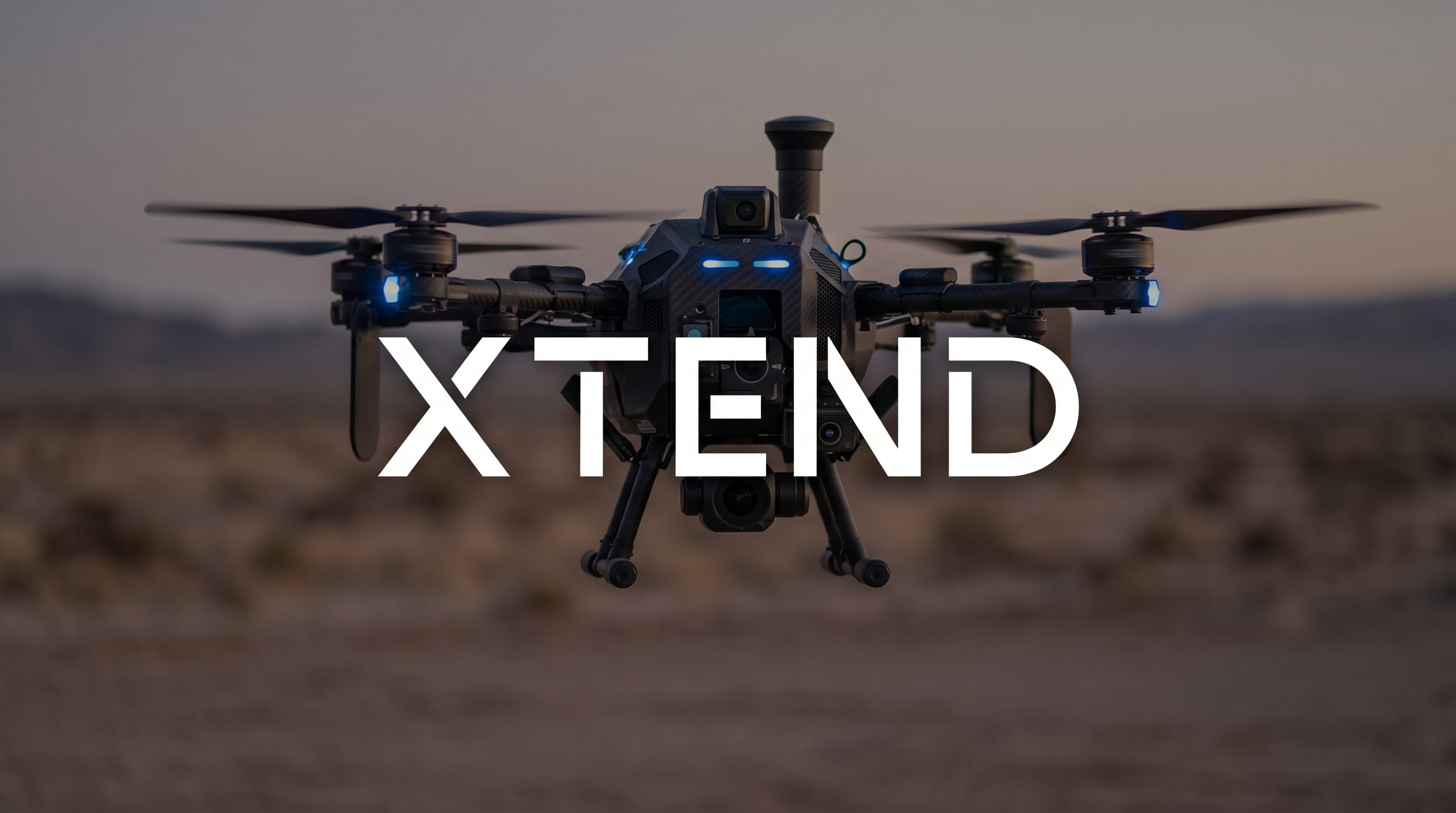
The drones are already in the field. They're flying into earthquake rubble, operating in contested airspace across active conflict zones, and patrolling sites where putting a human being would mean putting that person at risk. The technology driving them isn't a prototype—it's a deployed, battle-tested AI operating system. XTEND CEO Aviv Shapira calls it "AI at the speed of flight," and with a planned $1.5 billion Nasdaq listing on the horizon, the rest of the market is starting to pay attention.

An Operating System, Not Just a Drone Company
The most important thing to understand about XTEND is what it actually sells. It's not a drone manufacturer competing in what Shapira calls "a race to the bottom" on hardware specs. It's a software company, specifically, an AI operating system that plugs into drones and robots made by other manufacturers and makes them dramatically smarter and easier to operate.
The origin story matters here. XTEND started in competitive drone racing, where Shapira's team figured out that the hardest part of flying a drone at 100 miles per hour through an obstacle course wasn't the hardware—it was the training time. So they built software that collapsed months of FPV training into about three minutes. The insight that followed was straightforward: if you could make drones that easy to fly for sport, you could make them that easy to deploy in places where lives were on the line.
That pivot from gaming to defense mirrors a trajectory investors have seen before. NVIDIA (NASDAQ: NVDA) didn't set out to power large language models, it set out to render video games. The parallel isn't lost on Shapira, and it shouldn't be lost on investors either.
5 Levels of Autonomy and a Timeline That's Moving Fast
XTEND has mapped out five levels of drone autonomy, and the company says it's already operating at levels two and three at scale, with roughly 10,000 systems deployed across more than 32 countries.
Level one is traditional manual control: one operator, one drone, hands on a controller. Level two introduces AI assistance, where the drone handles the how while the operator handles the what. Level three, which XTEND calls task autonomy, removes the operator from the field entirely. A soldier or security team 2,000 miles away taps a window on a screen and the drone enters the building. They say "scan for survivors" and the drone runs the search. No manual flight required.
Level four, what Shapira calls AI pilots, is where one operator directs a swarm of hundreds of drones on a complex mission with a single prompt. Level five, still two to three years out, would have AI handle mission planning and orchestration end to end.
The Turkey earthquake deployment is the clearest illustration of what this looks like in the real world. XTEND sent indoor drones, operating without GPS or consistent communication, into collapsed buildings to search for heat signatures of survivors. The human team didn't fly the drones through rubble. They told the drones what to find.
The Partnership Roster
The company's software-first model has made it a natural integration partner for hardware names investors may already follow.
Lockheed Martin (NYSE: LMT) is co-developing a unified control system with XTEND, and the collaboration has deepened significantly.
In late 2025, Lockheed's Skunk Works division integrated XTEND's XOS operating system into its MDCX autonomy platform, enabling a single operator to command multiple classes of unmanned systems simultaneously in joint all-domain command and control scenarios. The companies also demonstrated a "marsupial" mission, where a large mother drone deploys and controls a smaller drone on target.
Ondas Holdings (NASDAQ: ONDS) is another active partner, with XTEND's software running on Ondas hardware to build out aerial defense systems capable of detecting and intercepting hostile UAVs, a use case that's moved from theoretical to urgent given recent conflict zones.
Unusual Machines (NYSE American: UMAC), based in Orlando, supplies U.S.-made components—motors, batteries, flight controllers—that go into XTEND's drone production out of its Tampa manufacturing facility.
Red Cat Holdings (NASDAQ: RCAT) is listed among competitive peers in the drone space, though the lines between competition and collaboration in this ecosystem are notably blurry. Boston Dynamics is also using XTEND's software on its platforms, extending the company's footprint into ground robotics alongside aerial systems.
Government Contracts and Proven Demand
The partnership roster is notable, but the contract wins are where investor attention should focus. In December 2024, XTEND secured an $8.8 million DoD contract through the Irregular Warfare Technical Support Directorate to deliver its Precision Strike Indoor and Outdoor drone system, the first DoD-approved indoor/outdoor flying loitering munition platform of its kind. Then in November 2025, the company won an additional multi-million-dollar contract from the Office of the Assistant Secretary of War for Special Operations to develop and deliver next-generation AI-enabled one-way attack drone kits.
Active users of XTEND's systems now include the U.S. Department of Defense, SOCOM, the Israel Defense Forces, Singapore, and allied European defense forces—with production scaling out of the company's Tampa headquarters, which opened in July 2025 alongside a $30 million extension to a $70 million Series B round.
The Merger and the Path to Public Markets
XTEND is currently private, but a merger with JFB Construction Holdings (NASDAQ: JFB) is in process.
The all-stock deal is valued at $1.5 billion, with the combined company to be renamed XTEND AI Robotics and expected to trade on the Nasdaq under the ticker XTND. The transaction is expected to close by mid-2026, pending regulatory approvals and S-4 effectiveness.
Under the deal's terms, current XTEND shareholders would own approximately 70% of the combined company, with JFB shareholders retaining roughly 30%. The merger has been approved unanimously by both boards.
What to Watch
The S-4 filing will be the first public look at XTEND's financials and business structure, a significant data point for anyone tracking this space. The company reports a $500 million pipeline and $71 million in backlog, with $152 million in investor commitments and $42 million already funded.
The upside case is that an AI operating system designed for drones and robots sits in a structurally different position than the hardware makers it partners with. If autonomy scales the way Shapira describes, the software layer may be the most defensible part of the stack. The risk is execution: international expansion, a pending merger, active government contracts, and a race against well-funded competitors—all at the same time.
Stay focused on that S-4, because that's where the real picture of this company starts to come into view.
Where Should You Invest $1,000 Right Now?
Before you make your next trade, you'll want to hear this.
MarketBeat keeps track of Wall Street's top-rated and best performing research analysts and the stocks they recommend to their clients on a daily basis.
Our team has identified the five stocks that top analysts are quietly whispering to their clients to buy now before the broader market catches on... and none of the big name stocks were on the list.
They believe these five stocks are the five best companies for investors to buy now...
The article "Is This Pre-IPO AI Robotics Company the Next Big Defense Play?" first appeared on MarketBeat.