In the summer of 2009, shortly after winning his fourth championship with the Lakers, Kobe Bryant flew from Los Angeles to Houston. From there, he headed an hour west by car, past exurbs and strip malls and into rolling farmland. A winding road brought him to a set of iron gates and, just down the way, a gymnasium. Inside awaited the man Kobe had crossed the country to see—a man Bryant believed could take his game to the next level.
Hakeem Olajuwon had retired seven years earlier, after winning two titles and an MVP award with the Rockets. Though a dominant defensive force, he was perhaps best known for his graceful post moves, a series of spins, feints and fadeaways that caught defenders wrong-footed, leaving them trying to defend a man who had, in a split second, vanished. His signature shimmy even gained its own nickname, “The Dream Shake.”
After retiring, Olajuwon had purchased a 400-acre ranch near Katy, Texas, and converted a livestock barn into a state-of-the-art gym with a full-length NBA court. The gym soon became something of a mecca for lead-footed big men. Coaches and NBA general managers called, beseeching Olajuwon to tutor one of their centers. (Such was demand, it is said, that teams paid up to tens of thousands of dollars per session.)
In Kobe’s case, he tracked down Olajuwon after the Lakers played the Rockets in Houston. “I want to come out this summer and work with you,” Bryant said. At first, Olajuwon couldn’t tell whether Kobe was serious. But this is Kobe we’re talking about. Yes, he was very, very serious.
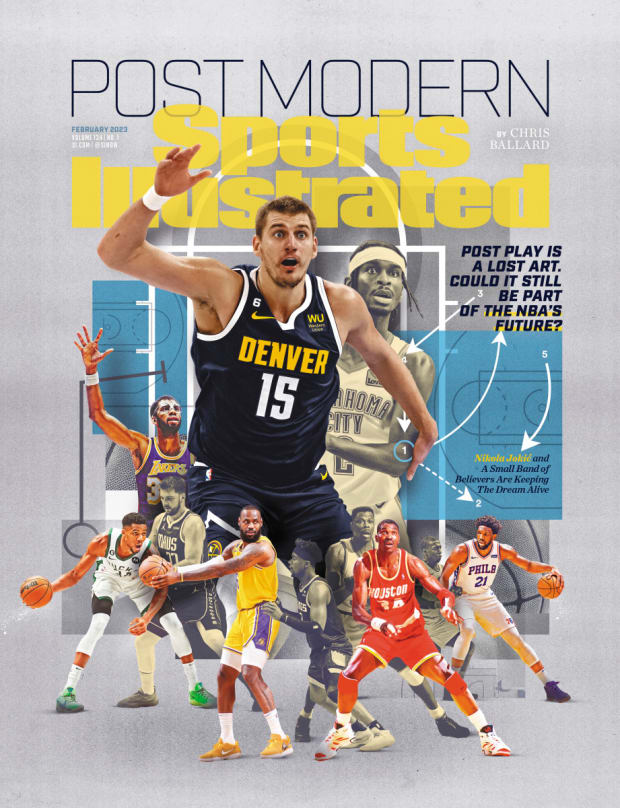
Cover photo illustration by The Sporting Press. Cover photographs by Greg Nelson (Jokic, Embiid), John Biever (Olajuwon), John Iacono (Abdul-Jabbar), Glenn James/NBAE/Getty Images (Antetokounmpo) and Rocky Widner/NBAE/Getty Images (James)
And so, later that year, Bryant stood under the basket in Olajuwon’s gym, listening as Hakeem covered the subtleties of the craft. How to feel a defender’s presence and react to the slightest weight imbalance. How to jump when catching the entry pass, so that, even before landing, you’re already on the move. How to use footwork and agility to build moves, much like how a boxer constructs a combination, jabbing and misdirecting.
Bryant caught on quickly—“fastest learner I ever coached,” Olajuwon says—and began deploying the moves that fall. Two years later LeBron James flew out and stayed for three days of instruction, hoping to learn how to punish smaller players on the block. (Olajuwon didn’t charge Kobe or LeBron.)
That the two best players on the planet would travel to the farmland of Texas to train under Olajuwon, seekers ascending Drop-Step Mountain to see the guru at the top, tells you just how valuable these skills once were.
But that was more than a decade ago—and a decade is an eternity in NBA time.
At first slowly, and then all at once, the game evolved, migrating ever farther from the basket. Seven-footers left the trenches to roam the perimeter, launch threes and create off the dribble; modern bigs aspired to be Kevin Durant, not Kevin McHale. Fewer people called Olajuwon. Now, he says, “Nobody posts up anymore.”
Indeed, the most prolific post-up teams today, like the Nuggets and the 76ers, attempt only six or so shots per game from the block, or half as many as the league-average team in 2010. Meanwhile, even the least prolific three-point-shooting teams today, the ones that are generally pretty terrible at it, like the Lakers, launch 30 threes per game.
Some—perhaps most—would say this isn’t such a bad thing, that the current pace-and-space league is an upgrade over watching centers methodically backing down defenders, like the typewriter giving way to the keyboard, or the landline to the cellphone.
But with all evolutions something is also lost. Sometimes it’s just a nuance—the satisfying metallic clack of an old-fashioned typewriter. Other times it’s an entire culture or a language.
So, what now becomes of the post game and the true believers who still teach it and preach it? I flew to Houston to find out what it’s like to watch something you love fade away.