Get all your news in one place.
100’s of premium titles.
One app.
Start reading
The Independent UK
The Independent UK
Helen Coffey

Is performative Bible reading the latest trend or are Gen Z really turning to Christianity?

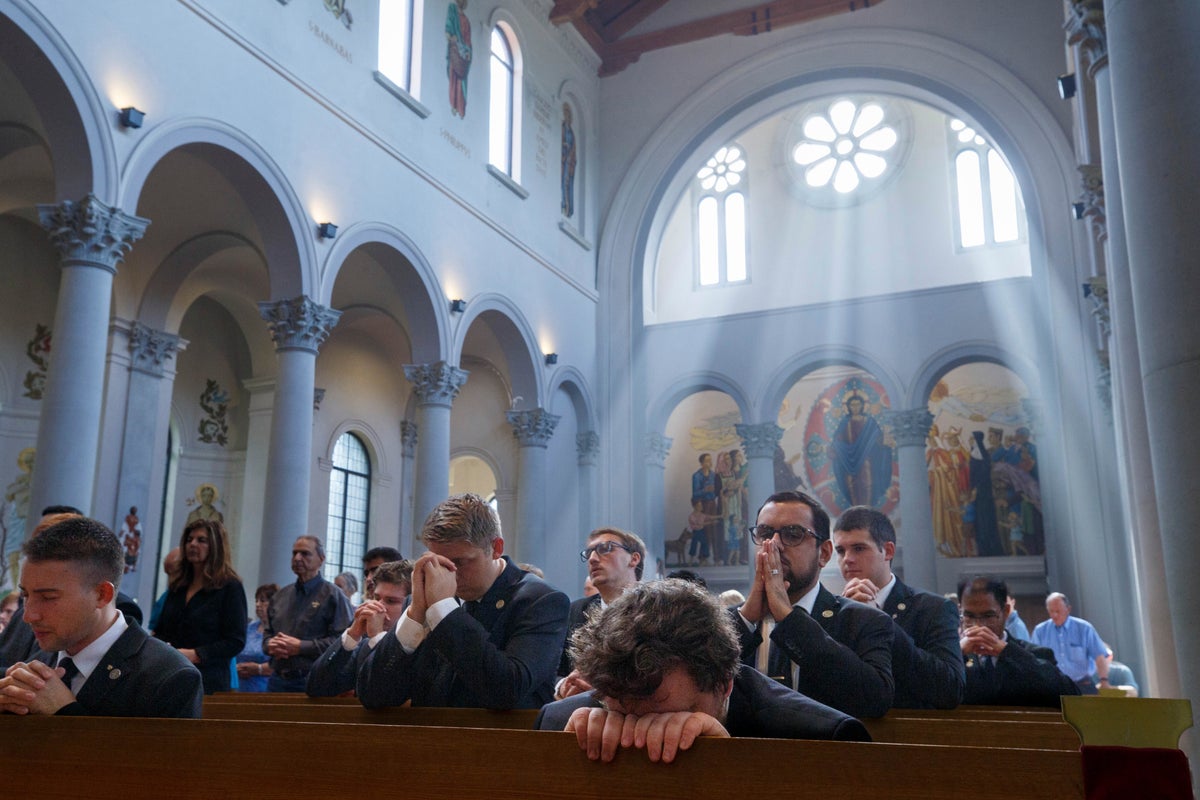
Worshippers pray during the Good Friday celebration of the Lord’s Passion and Adoration of the Holy Cross at St. Joseph Abbey in LA - (The New Orleans Advocate)

A young man of my acquaintance casually mentioned that he’d bought a bible recently. He proffered this information shyly yet excitedly, with no trace of embarrassment as he showed me the leather-bound King James version he’d picked up from a charity shop. It was the first time in his life he’d owned one, he said; he liked the heft of it, the age of it, the life it had lived before him.

“I’ve always been interested in it as a text – I just thought, maybe it’s about time I tried reading it?”

However surprising it might seem that a Gen Z from a family of atheists is suddenly the proud owner of the Good Book, he is far from alone. New data from Nielsen BookScan has revealed that UK Bible sales in 2025 reached their highest point since records began in 2008. Annual sales more than doubled from £2.69m in 2019 to £6.3m in 2025, while sales have shot up by 106 per cent in volume – the number of copies sold – over the past five years. This data excludes bulk orders by publishers or institutions; we’re talking about more individuals than ever buying a copy.

While there isn’t a comprehensive demographic break-down of who is buying Bibles, anecdotal, on-the ground observations suggest that much of this surge is attributable to the younger generation. “Booksellers are telling us it’s young people in particular who are buying them, whether that’s because they’re new into faith, or because they are longer-practicing Christians who want to know Scripture better and deeper,” says Dr Rhiannon McAleer, director of research and impact at Bible Society.

According to a Bible Society study, Christians aged 18-24 were the group most likely to be reading the Bible regularly. Despite their digital native status, they’re using physical copies at almost the same rate as Bible apps. Perhaps we shouldn’t be all that surprised that physical books still carry cachet with Gen Z; much has been made of this demographic’s return to “analogue” pursuits, with everything from scrapbooking to photo booths surging in popularity. Vinyl records have experienced a renaissance. Even Filofaxes are, allegedly, making a comeback.

Alongside all of this, religion has been enjoying a real moment in the cultural spotlight. Spanish megastar Rosalía’s seminal 2025 album, Lux, unabashedly embraced Catholic iconography and musical influences, complete with tracks inspired by female saints, Cathedral-style acoustics and cover artwork featuring the singer dressed in a kind of contemporary nun’s habit.

It followed a surprise fascination bordering on obsession with last year’s Conclave – the process by which a new Pope is chosen – spearheaded, not by Catholics, but secular young people who loved the camp, kitsch maximalism of it all.

Singer Rosalia (left), and Pope Leo XIV’s (right) selection at the last Conclave have sparked a renewed interest in Catholicism (Columbia Records/Getty)

Likely further spurred on by the 2024 film Conclave, starring Ralph Fiennes embroiled in a tale of intrigue, scandal and complex doctrinal politics, there was a huge amount of online speculation surrounding the potential candidates and machinations of the selection process. Dedicated social media accounts, such as Pope Crave (@ClubConcrave), sprang to the fore, while knowing, ironic tweets abounded (“we found love in a popeless place” being a particular favourite). Some papal contenders were given their own “Brat” cut by fans, combining video clips of cardinals with the acid green of Charli XCX’s era-defining album to create the ultimate mash-up of modernity and tradition. It doesn’t get more Gen Z than that.

Even Vogue has got in on the action, proclaiming “monastic” to be one of 2026’s biggest interior design trends; think rustic wood, stained-glass and inspo taken from religious architecture.

And yet what could be called the “aesthetic revival” of the Church, rooted in style rather than substance, is only one part of the puzzle. Both the Church of England and the Catholic Church have seen an increase in the number of people going through confirmation and baptism rites as adults. The Bible Society dataset found that the number of 18 to 24-year-olds attending church monthly had quadrupled from four to 16 per cent since 2018. This stat was part of a piece of research that dubbed a wider shift in attitudes towards, and engagement with, Christianity in the UK the “quiet revival”. The report’s authors posited that, though slow and subtle, a genuine resurgence was taking place.

“One of the remarkable things that we’ve been hearing over the last year or so, over and over again, is that people are just turning up at church,” says McAleer. “Often they’ve done their seeking before they even get to the church door, and you hear about people having bought and read a bible independently before they go to a service.”

You hear about people having bought and read a bible independently before they go to a service

Dr Rhiannon McAleer, Bible Society

YouGov’s bi-annual tracker has seen the proportion of 18- to 24-year-olds who say they believe in God or gods somewhat mirror this idea. It more than doubled between August 2021 and August 2023, going from 16 to 34 per cent, and had climbed to 39 per cent by August 2024, before dropping to 37 per cent the following year.

It’s a trend that Reverend Pat Allerton, a vicar at St Peter's Church in Notting Hill, London, has observed first-hand. He’s seen a steady growth in his church from people of all ages, “but definitely young adults. We’ve got a recent 20-year-old couple coming, a 21-year-old, 22-year-old, 23-year-old…” In his experience, the younger the person suddenly turning up at church, the less likely they are to have come from a Christian background. “These are people searching for something they’ve never had,” Allerton muses.

And indeed, it’s easy to see why the next gen might be feeling lost and in need of answers. There are multiple threats on the horizon, from wars and unstable geopolitics to the reality of racing towards irreversible climate change. Not to mention the onslaught of AI, already negatively impacting Gen Z’s employment opportunities. Seven in 10 teens and young adults in the UK say they are anxious about their future careers and concerned there will not be enough jobs, according to new research published by the King’s Trust. A quarter of people aged 16 to 25 feel they are going to fail in life.

A hunger for deeper meaning is an understandable response to an uncertain future. It’s not confined to Christianity or organised religion; there has also been a marked jump in young people identifying as “spiritual” and engaging with tarot, numerology and the Chinese zodiac. One US survey found that 80 per cent of Gen Z and younger millennials “believe in astrology”, while the proportion of British 18- to 24-year-olds who say they don’t believe in God but do believe in some kind of “spiritual greater power” more than doubled year-on-year from January 2025 to 2026.

Stormzy has been open about his Christian faith (PA)

At the same time, there has been a visible dwindling of power when it comes to the “new atheism” movement popularised by intellectuals like Richard Dawkins, author of The God Delusion at the turn of the century. It swiftly took root, with humanism presented as the natural status quo in an increasingly secular society. Between 1981 and 2021, the proportion of Brits who described themselves as atheist increased fivefold, from 4 to 21 per cent, according to research from King’s College London. By the end of the Noughties, admitting to believing in God, let alone being a practising Christian, felt like a shameful secret to be kept under wraps.

Cut to 2026, and that embarrassment seems almost antiquated. Spurred on by media representation (I’m looking at you, “Hot Priest” from Fleabag), Christianity has been further normalised by a number of young celebrities. Footballer Bukayo Saka, musician Stormzy, rapper Jelly Roll and Love Island star Matilda-June Draper have all spoken openly about the central role of faith in their lives. Shifting attitudes have resulted in 68 per cent of UK evangelicals aged 18 to 24 feeling more confident in sharing their faith, according to a new study commissioned by Christian communications agency Jersey Road.

There are, of course, other kinds of “role models” positioning Christianity in a very different way – often one designed to appeal to disillusioned young men. Much has been made of the fact that this cohort has seen the biggest growth in terms of turning to Christianity; the proportion of young men reporting monthly church attendance leapt from 4 to 21 per cent between 2018 and 2025.

Characters like Jordan Peterson have stoked a renewed interest in the idea of Christian stoicism and what it means to live virtuously; the controversial academic’s bestselling book, 12 Rules for Life, called for men to find meaning through responsibility and maintain ethics even through times of hardship.

These are people searching for something they’ve never had

Reverend Pat Allerton

Elsewhere, legitimate fears are surfacing that some young men are being drawn in by an ideology of what’s been dubbed “masculine Christianity”, a kind of macho warping of God’s word that has been linked to hard-right political stances. There has been a noticeable rise in Christian nationalism, with Stephen Yaxley-Lennon, better known as Tommy Robinson – the British far-right, anti-Islam activist – claiming to have “received Jesus Christ as his Lord and Saviour” after finding faith while in prison.

In September, his Unite the Kingdom rally, supposedly championing free speech, saw over 100,000 people marching through central London. It was awash with Christian imagery: crosses, men dressed up as crusaders and placards with Bible verses (though presumably not “love thy neighbour”, considering the anti-immigration sentiment). Many carried posters of Charlie Kirk, a Maga commentator and influencer who was vocal about his Christian beliefs, following his assassination earlier that month.

A much smaller carol service to “put the Christ back in Christmas”, also held in London, was organised by Robinson in December. However, not all attendees got the memo that this was not intended to be a political event; as one non-churchgoer told UnHerd’s Felix Pope: “I think my prime motive for coming is to defend Christmas against the Muslim hordes and eroding of our culture.”

Right-wing influencers like 17-year-old Young Bob, who describes himself as a “Christian pro-life and remigration activist”, are merging hard-right political views with religion in a way that’s troublingly reminiscent of the United States. The Reform party seems to have started following the Republican party playbook when it comes to reproductive rights; Nigel Farage last year appointed right-wing anti-abortion theologian James Orr as a senior adviser.

Christian nationalism is on the rise, spurred on by far-right activist Tommy Robinson at September’s Unite the Kingdom rally (Getty)

All of this puts the Church in a difficult position in terms of separating individuals’ self-proclaimed religious identity with the often anti-Gospel message they’re spouting. Church of England bishops and leaders from other Christian denominations joined forces last year to condemn what they called the “co-opting of the cross” to cause division and exclusion at Robinson’s September rally.

Despite all this, those on the ground say the young men they’ve witnessed turning to church are not angry dissidents fuelled by political ideology – they’re instead motivated by a true desire for connection, purpose and answers to life’s deep questions.

Having met many young men over the last year or so who are exploring Christianity for the first time, McAleer says: “I don’t think I’ve met any who’ve come in via the far right. I’m not saying that it’s not happening at all, but it’s certainly not the totality of it.”

There’s an openness from people as everything else in the world shakes

Rev Pat Allerton

On the contrary, the Bible Society research suggests that young male Christians show very pro-social behaviours: they’re likely to say they feel close to people in their local area, and to be engaging in positive activities such as volunteering or giving to a food bank. “And that’s absolutely something that I’ve heard reflected back from church leaders – they are seeing people who are really interested in being part of community,” adds McAleer.

And as much as anyone can buy a bible “performatively” and waft it around in the name of Islamophobic doctrine, the digital data points to something else: an upswing in people genuinely reading the text. YouVersion, the world’s most-used Bible app, recently hit the milestone of a billion downloads – but the real success lies in engagement. There is double-digit growth in the number of people using the app for at least four days a week across the UK compared to this time last year. All of the top five days in YouVersion history for daily use are, in fact, from 2026.

Amid a chaotic world and uncertain times, it is, says Allerton, a period of unprecedented hope within the Church. “I’ve been a Christian nearly 30 years, and last year was my most enjoyable year in ministry,” he says. “There’s an openness from people as everything else in the world shakes. I really think this is the beginning of a Christian revival in not just this nation, but around the world.”

Sign up to read this article
Read news from 100’s of titles, curated specifically for you.
Already a member? Sign in here
Related Stories
Top stories on inkl right now
One subscription that gives you access to news from hundreds of sites
Already a member? Sign in here
Our Picks
Fourteen days free
Download the app
One app. One membership.
100+ trusted global sources.