There are few worse feelings in golf than losing your confidence with the putter in hand, as golf becomes a lot less fun when nothing is dropping on the greens.
This can happen for a number of reasons, but you don't have to simply accept your fate and resign yourself to a life of three-putts and flat stick fury.

Learning how to grip a putter correctly is one of the most basic but important lessons any golfer can learn, but once you've landed on your preferred method it doesn't mean that this will stick with you forever.
Golf Monthly's Instruction Lead Baz Plummer recently carried out a putting grip experiment to find the best method for him, with some very interesting results, so you certainly aren't alone in considering your options.
In this article, expert PGA professional and Golf Monthly Top 50 Coach Sarah Bennett shares her best advice to guide you through this process...
Time To Try A New Putting Grip?
You often see the top professionals trying a new putting grip when the flat stick goes a bit cold, or they are looking for that extra surge of improvement on the greens, but this process is something amateur golfers should also consider.
I would never advise you to tinker for the sake of it, especially if you are already putting well, but when the time comes for a change in style you should definitely give these three different methods a try...
1. Reverse Overlap Putting Grip

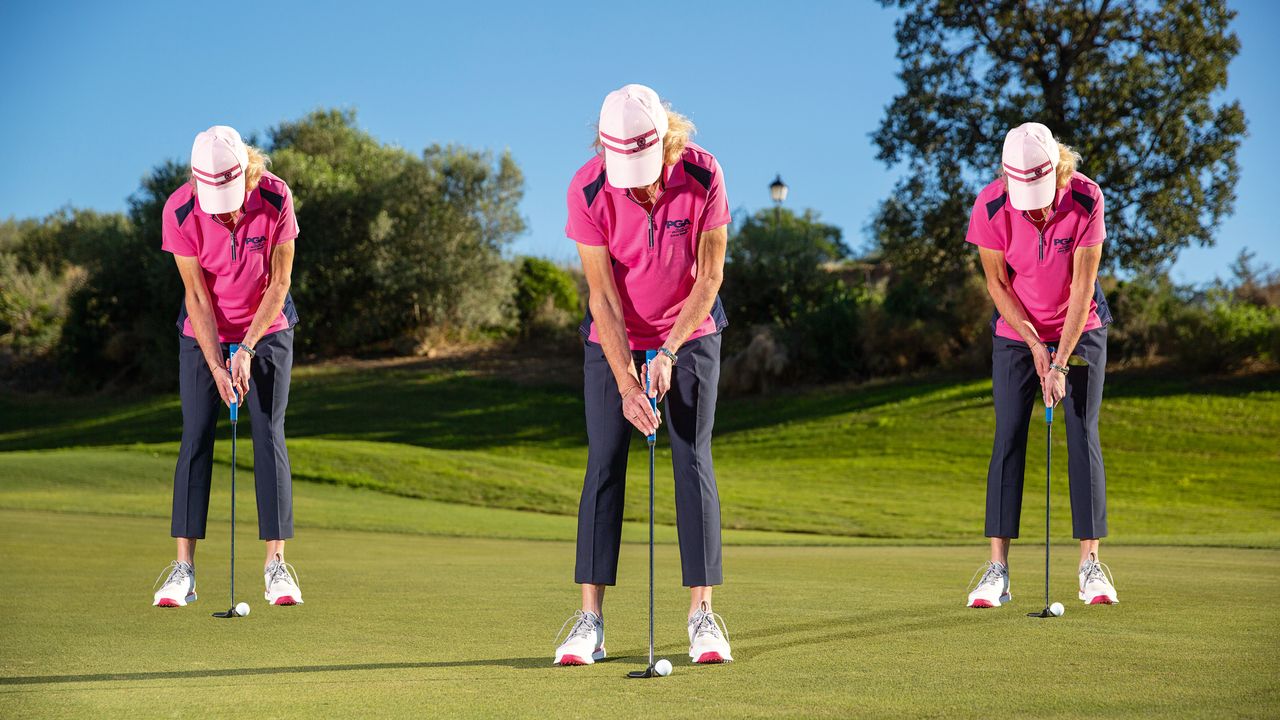
This reverse overlap putting grip is one of the more conventional styles.
Let your arms hang down nice and relaxed. I prefer the grip to sit in the lifeline of the left hand, unlike the full-swing grip, which is in the fingers.
Wrist hinge is not wanted in the putting stroke and the lifeline hold creates a continuous connection and extension of the lead arm.
I like to feel as if my left hand works towards the hole with this grip. Note the ‘V’ of my right hand pointing towards my right shoulder. Many people put the thumbs directly down the centre, which can cause the shoulders to point too far left (open).
2. The Claw Putting Grip

The claw grip for putting has been finding favour among more golfers as they eliminate any unwanted detrimental hand and wrist action in the lower hand during the stroke.
The upper hand is the power source and acts as the dominant hand, while the lower hand remains in a flat, stable, passive position.
I’d recommend this style of grip if you struggle to convert a high percentage of short putts, which will likely be down to an inconsistent clubface position.
But I actually find this type of grip makes it harder to achieve consistent distance control from a longer range.
It has worked for World No.1 Scottie Scheffler so far, so it's certainly worth a try.
3. The Left-Hand-Low Putting Grip

The left-hand-low putting grip has become popular with golfers at all levels.
I often advocate it for my putting clinic, and new golfers often say they prefer the left arm feeling as though it’s a continuation of the shaft.
One benefit is the shoulders sitting more level, which fosters a better putter path with the upper body working as one unit. Try various putts to see if it might work for you.