United States President Donald Trump wants to send a hospital ship to Greenland “to take care of the many people who are sick and not being taken care of there,” he wrote on Truth Social on 22 February.
Greenland’s Prime Minister Jens-Frederik Nielsen rejected the offer, citing that the health system in the country is free for everyone, something the United States cannot offer, he said.
But Trump’s claims don’t appear to come out of thin air. Greenland has long struggled to recruit and retain its healthcare staff. The government aims to tackle this through measures such as easing residence permits for professionals.
Anna Wangenheim, Greenland’s Minister of Health and Persons with Disabilities, responded on Facebook that they are working to strengthen their healthcare system, and there is a growing political will to recruit more healthcare professionals from abroad.
Wangenheim added that Greenland will not turn any help away, “not even from the United States”. Healthcare professionals who wish to work in the country, provided they respect the patients, the language, and the culture, are welcome.
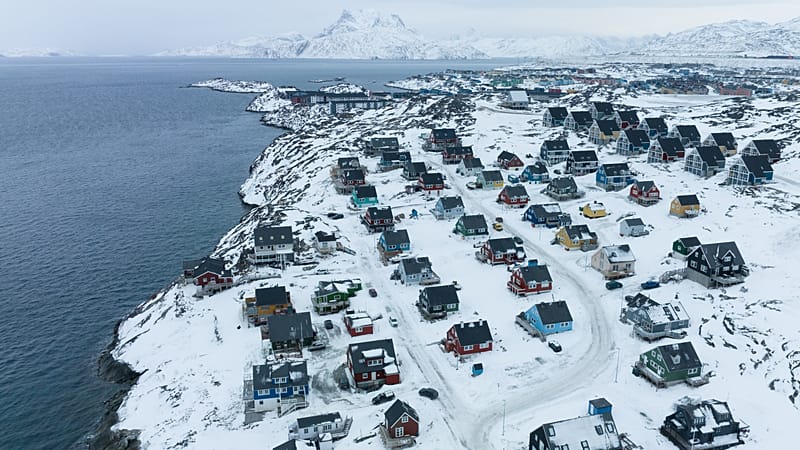
As of January 1, 2026, Greenland’s population was counted at more than 56,000, with people dispersed across vast distances. It is the world's least densely populated territory. Around 20,000 live in the capital, Nuuk, with the remainder spread across remote towns and settlements.
Healthcare burden
In 2023, Greenland’s burden of disease measured by Disability-Adjusted Life Years (DALYs) per 100,000 people stood at 38,715. One DALY equals one lost year of healthy life.
The equivalent figure for Denmark is 30.931 and the European average stood at 36,863.
It is estimated that approximately 1.5 percent of the Greenland population was living with cancer in 2023, 18.8 percent with a mental health disorder, both higher than the EU average.
Life expectancy also lags behind Europe. A newborn boy in Greenland can expect to live for 69.3 years, and a newborn girl for 73.9 years, which is far lower compared with the European average of 81.7 years.
How is the health system organised?
The health sector operates across 70 locations. There are approximately 120 medical positions, but around 60 are permanent staff.
Of the 300 nurse positions, 200 are permanent, according to Trap Greenland, a digital encyclopaedia of the country written by local researchers.
The system is divided into five regions, each served by a regional hospital. Queen Ingrid’s Hospital in Nuuk is both a regional hospital for Region Sermersooq and the national hospital.
“Outside Nuuk, the backbone of the system is general practice,” Henrik Hansen, medical advisor at Greenland’s Department of Health and Persons with Disabilities, told Euronews Health.
Specialists from Denmark periodically travel to Greenland to perform advanced procedures, such as eye surgery. Most other surgical procedures, internal medicine, and psychiatry are based at the hospital in Nuuk.
Healthcare has been under Greenlandic jurisdiction since 1992. However, some services are still not available in the territory.
Challenges in delivering healthcare
Greenland’s healthcare system manages the most basic medical challenges. More advanced interventions, highly specialised treatments, and complex care take place in neighbouring Denmark.
Hansen explained that cancer patients are offered to go to Denmark for advanced treatment such as radiotherapy, as Greenland is not equipped to handle radioactive substances.
Invasive cardiologic interventions like angioplasty, stenting for blocked arteries, or valve replacement, are also not available in the region for patients with cardiovascular diseases. Nor are hemodialysis or kidney transplants for people with renal diseases.
In its 2025 annual report, Greenland’s Health Council noted that there is an ongoing desire for as much healthcare treatment as possible to take place close to the patient’s home. Only cases that cannot be handled locally should be managed at Queen Ingrid’s Hospital, and only those beyond its capacity should be referred to Denmark.
However, the Council noted, the more specialised the treatment is, the more challenging it becomes to provide it locally – not only because of staffing, but also because of infrastructure and regulatory requirements involved.
The role of telemedicine
Geography remains one of Greenland’s greatest obstacles. It can take days or even weeks to travel from some settlements to a town with a doctor and healthcare facilities, and weather conditions often cause delays.
“Telemedicine has, to some extent, changed the need for personal contact. For example, skin diseases are now diagnosed with telemedical assistance from Denmark,” Hansen added.
The Greenlandic Health Service launched the app Puisa in 2023 to facilitate secure video consultations between patients at home and healthcare professionals, aiming to reach the most remote areas of the country.