
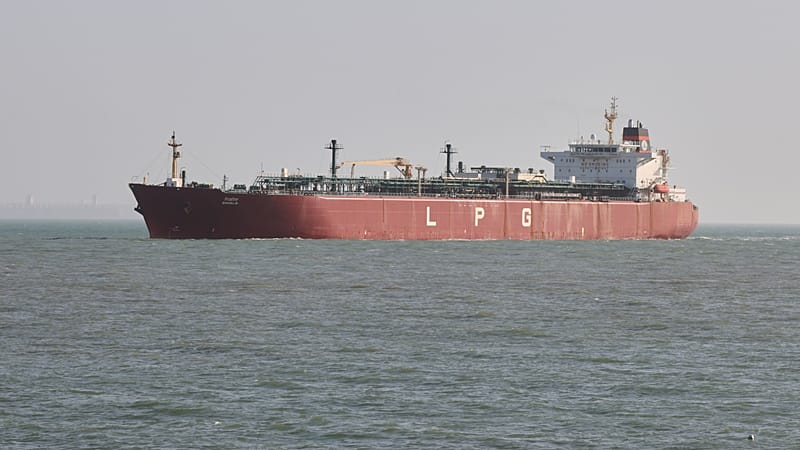
Asian economies are scrambling to manage rising fuel costs and conserve energy as US-Israeli strikes on Iran disrupt one of the world's most critical energy corridors.
Roughly a fifth of global oil supply transits through the Strait of Hormuz, a narrow waterway linking the Gulf to international markets, with most of it heading east.

China, India, Japan and countries in Southeast Asia are the largest consumers, importing about 80% of the oil that passes through the Strait and accounting for roughly half of East Asia’s imported oil.
Following Iran’s closure of the Strait of Hormuz on 2 March, tanker traffic plunged and at least 15 vessels were under attack. However, supplies have not been completely disrupted, with many tankers still arriving across Asia.
Spillover effects on Asia
While energy continues to trickle into Asia, some countries are already feeling the strain.
Pakistan, which relies heavily on imported oil and gas for transport, has seen petrol prices surge by nearly 20% since the attacks began on 28 February.
Businesses are also facing higher costs and increased absenteeism as workers try to save on fuel, according to energy analyst Osama Rizvi.
"We are seeing a jump in food prices. Also, uncertainty is rife. For the common man, who spends more than 51% of his income on basic food items, such conditions hint towards an impending doom," he added.
Authorities have responded with measures including a 50% cut in fuel use for government vehicles and a 60% reduction in the number of such vehicles on the road.
Vietnam has also encouraged remote working to reduce fuel consumption while drawing on price stabilisation funds.
Concerns are mounting as Gulf states halt operations at key facilities, including QatarEnergy, Saudi Arabia’s Aramco and Bahrain’s Bapco Energies, further constraining supply.
Strategic reserves: China’s stockpile
In the event of a full shutdown of Middle Eastern oil flows, countries would need to draw on reserves, though levels vary widely. Pakistan’s reserves are estimated to last 28 days.
China appears better positioned, with strategic reserves covering roughly 120 days.
"There are additional corporate reserves that provide a further buffer," Dan Wang, China Director at Eurasia Group noted.
"I've been talking to a lot of Chinese state-owned companies, they sound quite confident that China can shield this risk," the economist added.
Alternative sources
Analysts such as Wang say a prolonged and complete shutdown is unlikely, as exporters themselves depend on the route.
“Even if tensions continue, there will likely be some guaranteed shipments because exporters themselves rely on this route,” the economist added.
China’s reliance on Iranian oil sits at around 13% but accounts for roughly 90% of Iran’s exports. Iran is also able to bypass the Strait of Hormuz.
Albeit less efficient, the Jask Oil Terminal in Iran, built specifically to route exports around the Strait of Hormuz, has resumed exports, loading about two million barrels on 7 March, according to Kpler.
To ease pressure, the International Energy Agency (IEA) has agreed to release a record 400 million barrels of emergency oil.
Although alternative supplies are being explored, stabilising the Strait remains critical.
“To be clear, the most important thing for a return to stable flows of oil and gas is the resumption of transit through the Strait of Hormuz,” IEA Executive Director Fatih Birol said in an address in Paris.
For many analysts, diplomacy will be key.
“There's really no other way around it. If you want to secure the supply, it’s the voice through diplomatic channels,” Wang said.
Analysts such as Rizvi remain sceptical about whether tensions will ease.
Yun Sun, a senior fellow and director of the China Program at the Stimson Center echoes Rizvi’s sentiments.
“Parties to the conflict will first of all want to de-escalate for diplomacy to work. I don't know if we are there yet. Both sides want the other side to compromise. That's usually not a sign of diplomacy,” Sun noted.
Long-term ripple effects
Even if flows resume, the crisis could reshape Asia’s economic ties with the Middle East.
Sun said China has already been rethinking its reliance on the region, with renewable energy projects likely to accelerate.
Wang added that countries may reassess broader economic dependencies.
“It's also the investment dependence and export dependence. So it's like a whole package. I think that's what makes this crisis way worse than actually just the oil crisis,” she concluded.