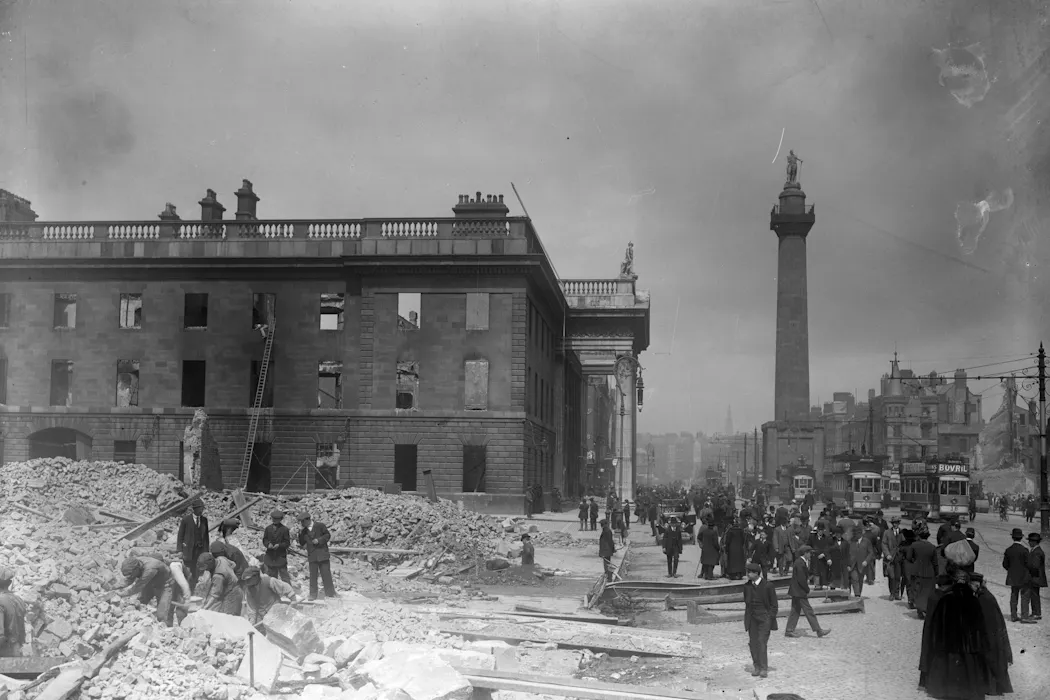
On November 26, 1923, a woman named Anne McCormack applied for a military dependent’s pension on the grounds of her husband, James McCormack’s death. He had been a soldier in the Irish citizen army, under the socialist and revolutionary leader, James Connolly. This group was committed to the establishment of a workers’ republic. Its members participated in the week-long armed insurrection of 1916 known as the Easter Rising.
James McCormack was shot in the head on the second day of the rising, April 26, 1916. Records held in the Military Service Pensions Archive show he died where he fell on Moore Lane, close to the General Post Office, the epicentre of the rising.

For many years following the establishment of the Irish state (today’s Republic of Ireland) in 1922, the focus of Irish historians, not to mention the general public, was on those, like James McCormack, who died for Ireland. Annual commemorations of the 1916 rising were focused on those executed by the British or killed in the fighting. But little attention was paid to those, like Annie, who survived.
Hundreds of thousands of people had their lives thrown off course as a result of personal injury, bereavement and trauma, while others had their material fortunes irreversibly altered. Since 2007, my research and that of many historians has revealed the high price of “living for Ireland”. Through publicly funded digitisation projects, for example the 1901 and 1911 censes, researchers have had access to details of births, deaths, marriage registrations and, more recently, military service pension files. This has enabled us to flesh out the lives of those who lived through and beyond the tumultuous Irish revolutionary period of 1916 to 1923.
Living impact
The pensions archive shows the impact of the revolution on the everyday life of people who survived it and went on to build a new state. It contains over 250,000 files relating the lives of over 80,000 individuals who applied for pensions as combatants or surviving dependants.
According to the McCormacks’ digitised marriage certificate, found in the Irish Genealogy online archive Annie, as she was known, married James only eight years before she was widowed with three young children. Records show that Patrick Drinan, a member of the newly established police force in Ireland, An Garda Síochána informed the Irish Army that since 1916 Mrs McCormack was “in poor circumstances financially. She had three children to support out of her earnings which average roughly about 12/- per week.”
Drinan noted that Annie’s father, who like many elders, lived with his daughter, was in receipt of old age pension – the great financial boon introduced in 1908. The policeman also explained that Annie had been awarded £500 in compensation, in 1917, for the loss of her husband, by “the National Aid Fund”. This is probably a reference to the Irish National Aid Association and Volunteer’s Dependants’ Fund.
The association distributed funds entrusted to it by the leaders of the rising to support the families of those killed or executed. Annie’s husband had been earning £1 week at the time of his death, which was at the higher end of a worker’s salary. The sum she received from the fund points to the depth of the McCormacks’ Republican credentials. The widows of executed leaders of the rising received an investment of £1,500 and one-off grants of between £250 and £350.
Entrenched inequality
My research has looked at the inherent inequality of the male-breadwinner model of Irish society at the time, and how losses incurred during the revolution left female-headed households, often widows, in extremely vulnerable positions.
Annie was one of the relatively lucky ones. She was awarded a pension of £90 for the duration of her widowhood, along with £24 per child, until they reached the age of 18.
Despite this, her pension file documents how she struggled to keep her sons supplied with the schoolbooks required to complete their education. It is significant that she sought to give them the kind of education that would spare them a life of labouring like their father and grandfather had. A relatively small proportion of the Irish population managed secondary education prior to the late 1960s, when it became free, yet Annie kept her sons (for a while at least) in the prestigious Jesuit Belvedere College in Dublin.
Balancing the books was an exhausting process for Annie. Throughout 1927 her health deteriorated. This likely explains why she failed to notice that the army continued to pay her eldest son’s allowance three months after he turned 18.
On February 29, 1928, the Army Finance Office wrote to inform Annie that it had overpaid £5 1s 6d (£5.075) in relation to her eldest son. The sum had been deducted from her allowance.
Annie’s last action was to write to the army to explain how much distress and difficulty this deduction had caused her. On December 1, 1928 she died at the age of 45 from tuberculosis, then endemic in Ireland
Her death certificate reduced her to the widow of a labourer. This is testimony to a life of difficult living conditions, poor nutrition and stress. The Ireland her husband James died for did not turn out to be the workers’ republic that the Irish Citizen Army had fought for, nor did the land of equal opportunities promised in the 1916 Proclamation of Independence transpire.
There are two subsequent letters in Annie’s file that reveal the enduring legacy of loss. In 1936, her youngest son wrote to ask for help finding a job. And nearly two decades later, in 1953, her eldest son wrote to remind the state of how losing his parents had reshaped his life: “My father James McCormack … was killed in action 1916 CA for which my mother receaved (sic) a pension until she died in 1927. I was 18 years of age then, and had to support two younger brothers 16 years and 14 years respectfully as her pension died with her. I was the only support or home, and got no help of any kind.”
Lindsey Earner-Byrne is affiliated with Trinity College Dublin and a member of the board of the Irish Manuscript Commission since 2021
This article was originally published on The Conversation. Read the original article.