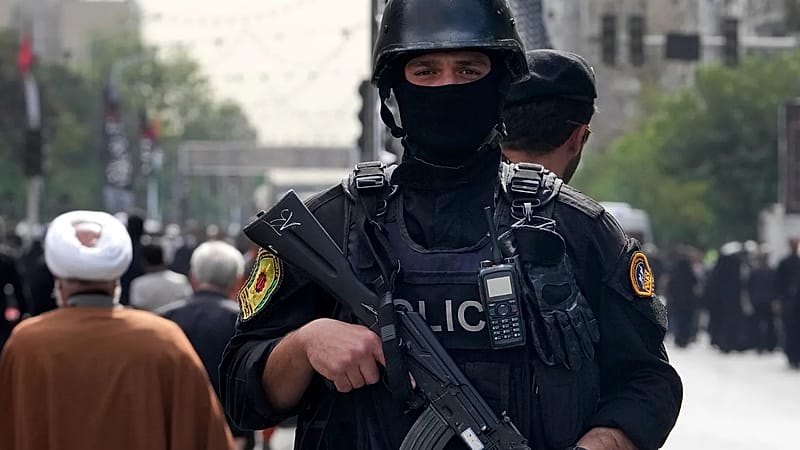
Iran executed a man convicted of setting fire to a government building during the January 2026 protests, the judiciary's Mizan news agency reported on Wednesday, in the latest in a series of executions linked to the wave of unrest that left thousands dead.
Mohammad Amini Dehaghani was hanged after the Supreme Court upheld his death sentence, Mizan said, stating that all legal procedures had been completed and that his trial was held in the presence of a lawyer.
No details were given about when he was arrested, when the death sentence was issued or how long the proceedings took.
The judiciary said he had thrown a Molotov cocktail at the governor's office in Dehaghan, Isfahan province, on 9 January 2026, set the building on fire, attacked a police station, blocked roads and damaged public property.
Investigators cited CCTV footage and what they described as the defendant's confessions as evidence.
The judiciary also accused him of distributing anti-government propaganda, contacting social media accounts linked to the Pahlavi royal family, communicating with anti-government activists online and spreading material intended to "disturb public opinion".
He was sentenced to death on charges of "moharebeh" — a specific legal category in the Islamic Republic representing a severe offence that roughly translates to "waging war against God" — and "efsad-e fel-arz," or "corruption on Earth".
The charges included allegations that he used a Kalashnikov rifle allegedly taken from security forces during what Iranian state media call the "Dey Coup Attempt," a term used by authorities to describe the January protests.
After large-scale protests sparked by sudden hyperinflation last December spread to the entire country the following month, the Tehran regime went on a bloody crackdown against the demonstrators, resulting in a death toll still impossible to independently verify.
Iranian authorities have put the figure at 3,117, while the rights group HRANA says it has verified 7,007 dead. Unofficial, unconfirmed estimates have gone as high as 40,000.
Human rights organisations have repeatedly said defendants in protest-related cases are tried in opaque proceedings, often without access to independent legal representation, and that convictions frequently rest on confessions allegedly extracted under torture.
Amnesty International said Iranian authorities were using "wartime conditions" as a pretext to intensify their crackdown through mass arrests, accelerated trials, politically motivated executions and asset confiscations.
The United Nations said earlier this year that Iran had executed at least 40 people in the first half of 2026, including 18 in cases related to national security.
Separately, Iran's judiciary announced on Tuesday that it had executed two men, Mohyeddin Abdollahi and Hossein Palani, convicted of membership in the so-called Islamic State terrorist group and charges including "baghi" — meaning "armed rebellion" — and carrying out armed actions against the Islamic Republic.