
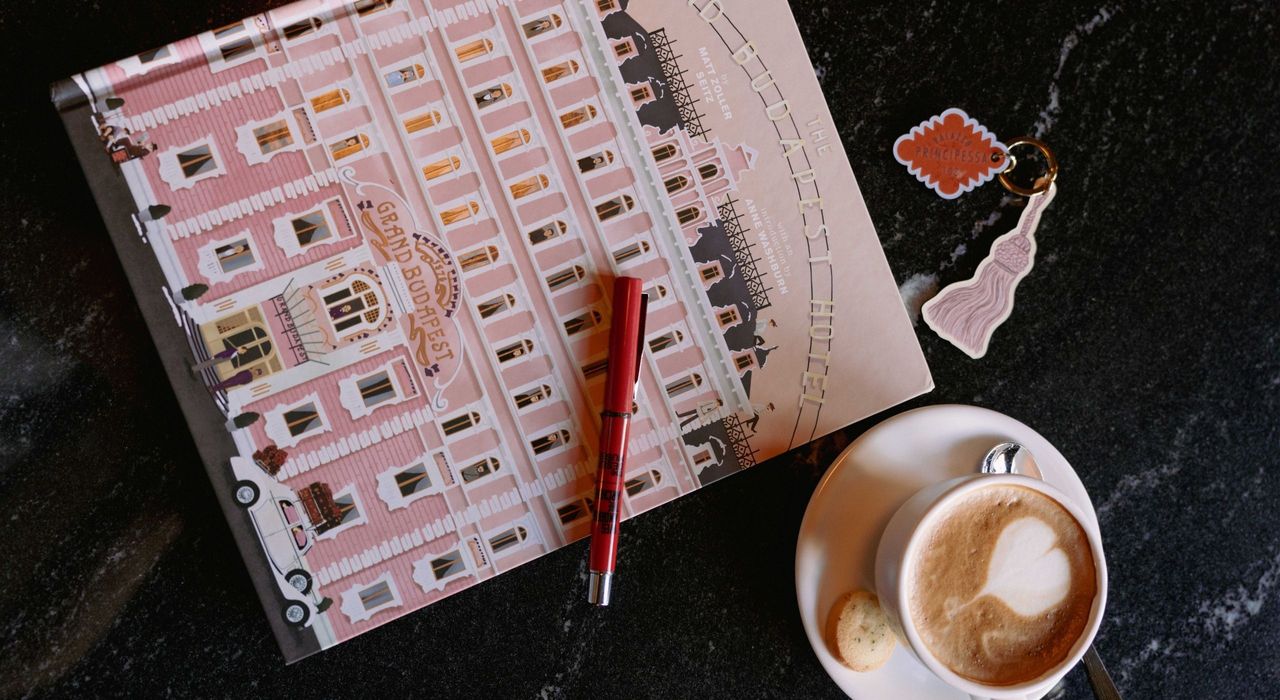
The confectionery-colored blush pink of The Grand Budapest Hotel is a dream-like shade that once seemed like it could only exist in cinema. For a time, the pastel world of Wes Anderson could only be experienced through a screen, watched from the comfort of a plush sofa on a slow Sunday morning. Yet that world has begun to seep beyond the frame, satisfying a wider cultural impulse, the desire not simply to observe films, but to inhabit them.
In the age of 'set-jetting', where itineraries are increasingly influenced by the silver screen, architecture, hospitality, and storytelling are becoming inseparable disciplines, as we found in our latest travel trends report. Hotels are no longer purely functional or destinations in themselves, but stories where every room feels like another chapter. Nowhere is this more elegantly executed than in the collaboration between W Hotels and the Design Museum, a partnership that reframes hospitality as an immersive cinematic sequence.

This growing fascination with inhabitable film worlds sits within a wider cultural shift toward highly aestheticized interiors and narrative-driven design: something Wes Anderson himself pioneered by letting the spaces in his movies tell the story through a distinctively Wes Anderson-esque style.

At the heart of this new initiative, titled The Director's Route by W Hotels, is the unique vision of Wes Anderson. A filmmaker whose worlds have perpetually brought together set design and interior architecture.
What began at the Design Museum with Wes Anderson: The Archives, the director's first major retrospective in London, and one of the best design exhibitions to catch in the city for a few more weeks, now spills beyond museum walls into lived experience.
Original props, costumes, and graphic artifacts are not just exhibits but thoughtfully integrated into the hotel experience, informing a trilogy of hotels across Europe at W London, W Prague, and W Budapest.
If Anderson's films are known for their satisfying symmetry, curated color palettes, and intricate details, The Director's Route translates these characteristics into an inhabitable space.

Across all three cities, storytelling becomes collectible, like a box set of Wes Anderson movies. Guests will encounter Wes-inspired suites, food and beverage, and even the menus are designed by graphic designer Annie Atkins, whose work has helped define Anderson's on-screen visual identity.
The hotels are embellished with thoughtful archival details: Library Cards to be stamped like passports for drinks and Polaroid cameras left around to encourage guests to document themselves within the cinematic story.
Unsurprisingly, in Budapest, the emulation of The Grand Budapest Hotel feels especially alive. The city's ornamental grandeur provides a natural extension of Anderson's fictional republics and meticulously constructed spaces. Ultimately, hotel design is no longer purely decorative, but a fully constructed story.
The rise of immersive hospitality reflects a broader cultural desire not just to watch films but to inhabit them, as cinema further merges with the travel industry. The Director's Route offers the chance to step into the frame, proving that real life can be composed with the same intentional beauty as cinema.
Revisit our analysis of the color scheme that made The Phoenician Scheme a must-watch for all interior enthusiasts, or take a piece of Wes Anderson's whimsy home with you with the curated edit of coffee table books and accessories gathered below.
Go Wes Anderson-esque, at Home

Powder-coated in pink, this Westwing cabinet with ribbed glass is stylish and sleek, and would look wonderful styled with everything from tableware to your Wes Anderson memorabilia.
The official catalogue to the immersive Wes Anderson exhibition at the Design Museum, celebrating over 30 years in cinema.
This LAETITIA ROUGET plate feels distinctly Wes Anderson, perfect for a buttery pastry or a cream filled cake.
Bringing together fun, colour and stripes, this lamp will bring a little bit of Wes Anderson coded joy to any dark corner.