Get all your news in one place.
100’s of premium titles.
One app.
Start reading
The Independent UK
The Independent UK
National
Marcia Dunn

Interstellar comet 3I/Atlas will make its closest approach to Earth today

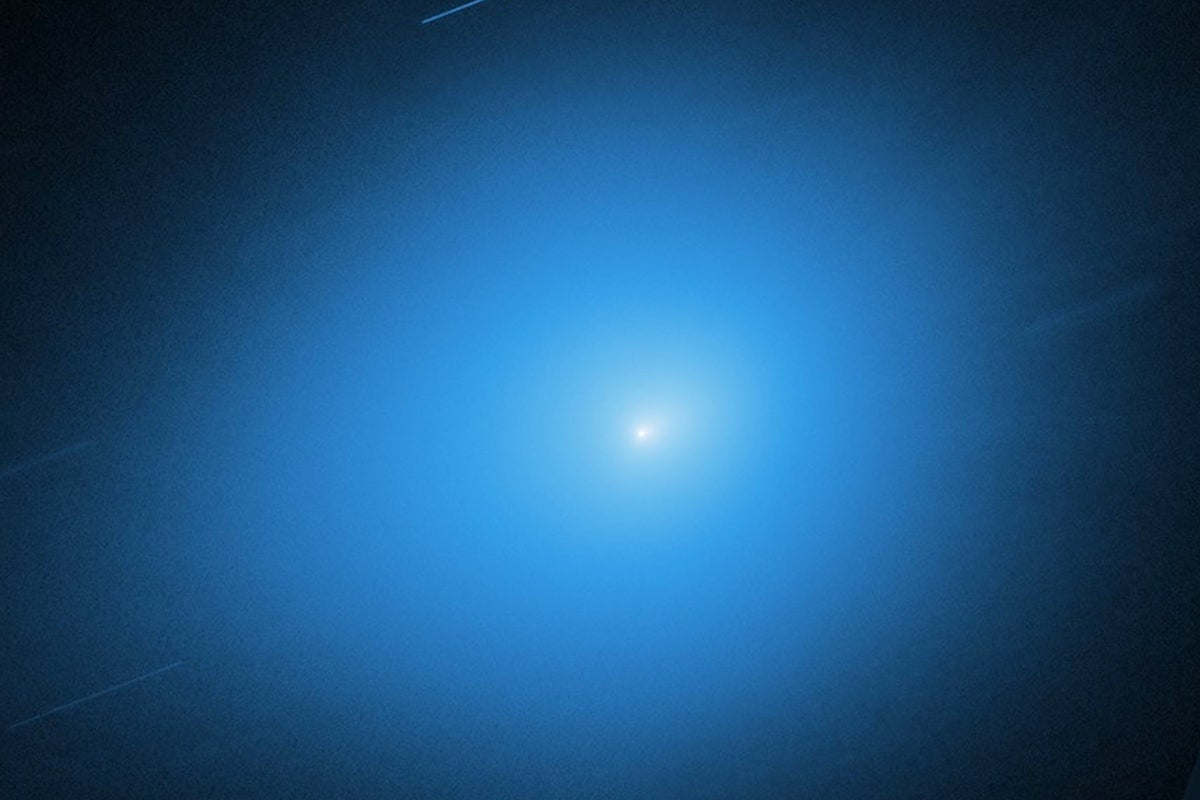
This image, provided by NASA, shows the interstellar comet 3I/Atlas captured by the Hubble Space Telescope on Nov. 30, 2025, about 178 million miles (286 million kilometers) from Earth. (NASA, ESA, STScI, D. Jewitt (UCLA), M.-T. Hui (Shanghai Astronomical Observatory), J. DePasquale (STScI) via AP) - (NASA)

A stray comet will make its closest approach to Earth today in one last hurrah before racing back toward interstellar space.

Discovered over the summer, the comet known as 3I/Atlas will pass within 167 million miles (269 million kilometers) of our planet this Friday.

It’s the closest it gets to Earth on its grand tour of the solar system.

NASA continues to aim its space telescopes at the visiting ice ball, estimated to be between 1,444 feet (440 meters) and 3.5 miles (5.6 kilometers) in size.

But it’s fading as it exits, so now’s the time for backyard astronomers to catch it in the night sky with their telescopes.

The High Resolution Imaging Science Experiment (HiRISE) camera aboard NASA's Mars Reconnaissance Orbiter captured this image of interstellar comet 3l/ATLAS on Oct. 2, 2025. At the time it was imaged, the comet was about 0.2 astronomical units (19 million miles, or 30 million kilometers) from the spacecraft (NASA/JPL-Caltech/University of Arizona)

Acting Nasa administrator Sean Duffy wrote of the comet in October, “NASA’s observations show that this is the third interstellar comet to pass through our solar system. No aliens. No threat to life here on Earth.”

And he added about how it got its name, “3 = the third, I = interstellar, meaning from beyond our solar system, ATLAS = discovered by our Asteroid Terrestrial-Impact Last Alert System (ATLAS) team.”

The comet will come much closer to Jupiter in March, zipping within 33 million miles (53 million kilometers). It will be the mid-2030s before it reaches interstellar space, never to return, said Paul Chodas, director of NASA’s Center for Near Earth Object Studies.

It’s the third known interstellar object to cut through our solar system. Interstellar comets like 3I/Atlas originate in star systems elsewhere in the Milky Way, while home-grown comets like Halley's hail from the icy fringes of our solar system.

A telescope in Hawaii discovered the first confirmed interstellar visitor in 2017. Two years later, an interstellar comet was spotted by a Crimean amateur astronomer.

NASA’s sky-surveying Atlas telescope in Chile spotted comet 3I/Atlas in July while prowling for potentially dangerous asteroids.

Scientists believe the latest interloping comet, also harmless, may have originated in a star system much older than ours, making it a tantalizing target.

Sign up to read this article
Read news from 100’s of titles, curated specifically for you.

Already a member? Sign in here
Related Stories
Top stories on inkl right now
One subscription that gives you access to news from hundreds of sites
Already a member? Sign in here
Our Picks
Fourteen days free
Download the app
One app. One membership.
100+ trusted global sources.