
We last took an in-depth look at integrated graphics performance four years ago, using a combination of desktop and laptop hardware. Things have changed a lot in the intervening years, and while no one is going to replace a high-end GPU with an integrated solution any time soon, budget gaming solutions are clearly in sight. Perhaps that's why we haven't really seen any true budget GPU solutions from Nvidia for several years, with the least expensive models often adding several hundred dollars to the price of a PC or laptop.
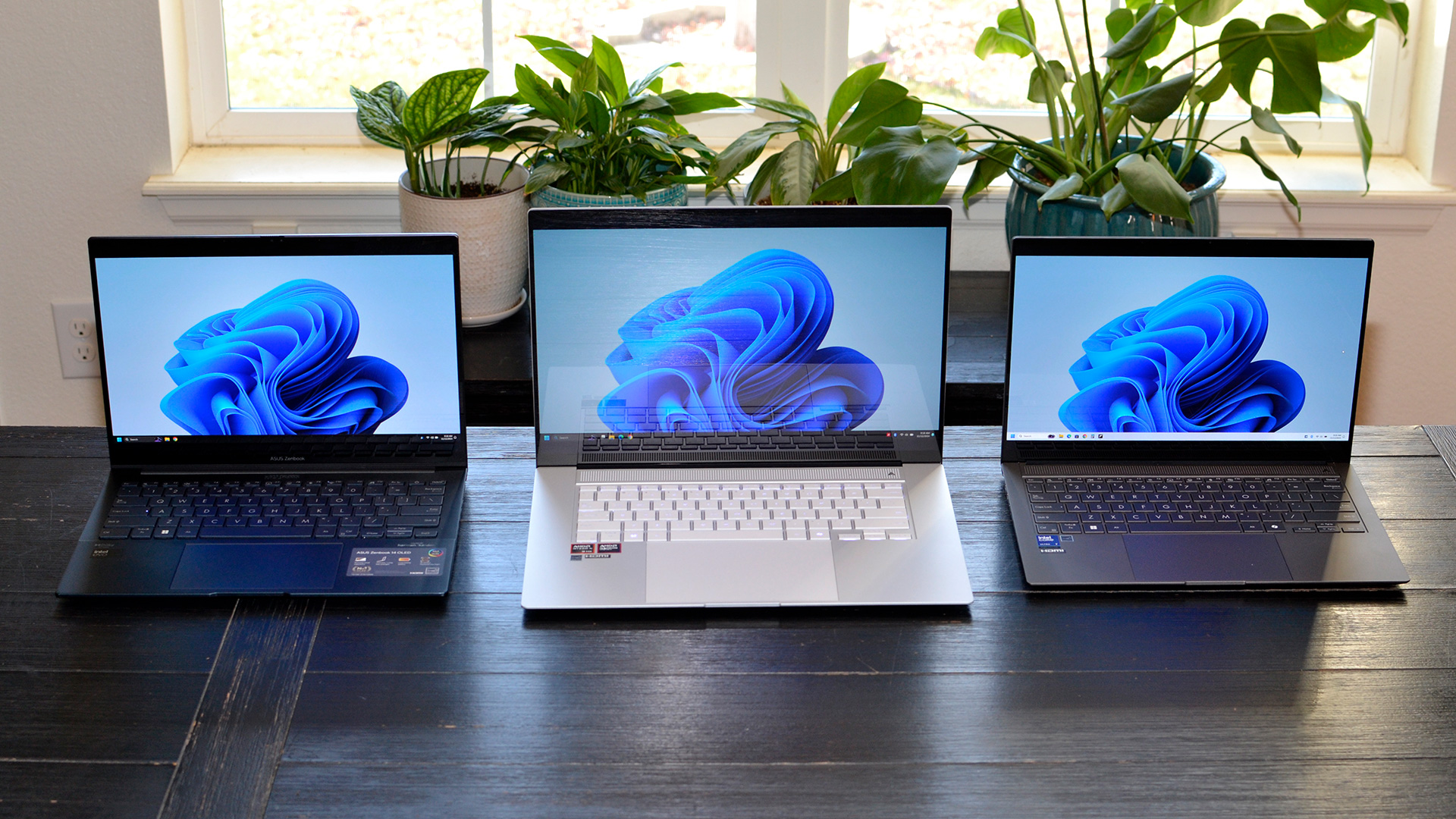
With Intel's Lunar Lake and AMD's Ryzen AI mobile processors now launched, it's time for a rematch. We've got three roughly equivalent laptops for testing, all from Asus (via AMD and Intel). The newest is the Asus Zenbook S14, equipped with a Core Ultra 7 258V processor and Arc Graphics 140V (aka Lunar Lake or LNL). It's mostly the same chassis as the previous generation Asus Zenbook OLED 14, which has a Core Ultra 7 155H and Arc Graphics (aka Meteor Lake or MTL). And from the AMD camp, we have the larger Asus Zenbook S16 with a Ryzen AI 9 HX 370 processor with an Radeon 890M GPU (aka Strix Point).
We did some preliminary benchmarks last month, showing how Lunar Lake's graphics fared against the other options. But after both user and vendor feedback, we felt a deeper comparison was in order. Also, Intel has updated drivers for Lunar Lake that improve the situation (though they're still not on a unified driver version). This time, we're going whole hog with a selection of 24 games, including many recent releases.
We're interested in both performance and compatibility, and have notified the appropriate companies of any issues we encountered (which means we told Intel one of the games we tested is borked). We also took steps to ensure a level playing field, as much as possible. That means — and this is an absolutely critical point — that we are not using things like FSR 1/2/3, frame generation, XeSS, HYPR-RX, AFMF2, or any other proprietary technologies. Because we know, from experience, that even if XeSS and FSR2 can run on GPUs from the other vendors, they don't necessarily run optimally.
We're looking at the underlying GPU performance, at native resolution, plain and simple. Is that "fair?" And what does fair even mean? We think it's best to level the playing field without bringing in outside software solutions for a primary performance comparison, but AMD is proud of HYPR-RX, AFMF, FSR, and its other technologies and has a blog post that coincidentally also went up this morning, where AMD claims a 75% lead over Intel's 258V — with both sides using all the software tweaks available. (On a related note, this is precisely why we haven't been testing with DLSS in every game where it's an option on our desktop GPU reviews for the past six years.)
We also ensured that all three laptops have a CPU package power of around 28W — though Intel's Lunar Lake has DRAM on package, which draws about 1.5W of power, so technically it's at a slight disadvantage... but it also has faster LPDDR5x-8533 memory, which certainly helps in some of the games we tested.
And finally, for good measure, we ran the same tests on an older Dell G15 laptop that has a Core i5-12500H and an RTX 3050 Ti 4GB dedicated graphics card — which, for the record, was also tested without using DLSS. We expect the dGPU to be faster, but we wanted to see how much of a gap exists between a relatively-budget gaming laptop and these newer integrated GPUs. It's definitely not an apples-to-apples matchup, however, as the G15 comes with a single DDR5-4800 8GB stick of RAM, and that doesn't do it any favors. Consider it a point of reference rather than a definitive statement on the RTX 3050 Ti or any other dedicated GPU.















