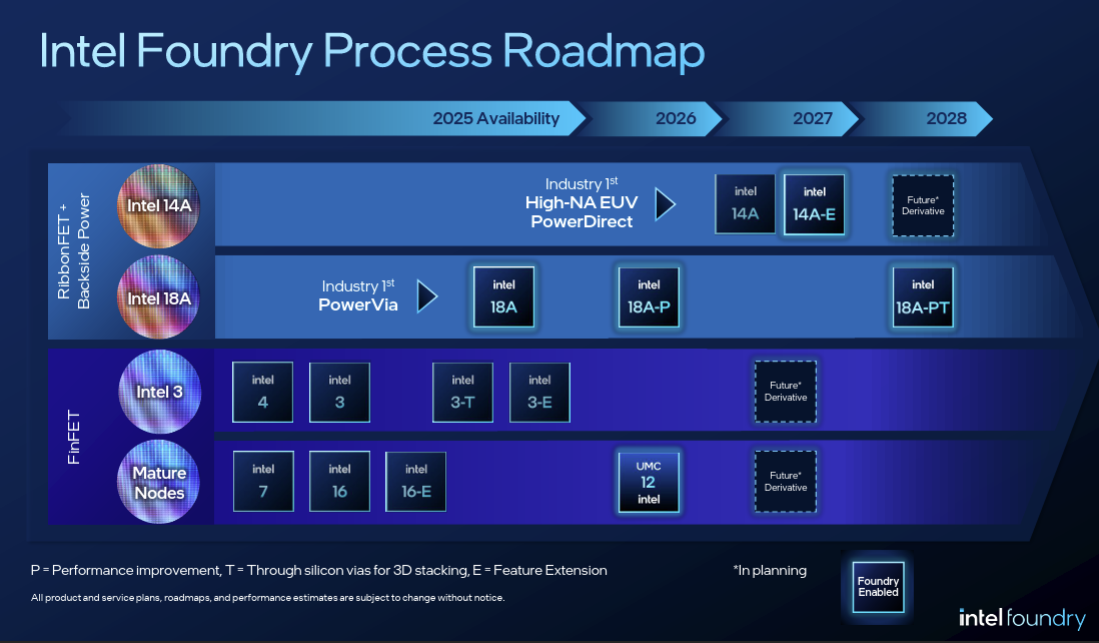
Currently, Intel's Foundry division loses billions every quarter as it invests heavily in new process technologies and production capacity. However, the company hopes that the Intel Foundry unit will break even sometime in 2027, which will coincide with the rollout out Intel's 14A manufacturing technology and production start on 18A-P node.
Intel this week reaffirmed that the first product made on its 18A (1.8nm-class) fabrication process, the client PC processor (codenamed Panther Lake), will hit the market late this year and will ramp next year. The manufacturing technology will also be adopted for Xeon 'Clearwater Forest' and some third-party products, but from Intel's Foundry business perspective, 18A is will be a proof-of-concept for external clients. If this production node is a success, more potential customers will adopt its successors, including 18A-P, and 14A (1.4nm-class).
"I think we do need to see more external volume come from 14A versus versus 18A, said David Zinsner, chief financial officer of Intel, at the J.P. Morgan Global Technology, Media and Communications Conference. "We have […] a bunch of bunch of potential customers, and then we get test chips, and then some customers fall out in the test chips, and then there is a certain amount of customers that kind of hang in there. So, committed volume is not significant right now, for sure. But, you know, I think we have got to partly prove ourselves a little bit with our own product and eat our own dog food here, and then […] we start to see some engagement around customers."
Zinsner admitted that if the company choses to use High-NA EUV lithography with its 14A process technology — as it plans to at the moment — its costs will go up initially. Intel hopes that advantages enabled by the new fab tools will outweigh those higher costs.