
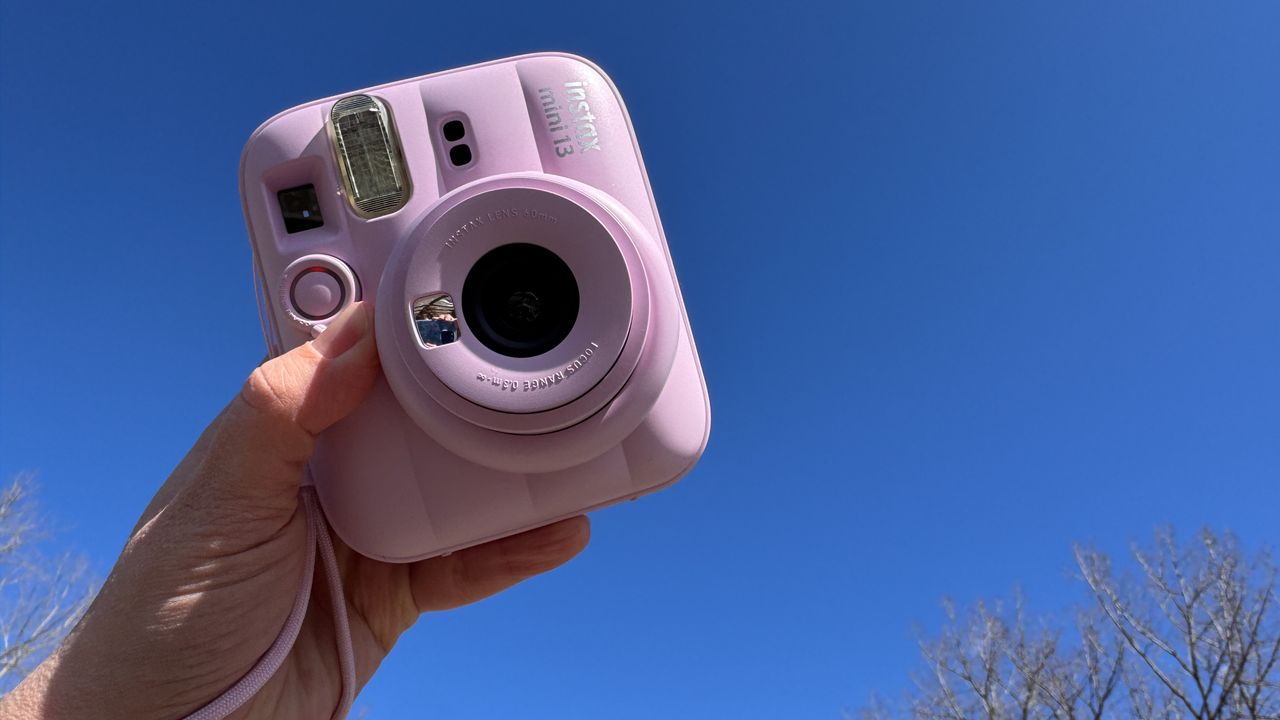
Fujifilm’s affordable Instax Mini cameras have long been a party favorite, but the budget instant film line is finally capable of taking selfies beyond those outstretched arm snaps. The Fujifilm Instax Mini 13 is the brand’s new under US$100 budget instant film camera – and it finally brings a selfie timer to the longstanding film favorite.
The Instax Mini 13 continues many of the loved features from the Mini 12, including a simple design, automatic exposure, and a budget-friendly price. But Fujifilm has tweaked the design and added a selfie timer, among other changes. I tried the newest budget Instax – and it’s a charming albeit imperfect camera to rival the best instant cameras.

Fujifilm Instax Mini 13: Specifications
Film type |
Instax Mini instant film |
Lens |
60mm |
Focus range |
.3m to infinity |
Film developing time |
90 seconds |
Print size |
54×86mm (2.1 in × 3.4 in) |
Printed image size |
62x46mm (1.8 in × 2.4 in) |
Power |
2x AA batteries |
Available colors |
Purple, blue, pink, green and white |
Fujifilm Instax Mini 13: Price

The Fujifilm Instax Mini 13 carries a similar price to its predecessor. It retails for $93.95 in the US, $109.99 in Canada, and AU$129 in Australia. UK retailers have not yet announced availability, but if the price remains similar to the previous model, it should be around £80.
The camera is expected to begin shipping in June of 2026 in the US and Canada; Fujifilm UK hasn't yet shared an estimated shipping date. Check major retailers like Amazon, Adorama (US), B&H (US), Wex Photo (UK), London Camera Exchange (UK), or Camera House (Australia) for pre-orders.
Fujifilm Instax Mini 13: Key Features

I could sum up the changes between the Instax Mini 12 and the new Mini 13 in one word: Selfies. Okay, so there are a few other small differences, but the biggest upgrades are meant for selfie-takers.
The Mini 13 has finally gained a selfie timer, which can be set to two or ten seconds. That’s a nice upgrade considering the most affordable Mini is geared towards casual users anyway, so it makes sense not to keep the selfie timer reserved for just more advanced models like the Mini 99.
The strap also has an unusual feature: a built-in wedge meant to help prop up the camera when using that selfie timer.
The Mini 13 continues the updates from the Mini 12 as well, including a close-up option and automatic flash control.
Fujifilm Instax Mini 13: Build and Handling

The updated design on the Instax Mini 13 reminds me of a camera wearing a puffer jacket. The Mini 13 continues the bubbly, rounded shape of the 12 but adds more contours down the camera body, which immediately brings to mind the lines on a puffer jacket.
Those contours still don’t give the little camera much of a grip, but Instax is designed for snapshots, not long shoots, so the shape didn’t bother me much.

The shutter release sits at the front of the camera underneath the viewfinder, and it’s surrounded by a lever that turns on the selfie timer. That selfie timer is the only feature I had to dig out the instructions for. A quick twist of the lever turns on the two-second timer. Turn the lever and hold for two seconds to activate the ten-second timer instead. The light around the shutter release will flash, press the shutter to start the timer, or turn the lever again to turn off the timer.
A small mirror around the lens aids in framing those selfies. This is helpful to see if you’re fully in the frame, but not large enough to, say, show that your pose is giving you a double chin.
A quirky new feature hides in the camera strap – and if you don’t read about it, you may not realize that it’s there. A plastic Instax logo is built into the strap. But, this also doubles as a wedge to help angle the camera right if you place it on a table or another similar surface for selfies. There’s no tripod mount, so this is a nice way to quickly, if a bit imprecisely, adjust the camera angle for selfies.

The back of the camera houses the film door – just line up the yellow spot on the camera with the yellow on the film pack, press inside, shut the door, and take one photo to eject the protective cover.
The back also houses the viewfinder and a small dial that shows how much film is remaining.

The camera uses replaceable AA batteries rather than rechargeable ones, so there’s a cost to keeping the camera running alongside the price of Instant film.
Like the predecessor, I found the Mini 13 fairly easy and straightforward to use. The only feature that may not be obvious is how to switch between the two-second and ten-second timer, and that the little logo dongle doubles as a wedge.
Fujifilm Instax Mini 13: Performance
I’ve used several Instax cameras over the last few years, and the images coming from the Instax Mini 13 were exactly in line with what I expected. The credit-card-sized instant film prints aren’t the sharpest or most color-accurate images, but they have the charm of real film.
The film spits out the top of the camera and takes around 90 seconds or so to appear. Waiting for the chemical reaction to finish inside the photo is part of the magic of instant film. So too are the colors, which are close but a bit more retro than real life.
The added features make selfies simpler, though the .3m minimum focusing distance is still enough to take the standard arm-out-selfie.

The viewfinder on the Instax Mini 13 isn't 100 percent accurate. I caught some edges of objects that I didn't spot in the viewfinder, and sometimes shots of the subject that I thought were dead center were slightly off-center on the final print.
The flash on the Mini 13, like the predecessor, is always on, even outdoors in bright sun. It’s a powerful little light that adds a direct flash look to the shots, particularly indoors.
If I have one complaint about the Mini 13, it’s this: Photos taken outdoors in bright sun are often overexposed. The camera can’t quite handle the bright sun and washes out skin tones. The Instax Mini film doesn’t have the widest dynamic range, and the brightest portions of the image can wash out, particularly with bright sun.


But, this is similar to the Mini 12 as well as competing brands like the Polaroid Go, so it’s not uncommon for cheap instant film cameras to get a bit too bright sometimes. If you do intend to take a lot of photos outdoors, I would recommend looking at something like the Mini 99 or the digital-instant hybrid the Instax Mini Evo, which tend to do a bit better in bright sunlight.
Fujifilm Instax Mini 13: Verdict

The Instax Mini 13 levels up one of the brand’s most affordable instant cameras with new selfie tools, including a selfie timer and a wedge to help prop the camera at the best angle.
The charm of the affordable Instax hasn’t changed. It spits out shareable, fun, and quirky credit-card-sized prints. The camera bundles all the fun and unpredictability of instant film into an affordable and simple-to-use camera.
I do wish the camera did a bit better in bright sunlight, as the camera tends to blow out the brightest spots in the image. This is something the predecessor did as well. But, it speaks volumes that the tiny camera still actually does decently indoors, as long as the subject isn’t super far from the flash.
My few complaints with this camera are lessened by one thing: Price. I wish that I could turn the flash off, charge the batteries, and take double exposures. But Instax already has a camera that does that (the Mini 99). The Mini 13 is just quite a bit more affordable than the more fine-tuned model.
Buy the Instax Mini 13 if you want an affordable way to take party snaps on real film. Avoid it if you plan to take lots of photos outdoors in the sun, as the pricer models can do a bit better.