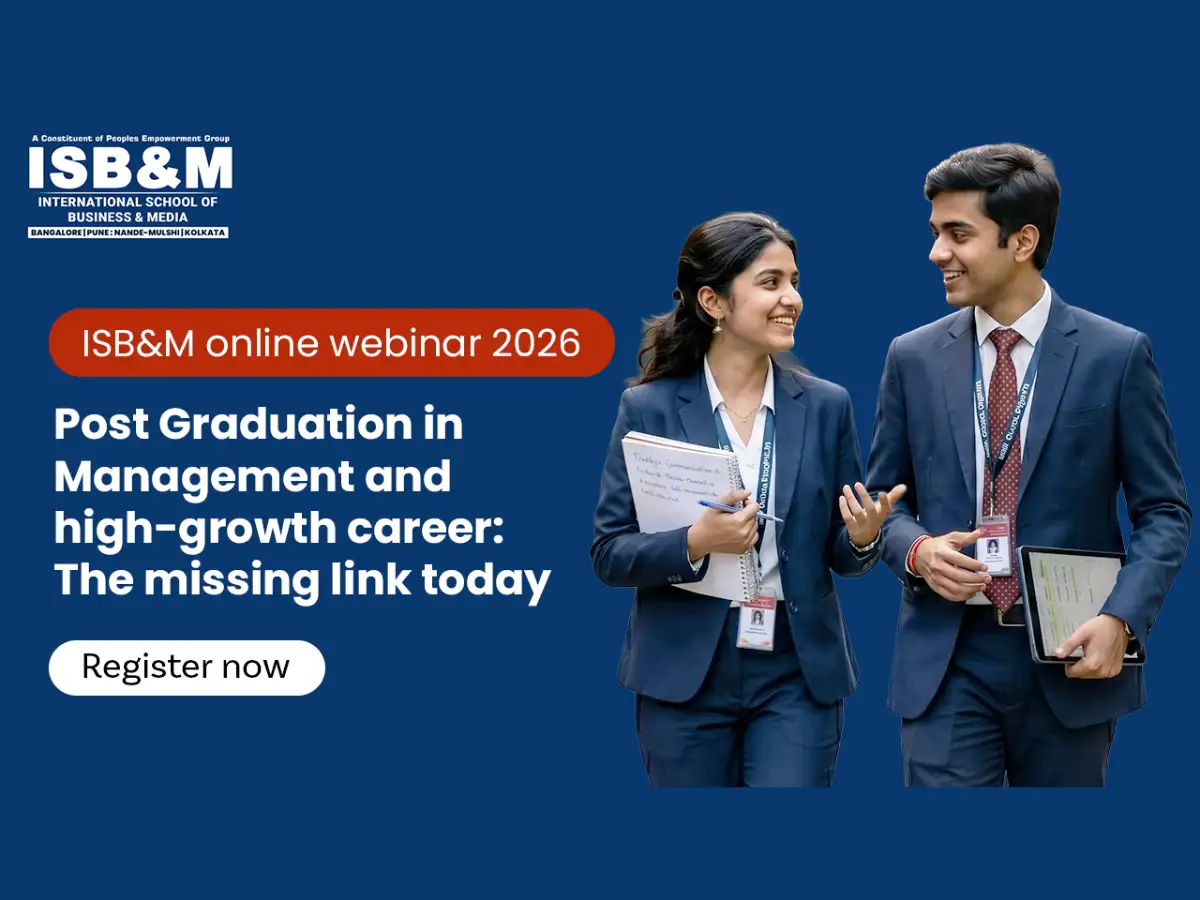
At a time when management education in India is being asked to create an enduring value, rather than merely deliver placements, an ET Career Talks webinar, in collaboration with ISB&M, made the case that the modern business degree must prepare students for uncertainty, adaptability, and execution. The conversation, moderated by Beverly White and featuring Dr. Pramod Kumar, President, ISB&M and Rajesh Padmanabhan, CEO, Talavvy Business Catalysts, framed the question bluntly: what does it take to build a high-growth career now?
The conversation comes amid a changing economic landscape, where the job market is more varied than ever.
The evolution of management education in India mirrors the nation’s socioeconomic realities, its priorities, and ambitions in the decades that followed the Independence. In the 1960s, it was conceived to contribute to nation-building and produce leaders who could spearhead the country’s economic vision.
In the 1990s, economic liberalisation redefined the very scope and meaning of management education, where it soon came to be seen as a vehicle for social mobility. It produced leaders who shaped a new era of banking, consultancy, technology firms, and consumer-facing brands.
However, today, as India aims to achieve economic growth of $5 trillion by 2027 and Sustainable Development Goals (SDGs) by 2030, the management education script needs a significant overhaul. As moderator Beverly White pointed out: The management education scenario in India has followed pretty much the same path for about a decade, but that path perhaps is not quite enough for a high growth career.