Get all your news in one place.
100's of premium titles.
One app.
Start reading
Cycling News
Cycling News
Sport
Will Jones

Ineos Grenadiers trialling hybrid wireless MTB groupset for Paris-Roubaix, but not for the reason you might expect

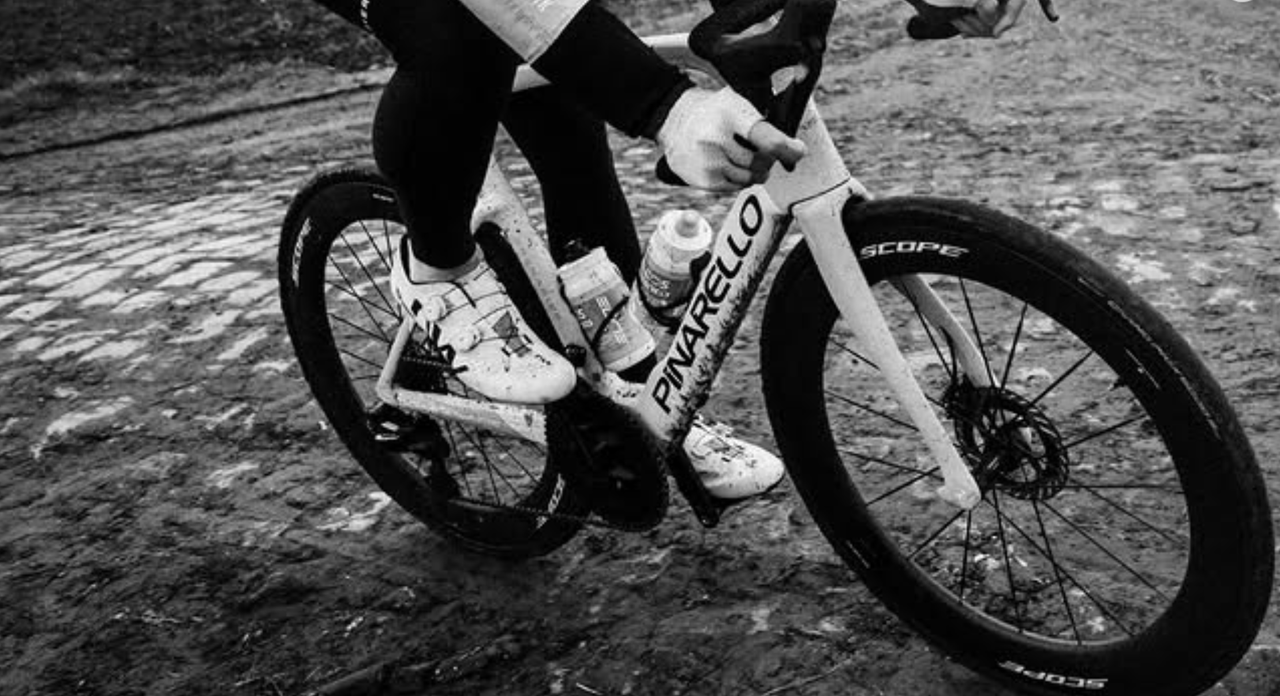
A black and white photo of a rider on cobbles.

While the bikes of Paris-Roubaix have certainly become less specialised in the past decade, with most riders opting to simply use their standard aero bike with minor modifications like wider tyres and double-wrapped bar tape, save for Israel-Premier Tech, who opted to race aboard gravel bikes in 2024, causing quite a stir.

That being said, we have seen some interesting cobble-oriented hacks in the past few seasons. Last year was notable for Lidl-Trek modifying their SRAM Red XPLR rear derailleurs with an additional limiter screw to force them to behave as 12sp rather than 13sp, allowing the riders to use the closer-spaced gearing of the 12sp SRAM Red road cassette.

We have also seen Shimano sponsored teams use GRX gravel derailleurs in the past in a bid to improve chain retention over the roughest cobbles, but this year the riders of Ineos Grenadiers have gone one better and appear to be testing a hybrid groupset comprising Shimano Dura-Ace road shifters, a non-native 1x setup up front with a chain tensioner as Shimano doesn’t offer a 1x road option as yet, and the new wireless XTR rear derailleur coupled with a road cassette.

While the fact that it is designed for mountain biking, and therefore more able to handle rougher terrain, may be the obvious reason for this setup, there are other advantages to the derailleur that go beyond increased chain tension and chain retention enabled by a stronger, dual-spring clutchless system.

First and foremost, the derailleur is wireless, meaning that in the event of a crash or entanglement, there is no derailleur cable to snag and disconnect, rendering the rider unable to shift. We often see mechanics using strips of butyl inner tube to secure the exposed cable on standard race days (an excellent way to spot if a team mechanic is on form), but this setup negates that risk altogether.

Furthermore, the XTR mech is designed to take impacts very differently than Dura-Ace. The latter system, when impacted during a crash, disengages the motor, and to reset it, a rider must either hold the button on the junction box (which is often impossible, since it is commonly hidden inside the frame), or shift all the way to the largest sprocket, then all the way to the smallest sprocket before being able to shift normally again (assuming there’s no significant damage). This reportedly affected Tadej Pogačar after his pre-Cipressa crash at Milan-San Remo, making his already-impressive win all the more so.

XTR, meanwhile, when knocked, disengages the motor before returning to the gear it was in before impact.

In a race where service from a team mechanic may be a lot harder to come by - often waiting for the car, which is often stuck behind other riders, to catch up with you at the end of the cobbled sector - reliability can be a real performance advantage. To this end, the team also appears to be opting for wheel sponsor Scope’s second-tier R series wheels, as opposed to the top-tier Artech wheels, which are easily identifiable by their fish-scale texture.

This mirrors Modern Adventure Pro Cycling, who are opting to use Factor’s more durable amateur race bike, the Monza, over the Factor OSTRO VAM or the hyper-aero but correspondingly unforgiving ONE.

Sign up to read this article
Read news from 100's of titles, curated specifically for you.
Already a member? Sign in here
Related Stories
Top stories on inkl right now
One subscription that gives you access to news from hundreds of sites
Already a member? Sign in here
Our Picks
Fourteen days free
Download the app
One app. One membership.
100+ trusted global sources.