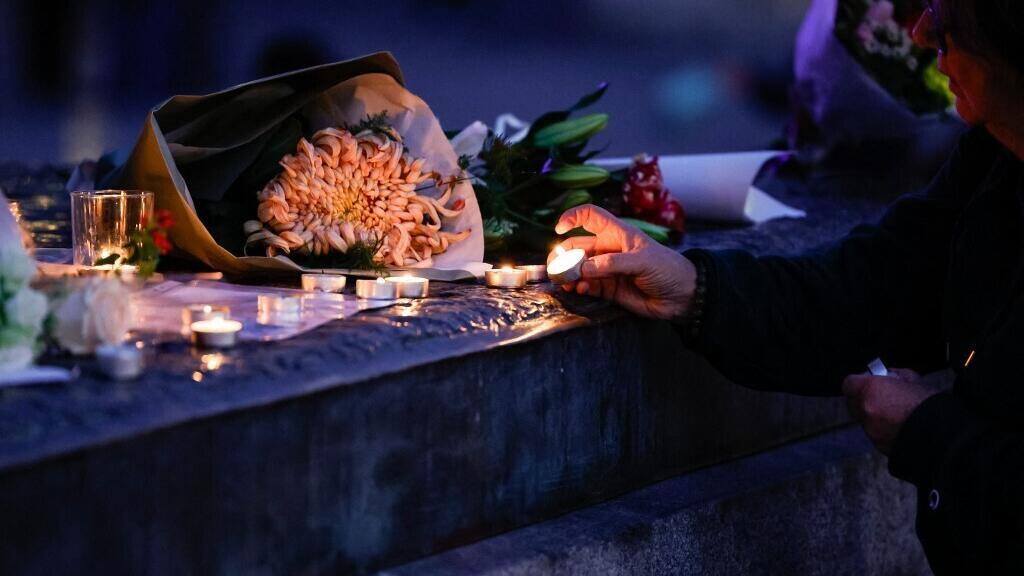
As France marks 10 years since the Paris attacks that killed 130 people and wounded more than 400, Bernard Cazeneuve, France’s interior minister at the time, spoke to RFI about the political landscape before and after the night that changed Paris.
The day began in Paris with a security exercise. "In the morning, an exercise [had been] organised involving the security forces, in case of a mass killing in Paris," recalls Cazeneuve of 13 November 2015.
In the afternoon, he presented a national plan to combat arms trafficking at the Hauts-de-Seine prefecture, north-west of Paris. In the early evening, he decorated the civil servants who had assisted police officer Clarissa Jean-Philippe during the January 2015 terror attacks.
In short, for Cazeneuve: "This was a day entirely devoted to preventing and combatting terrorism."
France marks decade of 2015 Paris attacks
The call from Hollande
At 8pm, everything changed.
"I received a call from the president of the republic, who was at the Stade de France, telling me that he had heard explosions," Cazeneuve remembers.
A few minutes later, police prefect Michel Cadot confirmed: "This is likely a criminal act of a terrorist nature."
Cazeneuve then received another call. "The police chief calls me back to tell me that shootings are taking place on a number of streets in the capital. At that moment, I realise that we are facing a large-scale operation designed to destabilise the country."
A new terrorism
He knew even then that France's resources were lacking, recalling that the police force had recently lost 13,000 jobs. In his view, the 2008 merger of two police intelligence agencies had "deprived the Interior Ministry of the tool it needed to detect early signs of radicalisation".
"We were not at the level we needed to be," he said. "There was a gap between the decisions we make and their implementation, which is an unavoidable delay, even though we were facing a real race against time."
The changing nature of the threat they were attempting to combat was also a crucial factor.
"In the years 2010 to 2015, we were not facing the same kind of terrorism that had struck Europe in the 1980s and 1990s," said Cazeneuve.
The terrorists of 2015 were "individuals living on national territory, who might be our neighbours, who became radicalised through the internet and left for Iraq and Syria, or were indoctrinated by groups that called for attacks to be carried out everywhere, to indiscriminately strike at citizens... in an attempt to fracture French society".
France probes plot linked to ex-girlfriend of Paris attacks convict
'The blindness of the left'
Cazeneuve – himself a member of the Socialist Party until 2022, when he left in protest at its decision to join an electoral coalition with other left-wing parties, including the far-left France Unbowed – is blunt about what he calls complacency on the part of some on the left, and the consequences.
"The blindness came from the fact that some people considered that taking an interest in Islamism was a form of Islamophobia, even though it was Islamism that was taking an interest in us," he told RFI.
"The left has always been the party of universalism, freedom of expression and rejection of communitarianism. All those who considered that the fight against the totalitarianism of Islamism was a form of Islamophobia forgot that the first people we are protecting are Muslims themselves."
He criticised the far left, saying those on that end of the political spectrum see "Muslims as an electoral constituency to be won over, for cynical reasons of political calculation".
The aftermath
When it came, in the aftermath of the attacks, to tackling the terrorists' desire to divide French society, Cazeneuve says he prioritised unity.
"[I did not want] to turn these attacks into a stage for grandstanding, but to speak as precisely as possible, to be as balanced as possible, and to continually call for harmony."
He recalls: "I visited many places of worship. Churches and synagogues, of course, but also many mosques, to tell our Muslim compatriots that the Republic was committed to embracing all its children."
How French Muslims have wrestled with Charlie Hebdo's impact, 10 years on
A country adrift?
His assessment of France's current political situation is pessimistic.
"We feel that the new world we were promised has turned out to be a return to a world we had forgotten, with all its worst flaws – that of the Fourth Republic."
He went on to list these flaws: "A collapsed party system, constant political manoeuvring and backroom deals, parliamentary debates that inspire a sense of shame, and a worrying budgetary situation that is not being addressed honestly."
Outlining his chief concern, he said: "We risk having a confrontation between two forms of rejectionism that are both disastrous for the country: the extreme left and the extreme right."
His solution is a rallying cry around "the left wing of government" with four key battles: "Affirmation of republican principles, compatibility between economic efficiency and social justice, ecological transition without economic decline, and commitment to democracy and the principles of the rule of law."
Cazeneuve concluded by quoting General de Gaulle: "A French person is someone who wants France to continue. That means wanting it to remain independent and free to make its own choices, universalist in its values, secular, without territorial divisions."
This article was adapted from the original version in French by Frédéric Rivière.