The Animal That Runs Like Almost Nothing Else on Earth
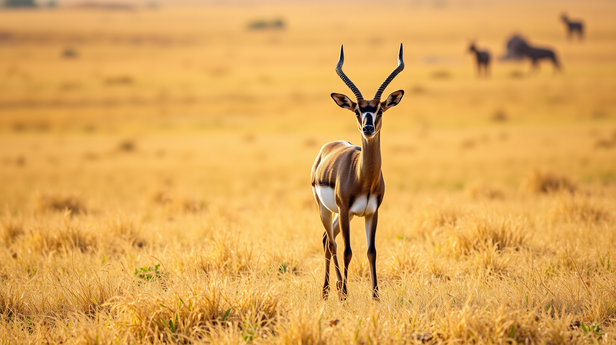
A blackbuck at full sprint hits 80 km/h. It can hold 65 km/h for long enough to exhaust most predators. Among land animals, only the cheetah, now extinct in India as a wild resident, could reliably run one down. The Indian wolf and the caracal still try, and occasionally succeed, but the blackbuck's survival strategy for tens of thousands of years has been simple: flat, open ground and the ability to see a threat coming from 500 metres away.

That strategy only works on open grassland. The moment the grass grows tall, or trees close in, or a road cuts across the escape corridor, the blackbuck's speed becomes irrelevant. It cannot see, and it cannot run. The animal is not built for cover, it is built for visibility and distance. This is the biological fact that every conservation plan for this species has to reckon with, and the one that most land-use decisions in India quietly ignore.
How Close India Came to Losing the Blackbuck
The Wildlife Protection Act of 1972 arrived at a critical moment. By the early 1970s, India's blackbuck population had dropped to an estimated 8,000 animals, down from several million at the start of the twentieth century. Colonial-era hunting was the first cause. Blackbuck were fast enough to make an interesting target and numerous enough to seem inexhaustible. They were neither.
After Independence, the pressures shifted from rifles to land. Agriculture expanded into the Deccan plateau grasslands, the semi-arid scrublands of Rajasthan, and the coastal plains of Andhra Pradesh, all prime blackbuck habitat. The animal had no forest to retreat into, because it does not live in forests. It retreated into smaller and smaller patches of open land, and its numbers fell accordingly.
The 1972 Act gave the blackbuck full legal protection. Poaching penalties became serious. A handful of sanctuaries, Velavadar in Gujarat, Point Calimere in Tamil Nadu, Tal Chhapar in Rajasthan, were designated specifically to hold viable populations. The recovery that followed was genuine. By the early 2000s, surveys put the national population above 50,000. The most recent Wildlife Institute of India estimates place it between 1,00,000 and 1,50,000 animals. The species went from the edge of local extinction to one of India's conservation success stories in roughly three decades.
Why the Recovery Is Shakier Than the Numbers Suggest
A population of 1,00,000 sounds safe. The distribution tells a different story. Blackbuck in India are not spread across continuous habitat. They exist in isolated pockets, separated by cropland, highways, and expanding settlements. The Velavadar population in Gujarat is genetically and physically cut off from the Tal Chhapar population in Rajasthan. The herds in Andhra Pradesh's Rollapadu Wildlife Sanctuary have almost no corridor connecting them to populations further north.
Isolation matters because blackbuck are herd animals. A herd below a certain size loses its ability to spot predators efficiently, the collective vigilance that makes open-ground living viable drops. Small, isolated herds also face inbreeding risk over generations. The Wildlife Institute of India has flagged genetic isolation as a growing concern for several of these pocket populations, though full genomic studies across all major herds are still incomplete.
Crop raiding adds a human dimension. Blackbuck graze on wheat, chickpea, and groundnut, exactly the crops grown on the plains they once roamed freely. Farmers who lose harvests to a protected species have limited legal recourse and often limited patience. Retaliatory poisoning, though illegal, remains a documented cause of mortality in agricultural zones bordering sanctuaries in Haryana and Rajasthan.
The Grassland Problem No Sanctuary Can Fully Solve
India has no national grassland policy. Forests have the Forest Conservation Act. Wetlands have the Wetland Conservation Rules. Grasslands, the specific habitat the blackbuck requires, are classified in most revenue records as wastelands, a colonial-era category that has never been fully revised. Land classified as wasteland can be legally converted to agriculture, plantation, or infrastructure with far fewer procedural hurdles than forested land.
This is where the blackbuck's long-term survival actually gets decided. Protected areas cover only a fraction of the grassland the species uses. The Deccan grasslands alone, which stretch across parts of Maharashtra, Karnataka, and Andhra Pradesh, hold blackbuck populations on private and community land that has no protected status. When that land gets converted, the animals either move into smaller fragments or they don't survive the transition.
Some state governments have experimented with community conservation areas and payment schemes for farmers who tolerate blackbuck on their land. The results are uneven. In parts of Rajasthan, the Bishnoi community's centuries-old religious prohibition on harming blackbuck has done more for the species than any formal government programme in those areas, a protection rooted in belief rather than law, and therefore not replicable by policy alone.
The blackbuck's recovery proves that legal protection and targeted sanctuary management can pull a species back from the edge. What it hasn't yet proved is whether those tools can hold a grassland-dependent animal in a country that has no formal mechanism for protecting the grassland itself.