Get all your news in one place.
100's of premium titles.
One app.
Start reading
The Economic Times
The Economic Times
Dipanjan Roy Chaudhury

India-Japan relationship could become world’s most important: Japanese Finance Minister

Ahead of next week’s bilateral annual Summit in New Delhi, Japanese Finance Minister Satsuki Katayama has stated that the India-Japan relationship could become the most important relationship in the world.

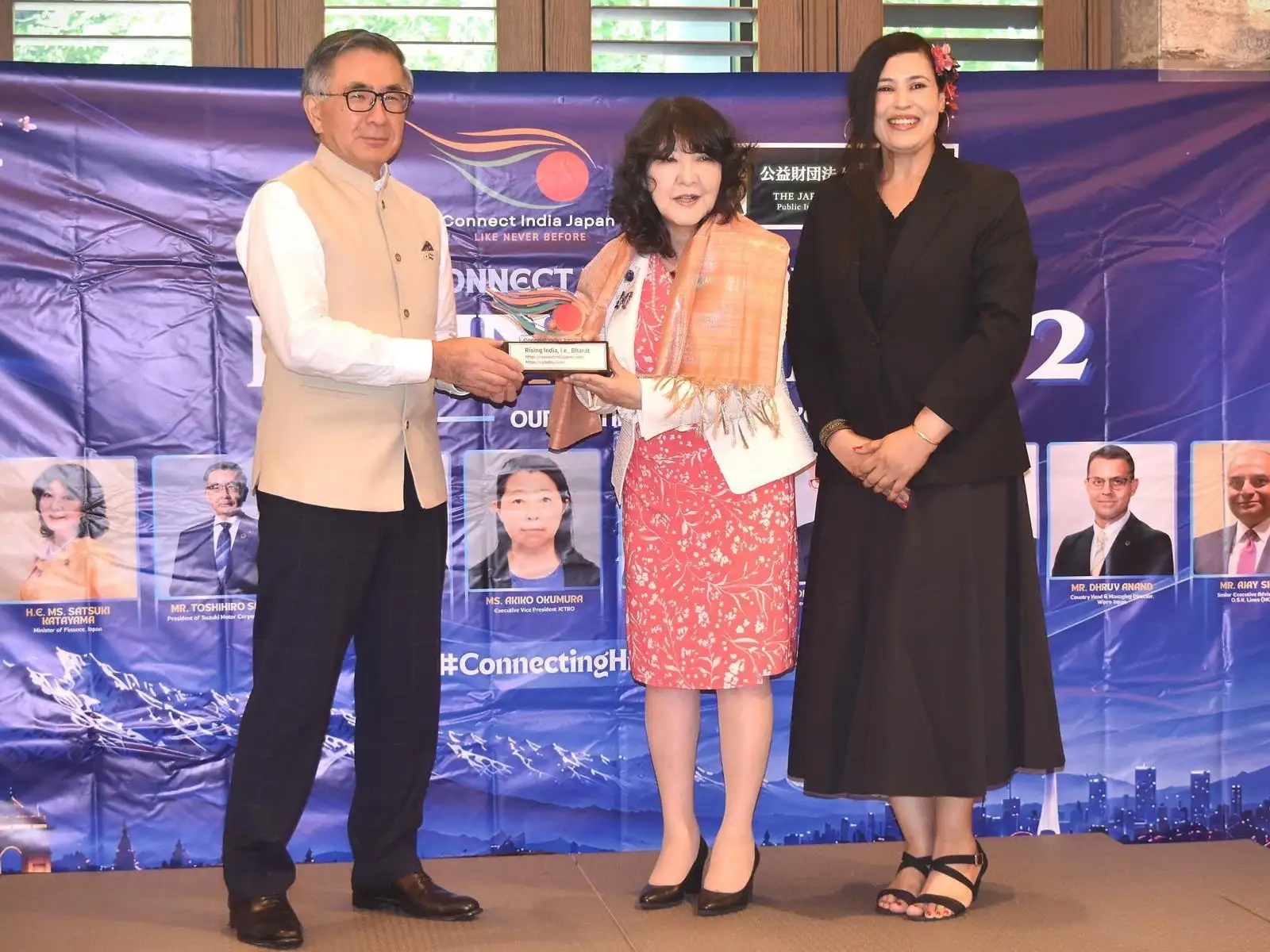
She was speaking at the sidelines of the recent annual Rising India conclave in Tokyo, organised by Indian entrepreneur Nupur Tewari. Delivering her keynote address, the Japanese Finance Minister called for ‘cooperation between partners who share common values and interests’.

Also Read: Japan Inc follows PM Takaichi to India, with chips and investments on the agenda

Katayama called Prime Minister Modi ‘a great leader’ and said that the India-Japan relationship had the potential to become the most important partnership in the world.

The event organised by the Connect India Japan foundation was attended by Suzuki Motor Corporation President, Representative Director, and CEO Toshihiro Suzuki, India’s Ambassador to Tokyo, Nagma Mohamed Mallick and senior figures spanning Japan’s diplomatic, defence, and policy establishment.

Suzuki said that Maruti-Suzuki’s record-high production of 2.35 million units in FY 2025 was a volume matched by only a handful of global companies, including Toyota and BYD. Exports reached approximately 448,000 units, a record, with vehicles shipped to markets across Africa, the Middle East, and beyond, this embodied India’s national vision of "Make in India, Make for the World." The Indo-Japanese car maker touches the lives of approximately 400 million Indians. Suzuki’s next challenge, the President said, was to grow alongside ‘the next billion’, the population advancing to the next stage of India’s development, he said.

Also Read: India, Japan discuss steps to fix energy supply disruptions

Delivering the opening address at the conclave, Mallick said Japan is the fifth largest investor in India, with approximately $45 billion invested over the past 25 years — a recent Japanese government report found that 76 percent of Japanese companies recorded rising profits. Around 1,500 Japanese companies run over 5,200 business establishments across India today, spanning automobiles, electronics, engineering, chemicals, logistics, and services.

She referred to flagship projects — the Mumbai-Ahmedabad High Speed Rail, the Delhi-Mumbai Industrial Corridor, the India-Japan AI Strategic Dialogue — as proof that the partnership is already operating at a different scale. Her vision for the road ahead was anchored in the eight pillars agreed upon at the 15th India-Japan Annual Summit: next-generation economic partnership, economic security, clean energy, smart mobility, ecological sustainability, technology and innovation, health cooperation, and people-to-people exchanges — with an ambition of 500,000 personal exchanges between the two countries.

India is on its way to becoming a developed nation by 2047 under the Viksit Bharat Mission. Japan, she said, is welcome to join that journey. "Together we have the capability of bringing our region and the world a more peaceful, more stable, more predictable era — which can provide benefits to all."

Akiko Okumura, Executive Vice President of JETRO, said India has become Japan's most compelling economic partner. More than 80 percent of Japanese companies operating in India intend to expand their business there, she said. Japanese investment has broadened well beyond its traditional strongholds of manufacturing and automotive, now spanning semiconductors, finance, startups, and IT. India increasingly viewed not merely as a market but as a production and export hub for the world. JETRO's five-pillar India strategy — economic security, talent exchange, advanced industries, market development, and SME investment — were a commitment to making the relationship more resilient and sustainable than ever, she said.

Keiichiro Asao, Former Minister of the Environment and a sitting Member of the House of Councillors, that India can pursue economic growth while protecting its environment, from water quality to air pollution. He drew on Japan's own development history — including the pollution that followed weak environmental regulation and finally Japanese technology and experience. He pointed to the Joint Crediting Mechanism (JCM) agreed between Japan and India during Prime Minister Modi's visit to Japan last year, under which emissions reductions achieved using Japanese-financed technology are shared between the two countries, and highlighted Japan's lesser-known strength in punctual urban rail systems as a potential solution to the traffic congestion and emissions India may face as it develops.

Connect India Japan (CIJ) is a platform dedicated to strengthening bilateral relations between India and Japan through flagship events, content, and community-building across business, culture, and policy. It was founded by Nupur Tewari, who has called Japan home for more than two decades.

Sign up to read this article
Read news from 100's of titles, curated specifically for you.
Already a member? Sign in here
Related Stories
Top stories on inkl right now
One subscription that gives you access to news from hundreds of sites
Already a member? Sign in here
Our Picks
Fourteen days free
Download the app
One app. One membership.
100+ trusted global sources.