Long before food became a symbol of India’s rich culture and a major part of its global identity and economy, it played a far more secretive and emotional role in the country’s struggle for freedom.
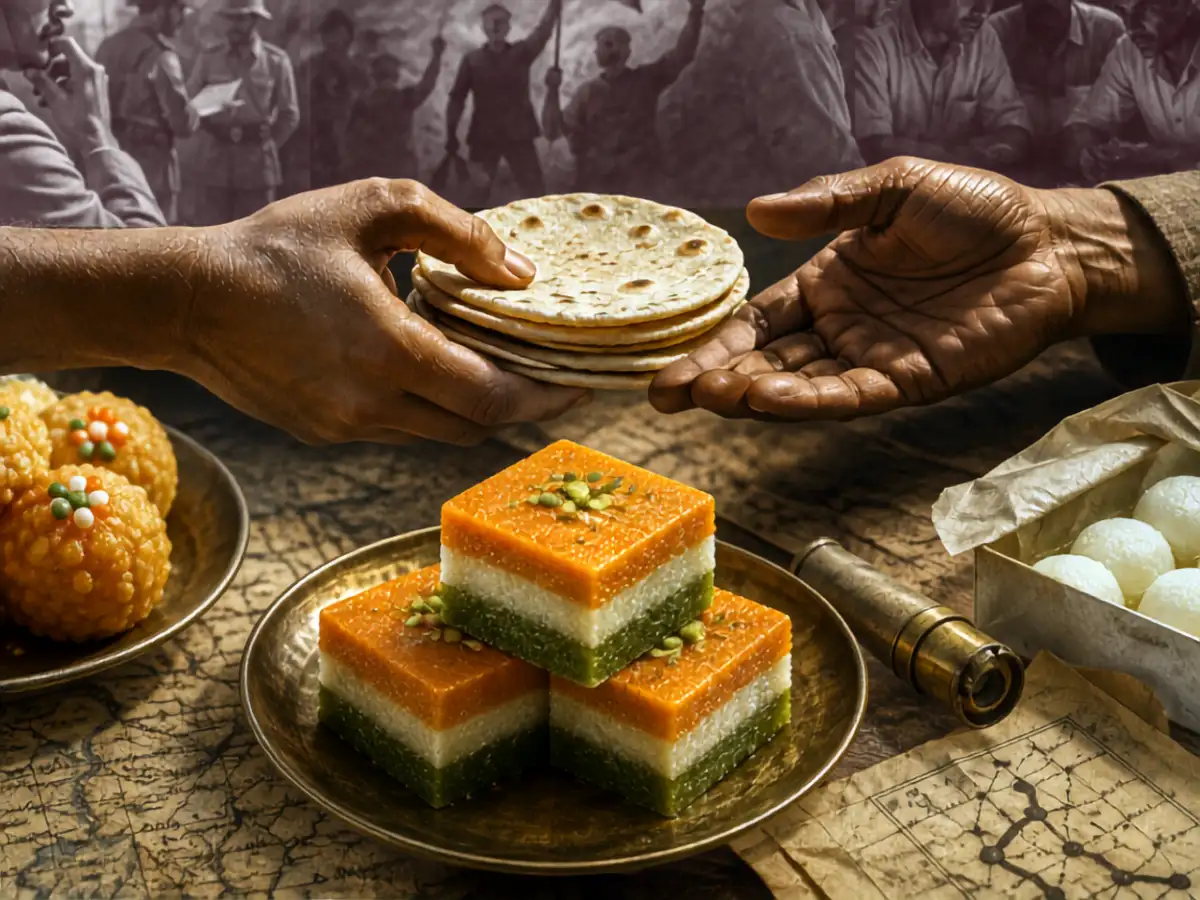
In an era when colonial surveillance was widespread and openly exchanging information could put lives at risk, revolutionaries had to find ingenious ways to stay connected. Food, something that was part of everyday life, quietly became part of this underground network. A chapati could travel from village to village, a sweet could carry a hidden meaning, and an ordinary food item could become a symbol of defiance.
As India fought its battle for freedom against colonialism, the everyday act of sharing food became an act of courage and resistance.
Read more: Swadeshi 1.0 vs. Made in India 2.0: How India turned a 1905 boycott into a 2026 business strategy
The role of chapati
India’s first major freedom struggle against the British began with the Uprising of 1857, when Indian soldiers rose against the East India Company. But even before the rebellion erupted, something ‘mysterious’ was already moving through the country, travelling hundreds of kilometres.
It was not a weapon. It was not a letter. It was a simple chapati, an everyday flatbread eaten in different parts of the Indian subcontinent.
These ordinary chapatis were passed from village to village with no message written on them. No explanation accompanied them. Yet their mysterious journey was spreading rapidly enough to alarm British officials.
In March 1857, Dr Gilbert Hadow, an army surgeon employed by the East India Company, wrote to his sister in Britain about the strange development, according to the Press Information Bureau (PIB). “There is a most mysterious affair going on throughout the whole of India at present. No one seems to know the meaning of it. It is not known where it originated, by whom or for what purpose, whether it is supposed to be connected to any religious ceremony or whether it has to do with some secret society. The Indian papers are full of surmises as to what it means. It is called the Chapati movement.”
Read more: Independence Day 2026: 79 years of an India on the rise as its households dream bigger
The mysterious circulation of chapatis had first come to British attention in early February 1857. One of the first officials to encounter it was Mark Thornhill, a British civil servant who served as a magistrate in Mathura during the 1857 uprising, near Agra. One morning, Thornhill arrived at his office to find four “dirty little cakes of the coarsest flour, about the size and thickness of a biscuit” lying on his desk, according to his account in The Personal Adventures and Experiences of a Magistrate During the Rise, Progress, and Suppression of the Indian Mutiny.
There was nothing remarkable about the chapatis themselves. What was strange was how they had arrived.
Thornhill was told that an Indian police officer had received them from a village chowkidar , or watchman. The watchman had received them from a man who had emerged from the jungle carrying the chapatis.
The instructions were simple: make four more and take them to the watchman in the next village. That watchman was then expected to repeat the process.
Thornhill examined the chapatis. There was no message written on them. They looked like the ordinary bread prepared in homes across India. But the mystery only deepened. British officials soon discovered that hundreds of chapatis were moving through Mathura and other parts of India. The strange chain stretched from the Narmada River in the south to the border with Nepal in the north, according to Thornhill’s account in The Personal Adventures and Experiences of a Magistrate During the Rise, Progress, and Suppression of the Indian Mutiny .
What alarmed the British most was the speed. For British officials already worried about growing unrest among Indian soldiers, the unexplained movement was deeply unsettling.
The movement of the chapatis happened at a time when food had already become a sensitive issue among Indian soldiers, who were increasingly suspicious of British attempts to interfere with their religious practices. The East India Company's armies were preparing to introduce new ammunition for the Enfield rifle. The cartridges had to be torn open with the teeth before being loaded into the rifle. They were greased with tallow, which in the UK was made from beef and pork fat.
For Hindu and Muslim sepoys, the cartridges raised fears that they were being forced to come into contact with substances that violated their religious beliefs.
The tension eventually contributed to the outbreak of rebellion at Meerut in April 1857. As the revolt spread, the mysterious chapatis took on an even greater significance in the eyes of British officials.
Many came to believe that the circulation of the breads had been a warning of the rebellion to come, perhaps a secret signal sent across India by conspirators preparing for an uprising, according to The Times of India.
While the first major uprising against British rule erupted in 1857, India still had a long and difficult road ahead before gaining Independence. And the use of food as a tool of resistance did not end with the mysterious chapati movement.