Get all your news in one place.
100’s of premium titles.
One app.
Start reading
Cycling News
Cycling News
Sport
Alex Dowsett

'In this role, I have told myself to say yes whenever possible' – Alex Dowsett takes us inside the mind of a WorldTour coach

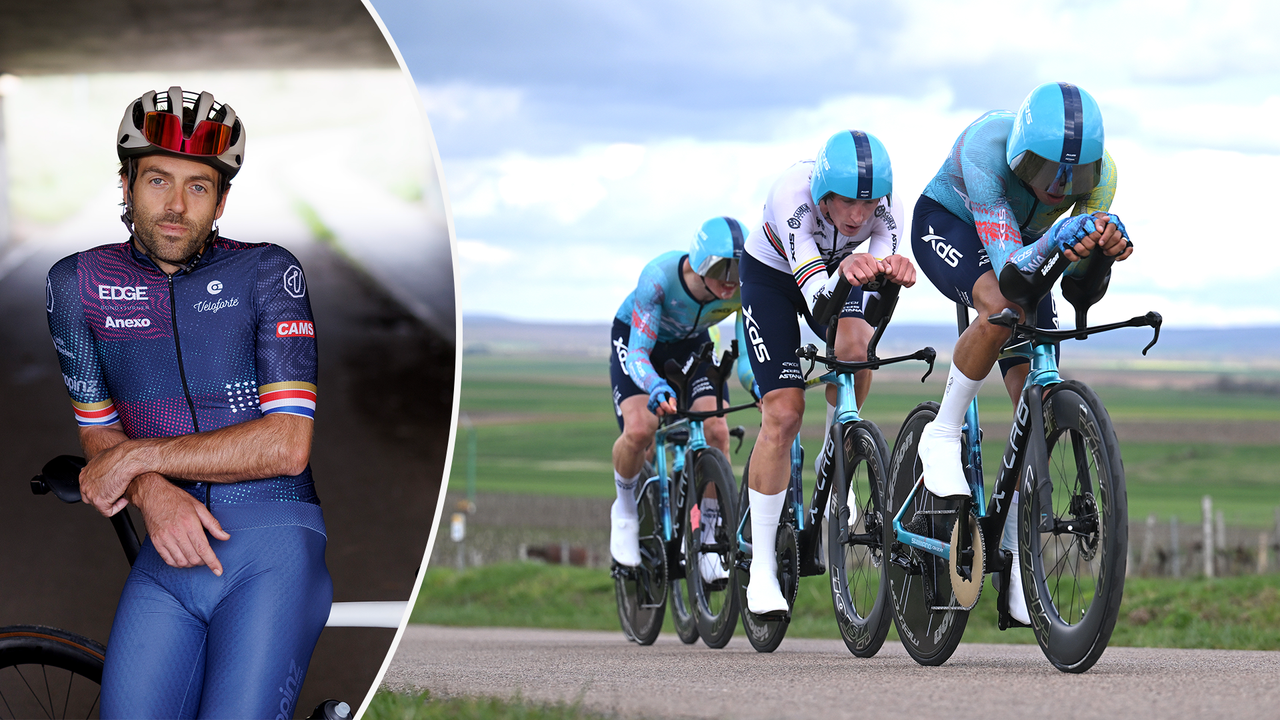
Alex Dowsett (circled) alongside XDS Astana riders during the Paris-Nice TTT.

There is an expression in fishing whereby each time the fisherman tells the story of the fish he caught, it gets bigger and bigger. The same holds for former professional athletes. Over time, the wins are greater, the stories are wilder, and the tough times are tougher. Back in my day, and all that…

The problem is, I am now in a position where that distortion matters. Whether it is working with the riders at XDS Astana or the coaching I do privately, I find myself making a conscious effort to put myself back in the athlete's mind. To ask myself what I would be thinking right now if I were being set this session, asked to go out in this weather, or told to hold this power.
Bad weather is a simple example. There is this misconception that British cyclists are happy to train in the rain. In the age of Zwift, I would not have tolerated it; I would have just got on the indoor trainer. Yet if someone from the team says to me, "You will be used to this, you are from the UK," I will casually agree, and one day I will have convinced myself it was always the case. That is the drift I am trying to avoid.

So whether it is setting a training session, asking a rider to maintain a certain pacing strategy in a time trial or deciding that they should brave the weather to get the work done, I have to put myself back in their shoes. My FTP certainly isn't what it once was, so for training sessions, I'll adjust them to my old numbers. If I base the session at 400 watts, I then figure out whether it's manageable before rolling it out to anyone else.

Ahead of a Tour de France individual time trial in 2019, I was advised that the quickest way around the course was to produce 500 watts for five minutes, twice inside a 30-minute effort. I fed back from experience and said simply, "We need to adjust this. I can do that once, but I do not believe I can repeat it, so we need to find a strategy that maximises what I have on the day."

Unfortunately, to win the TT that day, 500 watts were indeed required twice. I just didn't have that power in the locker. But the point stands. The rider in front of you knows things about themselves that no amount of data fully captures, and the best thing I could have done in that moment was to be heard.

I ultimately finished 21st on stage 13's individual time trial (Image credit: Chris Graythen/Getty Images)

I have been on the receiving end of advice from ex-pros who have forgotten what it feels like, or advisors who are experts in the field but have never truly been there. I would stand looking at them, thinking "You have no idea of the reality of what you are asking."

The difference between a good advisor and a mediocre one is the ability to listen in that moment, respect the feedback, and decide whether the conversation is there to challenge or to accept. More often than not, the response will require more questions.

As the years grow between me and my racing career, I can see how fast the peloton changes. Long-range attacks are commonplace. Racing kicks off earlier and is less predictable than before. There are aspects I can still relate to, but certain elements are now beyond my grasp.

It's in these moments that I have to trust the rider's feedback and judgement; then I try to understand it better myself and become an up-to-date expert as best I can while no longer in the peloton.

The drift is constant, and I must keep checking myself against it.

When a rider tells me they need something, I will always ask why if it isn't immediately obvious. Then I consider the feasibility or escalate if I don't know. In this role, I have told myself that I should say yes whenever possible for two reasons. The first is that the rider is probably right. The second is the confidence it instils in them when their needs are met.

If the answer is no, I need to be armed with a good explanation as to why not, and I need to have earned the right to give it. I have mentioned in these columns before how surprised I was by the sheer effort involved in simply getting a rider to a start line. Had I known that as a pro, I think I would have been less demanding and probably slightly easier to work with.

But we are all in the business of winning, and winning requires excellence, which is easy to say and difficult to do. That is intrinsically why winning is hard, and why the questions and demands should never stop coming. So, on reflection, I hope no XDS Astana riders have read this portion of my column.

The last thing I need is for them to suddenly develop some sympathy for the people trying to support them and ease off. We have races to win. Keep asking for stuff. Just don't tell them I said that.

Sign up to read this article
Read news from 100’s of titles, curated specifically for you.
Already a member? Sign in here
Related Stories
Top stories on inkl right now
Our Picks
Fourteen days free
Download the app
One app. One membership.
100+ trusted global sources.