Get all your news in one place.
100's of premium titles.
One app.
Start reading
The Times of India
The Times of India
World
TOI World Desk

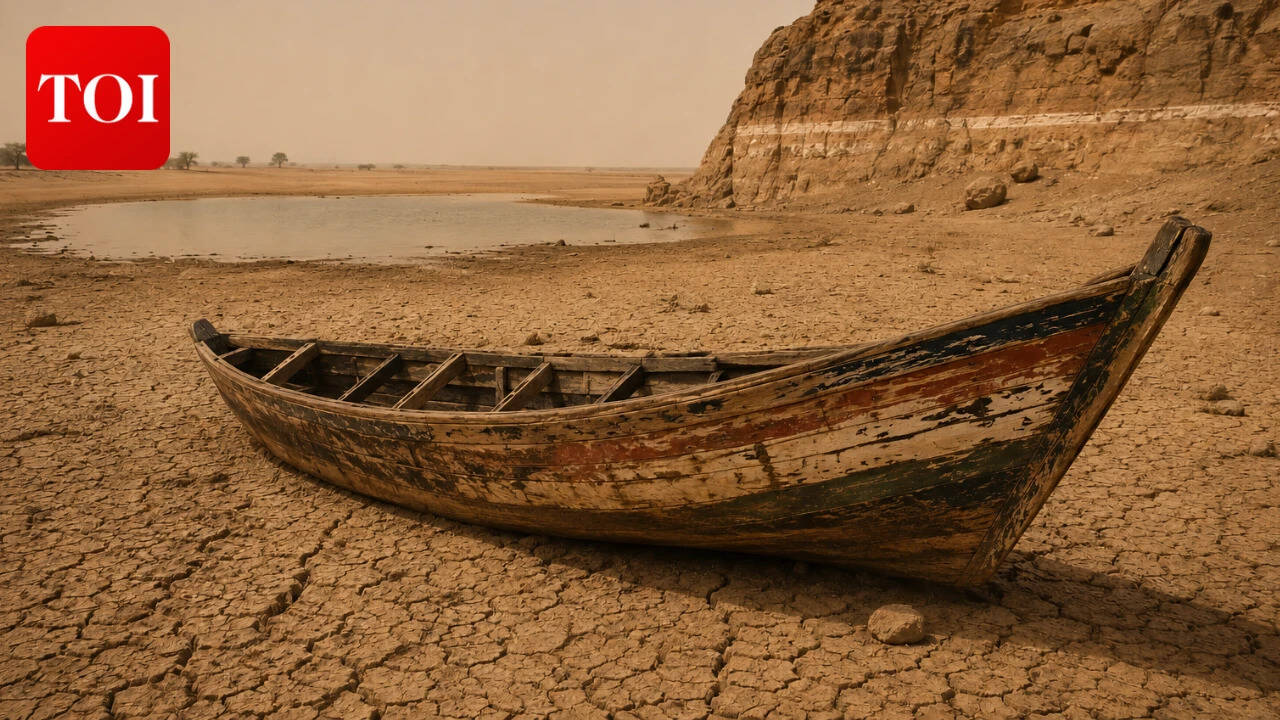
In the early 1900s, fishermen at the edge of the Sahara saw a desert lake start to die back; by 2000, Lake Chad had shrunk by 90%, and a series of NASA studies traced the cause to a deadly combination of irrigation and a drying climate

Imagine a lake so vast that it once stretched over 25,000 square kilometres, an area the size of Vermont. Now imagine that shrinking to just 1,350 square kilometres in a few decades. That’s what happened to Lake Chad in north-central Africa, and a landmark study explains why the story is more complicated and more human than most people think.

Get breaking news anytime, anywhere. Download the TOI app now!

According to this peer-reviewed study, ‘ Human and Natural Impacts on the Water Resources of the Lake Chad Basin,’ by researchers Michael T. Coe and Jonathan A. Foley of the University of Wisconsin-Madison, the lake's dramatic decline was the result of two forces working in tandem: a drier climate and a surge in irrigation. They used two computer models, IBIS and HYDRA, and 43 years of climate data to separate what was caused by nature and what was caused by humans.

From vast lake to shrinking shadow

Lake Chad is in the Sahel area of north central Africa, surrounded by Chad, Nigeria, Niger, and Cameroon. It is very shallow, less than seven meters deep, and therefore very sensitive to changes in rainfall. When the rains slow, the lake shrinks fast.

And the rains did slow. By the early 1960s, rainfall over the Chad drainage basin had dropped sharply. During the last 40 years, the discharge of the Chari/Logone river system, which contributes about 90% of the water entering Lake Chad, has declined by almost 75% from about 40 cubic kilometers per year in the early 1960s to about 10–15 cubic kilometers per year in the 1980s and 1990s. The lake had shrunk from about 25,000 square kilometers in 1963 to only 1,350 square kilometers at the time of its publication. Its shallowness meant that it responded fast to every change in the rainfall.

But climate wasn't the only culprit

Coe and Foley’s study looked at two different time periods. Climate variability was dominant between 1953 and 1979. Irrigation withdrawals were modest during this period, estimated at 2.5 km3/year from the Chari River system in the late 1960's and early 1970's. This study found that irrigation was responsible for only about 5 percent of the 30 percent decrease in lake area from the decade of 1956–1965 to the decade of 1966–1975. The climate was doing most of the damage.

Everything changed after 1980. Large-scale irrigation schemes multiplied, and by the 1990-1991 season, withdrawals had reached some 11.2 cubic kilometers per year, with some 10 cubic kilometers drawn from the Chari/Logone system and a further cubic kilometer from the Komadougou Yobé. This represented a fourfold increase compared to the 1953-1979 period. The models revealed an about 45% reduction in lake area between the 1980s and 1990s and the 1960s and 1970s. Half of the decline was due to climate, and half to human water use.

The lake's own geography made things worse

A separate peer-reviewed study adds a critical layer to this picture. According to the study ‘On the Causes of the Shrinking of Lake Chad,’ Lake Chad's unique physical shape, which allows it to split into two smaller, separate lakes under low water conditions, made it significantly more vulnerable to water loss than its size alone would suggest. Crucially, the study also found that irrigation withdrawals were a key reason the lake failed to recover even when rainfall partially returned in the 1990s. The window for natural recovery was open, but human water use kept it shut.

Together, both studies tell the same story: this was not simply a lake that dried up. It was a lake pushed to the edge by drought, and then held there by the demands of agriculture.

A feedback loop no one planned for

What makes this story particularly interesting is the feedback loop that the researchers found. In the early 1970s, communities responded to dry conditions by extending irrigation to ensure food production. But that response almost doubled the rate of water loss from the lake; human adaptation to climate stress inadvertently accelerated the very crisis people were trying to survive. The models used in the study were rigorously validated with a correlation coefficient of 0.93 between simulated and observed lake levels for 288 months of the available data.

Why this matters for Americans

It might feel distant, but the underlying dynamics are familiar. In recent years, the Colorado River, which provides water to some 40 million Americans in seven states, has been under considerable stress. The aquifers under the Great Plains are being depleted faster than they naturally recharge.

The same pattern, climate pressure compounded by agricultural overuse, is playing out closer to home. At the time of the Coe and Foley study, approximately 750,000 people lived in the immediate lake area and depended on it entirely. For a generation of Americans already dealing with intensifying summers, shrinking reservoirs, and worsening droughts, Lake Chad is not a distant cautionary tale; it could be a blueprint for what is to come if water is treated as an unlimited resource in a world that is fast proving it is not.

Sign up to read this article
Read news from 100's of titles, curated specifically for you.
Already a member? Sign in here
Related Stories
Top stories on inkl right now
One subscription that gives you access to news from hundreds of sites
Already a member? Sign in here
Our Picks
Fourteen days free
Download the app
One app. One membership.
100+ trusted global sources.