Get all your news in one place.
100's of premium titles.
One app.
Start reading
The Economic Times
The Economic Times

In the 1600s, a Native American clay pot was buried at a Spanish mission in Florida. Around 400 years later, archaeologists were stunned to find it intact

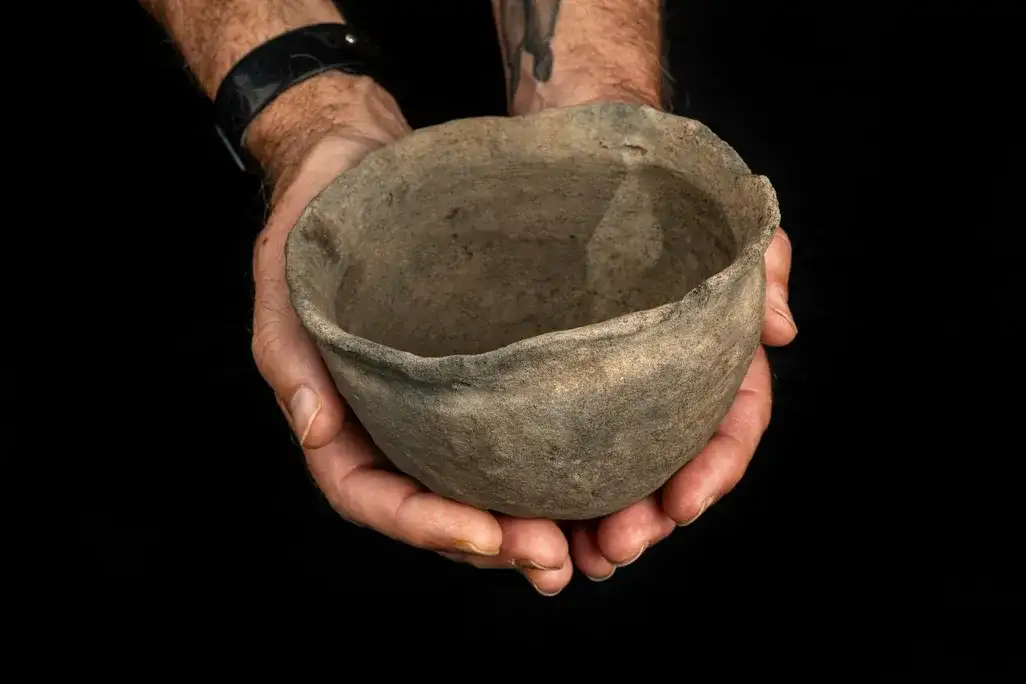
A remarkable archaeological discovery in Florida is shedding new light on Native American history and Spanish colonial life. Archaeologists have uncovered a rare, fully intact clay pot believed to have been made by a member of the Potano Indigenous community around 400 years ago.

Unlike most pottery fragments found during excavations, this vessel survived centuries beneath the ground without breaking, making it one of the most unusual discoveries at the historic site.

The discovery has excited researchers, who say intact pottery from this period is exceptionally rare.

ALSO READ: In 1902, Willis Carrier invented modern air conditioning after Florida doctor John Gorrie's decades-old cooling idea paved the way

A rare archaeological find in Florida

The bowl-shaped clay vessel was unearthed earlier this year during a University of Florida archaeology field course at the historic Mission San Francisco de Potano site in northwest Gainesville.

The pot features a smooth gray surface and a simple rim that gently flares outward. Even after spending hundreds of years buried beneath layers of soil and shifting sediment, it remained almost perfectly preserved.

Researchers say discoveries like this are uncommon because ancient pottery is usually found shattered into multiple pieces.

ALSO READ: Sam Altman says ‘we are now in the singularity’, OpenAI CEO reveals why he believes humanity has entered an AI era once thought possible only in science fiction

"It’s very unique," Gifford Waters, historical archaeology collections manager at the Florida Museum of Natural History, said in a statement.

"Typically, we find things that were broken and discarded."

ALSO READ: Sam Altman, Satya Nadella, Sundar Pichai, Elon Musk and Jensen Huang unite behind one AI vision

Students made the unexpected discovery

The excavation was carried out by University of Florida students learning archaeological excavation techniques under the guidance of Gifford Waters and Charles Cobb, curator of historical archaeology at the Florida Museum of Natural History.

While excavating the centuries-old site, the students uncovered what initially appeared to be another pottery fragment. As the soil was carefully removed, however, they realized the entire vessel was still intact.

For aspiring archaeologists, discoveries of this kind are exceptionally rare, especially during training excavations.

Who were the Potano people?

The pot is believed to have been crafted by the Potano people, an Indigenous subgroup of the larger Timucua culture that once occupied much of northern Florida.

Beginning in 1585, the area served as a major Potano village before Spanish colonists expanded into the region.

In 1606, Spanish authorities established Mission San Francisco de Potano, a Catholic mission intended to convert the local Indigenous population to Christianity.

The settlement became known as a doctrina, a larger mission where a resident friar lived among the community. Smaller nearby missions, known as visitas, were periodically served by priests from these larger mission centers.

Spanish missionaries often established doctrinas in large Indigenous villages because converting tribal leaders was viewed as an effective way to spread Christianity throughout the community.

Life at the Spanish mission was far from easy

Historical records suggest that life at Mission San Francisco de Potano was challenging for both Indigenous residents and Spanish missionaries.

"In this type of community, for the friar, 'it was a very difficult life,'" historian Michael Gannon told the Gainesville Sun in 2006.

The mission was one of more than 100 Spanish missions connected by El Camino Real, or "the royal road," an important transportation route linking St. Augustine with settlements across colonial Florida.

The mission briefly closed after the Timucua people rebelled against Spanish rule in 1656. Spanish forces later regained control and reopened the settlement before it was ultimately destroyed by English raiders in 1706.

A historic site filled with thousands of artifacts

Although the mission disappeared from public memory for centuries, artifacts began resurfacing in the 1950s. Modern archaeological excavations have been ongoing since 2006.

Researchers have now recovered more than 7,000 artifacts from the site.

Among the discoveries are:

  • Indigenous pottery fragments
  • Glass beads
  • Religious pendants
  • Bells
  • Stone tools
  • Nails
  • Bones from turtles, freshwater fish, turkey and other animals

Many of the animal remains were found together, leading archaeologists to believe the area once served as a cooking space or refuse pit.

Earlier excavations also uncovered massive wooden posts and clay footings believed to have supported either the mission church, school or the friar's residence.

"It’s one of the very few sites that I’ve ever worked on that there aren’t any modern disturbances," Waters told the Gainesville Sun in 2006.

"Out here, as far as we can tell, there’s been nothing."

Why was the ancient clay pot buried?

One of the biggest mysteries surrounding the discovery is why the perfectly usable vessel ended up buried. The pot was recovered inside a Spanish-built structure whose exact purpose remains unknown.

Because archaeologists found gun components nearby, they suspect the building may have served as military barracks for Spanish soldiers stationed there in the early 1700s.

Researchers also noted that the vessel lacks heavy charcoal residue, suggesting it was probably not used directly over an open fire.

Instead, faint scorch marks may indicate it was occasionally placed near a fire to warm food, though those marks may also have formed during the original firing process when the clay was hardened.

The vessel's design is also unlike other pottery styles previously recovered from the site, making it especially valuable for future research.

The unanswered question continues to puzzle archaeologists

Despite the remarkable preservation of the vessel, archaeologists still cannot explain why someone intentionally placed it into a pit centuries ago.

The discovery has raised fresh questions about daily life at the mission and the interactions between Indigenous communities and Spanish colonists during one of Florida's most transformative historical periods.

"You don’t leave things behind that you can still use, so why was this purposefully put into a pit?" Waters says in the statement.

As excavations continue, researchers hope future discoveries will help solve that mystery while revealing even more about the people who once lived at Mission San Francisco de Potano.

Sign up to read this article
Read news from 100's of titles, curated specifically for you.
Already a member? Sign in here
Related Stories
Top stories on inkl right now
One subscription that gives you access to news from hundreds of sites
Already a member? Sign in here
Our Picks
Fourteen days free
Download the app
One app. One membership.
100+ trusted global sources.