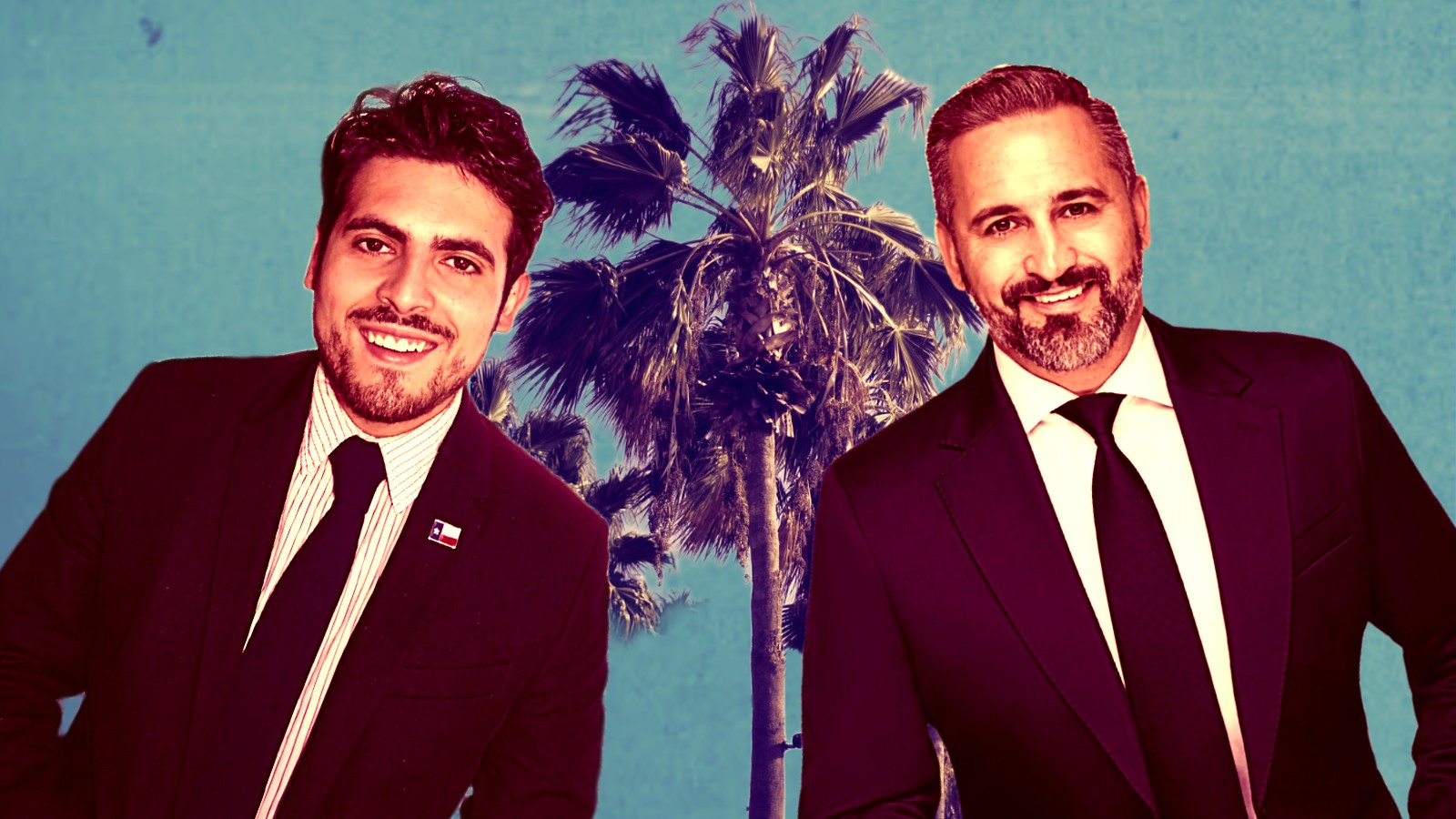
A close and contentious Democratic runoff is coming to a head this week in South Texas, pitting young progressive Julio Salinas, a former legislative staffer who hails from Mission, against moderate Victor “Seby” Haddad, a local banker and McAllen city commissioner.
The MAGA wave that washed through the Rio Grande Valley in 2024 has both candidates vying to recapture public trust, fight President Donald Trump’s agenda, and maintain the historically blue Texas House District 41. The 13-year incumbent state Representative Bobby Guerra—a prototypical moderate Valley Democrat—is stepping down, and has given his endorsement to Haddad. In the March primary, progressive voters split between Salinas and Eric Holguín, the Texas director of the Latino civil rights group UnidosUS. Salinas not only ousted Holguín from the race but earned the most votes overall, jolting the political system and putting him just above Haddad.
“The fact that he sort of emerged as the front-runner was genuinely surprising, given the sort of disparity in funding and disparity in endorsements,” said Álvaro Corral, a political science professor at the University of Texas Rio Grande Valley.
House District 41 sits in the heart of Hidalgo County and encompasses parts of McAllen, Mission, Edinburg, and Pharr; Trump won the border district, which is predominantly Hispanic, by 1.6 percent in 2024. Though conservative prosecutor Sergio Sanchez and MAGA candidate Gary Groves are also battling for the Republican nomination in a runoff, GOP voter turnout in this historically blue stronghold was notably half that of Democrats in the primary.
Given Trump’s aggressive immigration crackdowns and failure to address inflation, Corral believes it’s a good year to run as a progressive Democrat.
Salinas’ colorful campaign and strong social media presence are reminiscent of Zohran Mamdani’s insurgent mayoral run—or more close to home, Michelle Vallejo’s prior congressional runs. His platform focuses on improving public transportation, expanding Medicaid, and establishing paid family leave. His plan to strengthen public schools includes rolling back the state’s newly enacted private school vouchers and raising teacher salaries by $15,000.
Salinas, who is 26 years old, has embraced the identity of a young anti-establishment candidate going up against corruption and the “political machine,” vowing to fight against the oligarchs on behalf of working families. His largest campaign contribution, totaling $50,000, comes from the Leaders We Deserve PAC. Founded by gun control activist David Hogg, the PAC supports young progressives and seeks to primary Democrats who are “unwilling or unable to meet the moment.” In past elections, the PAC has spent big in Texas boosting other progressive candidates, including now-Houston state Senator Molly Cook.
On May 15, Salinas even received the endorsement of Senator Bernie Sanders, one of his biggest political inspirations. Sanders won Hidalgo County and much of South Texas in the 2020 Democratic presidential primary. “I’ve been knocking on doors since I was 15 years old for Bernie Sanders’ campaign,” Salinas said. “I’m proud to say we’ve gone full circle.” Other prominent endorsements include Austin Congressman Greg Casar, the Texas House Democratic Caucus Vice-Chair Mihaela Plesa, and a handful of other Democratic state representatives around the state.
Haddad, on the other hand, is Vice President and Chief Lending Officer at Lone Star National Bank, the largest bank based in the region. He has the backing of most of the Rio Grande Valley’s Democratic contingent in the Texas House, including state Representatives Terry Canales, Sergio Muñoz, Oscar Longoria, and Armando Martinez.
Haddad’s platform focuses on property tax relief, strengthening small businesses, and protecting public schools. In 2019, Haddad was elected to the McAllen City Commission, where he enacted term limits, lowered the property tax rate, and worked on initiatives to develop the community.
On Saturday morning, families and older folks packed every table within the colorful walls of the 107 Cafe in Edinburg. More people crowded around the door for free breakfast and coffee at the campaign event with prominent local leaders, including the current and former Edinburg mayors and Hidalgo County district attorneys.
Still, Haddad’s background has become fodder for his opponent. Throughout the race, Salinas has characterized Haddad as a wealthy banker corrupted by corporate influence and detached from the issues of the working class.
Several directors of the Lone Star National Bank have contributed to Haddad’s campaign. The bank’s founder Alonzo Cantu is considered to be the most powerful man in South Texas. Cantu is a founding board member of DHR Health, a large hospital system that operates in the Valley. Haddad’s father is a surgeon who also sits on the DHR Health management board.
The hospital’s political arm Border Health PAC has contributed $15,000 to Haddad’s campaign. The PAC’s contributors include directors of the Lone Star National Bank and Haddad’s father.
Haddad dismisses the suggestion that he is bought off or out of touch. Sitting in a McAllen coffee shop on Main Street, Haddad told the Observer that he’s not a millionaire and has never been influenced by power and money. He argued that the bank was an emblem of achievement for the Latino community, founded by the son of immigrants to offer services to disenfranchised people. “Local groups supported me because they want what’s best for the region,” Haddad said plainly.
Yet at the same time, he said it’s critical for business professionals like himself to have sway in the local community. “The bank would always say ‘Get involved in the community, get on boards, try to get into a decision-making capacity,’” Haddad said. “It’s part of growing professionally.”
Haddad’s voting history has been another source of scrutiny. He voted in Republican primaries for a decade, until flipping to vote in the Democratic primary for the first time in 2024. Haddad said that he’s always considered himself a moderate and has always been anti-Trump. He claims he supported both Barack Obama and Joe Biden for president, despite voting for Republicans farther down the ballot.
“As we saw any semblance of decency from the Republican Party sort of fade away … I can no longer even vote on that side whatsoever,” Haddad said.
During debates and forums, Salinas and Holguín questioned Haddad’s loyalty and values, accusing him of using the Democratic Party as a ploy for power. Holguín even suggested that Haddad received local endorsements through back-door agreements.
“I’m here to represent you,” Holguín told voters in a forum hosted by Raise Your Hand Texas, “not the powerful interests, or the corporations, or the banks.”
After coming third in the March primary, Holguín shocked many of his supporters by turning around and endorsing Haddad. He argued that House District 41 needs a candidate who can build a coalition of Republicans, Democrats, and independents to truly combat Trump’s agenda. His endorsement has shaken up people’s expectations for the runoff, making it unclear whether Holguín’s former supporters will give a competitive edge to Haddad or Salinas.
“Seby [Haddad] is genuinely decent, open to hard conversations, and doesn’t run from criticism,” Holguín wrote in the Rio Grande Guardian. “Seby isn’t just running to win a Primary. He’s making the case for November.”
The most concrete benefit for Haddad could be his access to campaign funding and local support from the political establishment, said Corral, especially in a race that Texas Republicans may target to flip in the general election.
Driving up 10th Street, which bisects the district, large signs greet you with Haddad’s smile on nearly every block.
“It’s undeniable that he would by far be the better-situated candidate financially to withstand the potential amount of money that would be spent on the Republican side to flip this seat,” Corral said.
As of the most recent reports through May 18, Haddad has raised about $285,000 and has $73,000 cash on hand remaining compared with Salinas at around $210,000 raised and $20,000 cash on hand.
In Holguín’s endorsement, he also mentioned that “ideology without strategy doesn’t move the needle for real people,” a subtle dig at Salinas’ unabashedly progressive campaign. Throughout the race, Holguín and Haddad have argued that Salinas lacks work experience or exaggerates his prior experience in the state Legislature, where he touts his position as an aide for state Representatives Lulu Flores and Christina Morales. One of Haddad’s mailers describes Salinas as “currently unemployed,” and claims he used his parents’ address to run for office.
Salinas said that was deliberately misleading. “I live with my parents, and I’m proud to live with my parents,” Salinas told the Observer. “The economy of today is not allowing people like me to buy homes.”
After graduating from the University of Texas at Austin in winter 2022, he became a legislative aide and communications director for Flores, an Austin Democrat. He also worked at the Ponce Law Firm in Austin, which he says has helped get immigrants released from inhumane Immigration and Customs Enforcement detention facilities.
He went on to become the legislative director for Houston state Representative Christina Morales, where he says he handled a portfolio of bills related to raising the minimum wage, addressing food deserts, adding ethnic studies to school curriculum, and increasing the homestead tax exemption. His tenure with Morales ended in January, when he began full-time campaigning for the 41st.
At a blockwalking event in Archer Park, a small square in the heart of old McAllen, Salinas greeted volunteers with his whole family in tow. Locals and members of the Texas State Employees Union gathered to talk about the race and get out the vote for Salinas. Born and raised in the area, Salinas seemed to already know many young voters we encountered.
A fresh high school graduate in light blue regalia excitedly posed for grad photos in the park with Salinas. She was eager to cast her first ever vote for him and took home a campaign sign. It’s those young voters, he says, who are eager for a progressive fighter like him—not the traditional sort of business-friendly moderate who’s long dominated the Democratic politics scene in this region.
“I reject the idea that you need to compromise your values, and you need to elect a DINO in order to win a competitive district,” said Salinas. “Especially in a time and a place where our organizational efforts have been one of the best in the entire battle.”