Get all your news in one place.
100’s of premium titles.
One app.
Start reading
Cycling News
Cycling News
Sport
Alasdair Fotheringham

'In some ways, as a young pro, I was in a way better place 10 years ago' – Slovenian stars Matej Mohorič and Jakob Omrzel interview each other

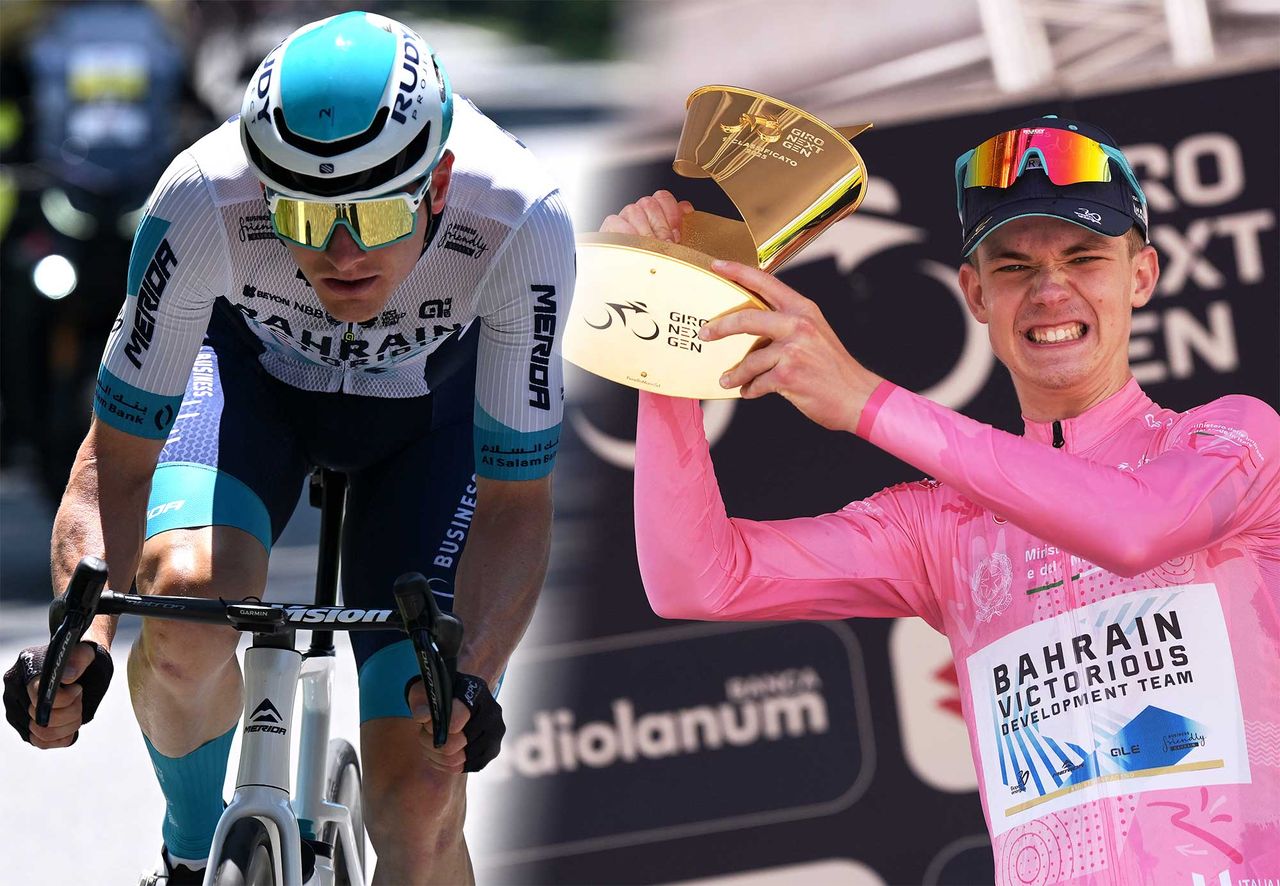
A split image of Matej Mohoric and Jakob Omrzel.

There were plenty of reasons why Cyclingnews opted to sit Matej Mohorič and Jakob Omrzel down one sunny December afternoon at their Bahrain Victorious training camp and try to get them to interview each other.

For one thing, it's been over a decade since Mohorič, then tipped as one of the brightest upcoming stars in the cycling universe after he'd taken Junior and U23 World Championships titles in two successive years, turned pro at 19.
As chance would have it, that's exactly the same age that his compatriot Omrzel has followed suit with Bahrain this January, and with similarly high expectations, too, following his wins in the Giro NextGen and the Slovenian National Championships, not to mention Paris-Roubaix Juniors earlier on. Despite a major, very dangerous, crash in September 2024, he subsequently had a successful spell as a stagiaire with the senior team – coinciding in some races with Mohorič – last year. Furthermore, they both started right out at the top, in WorldTour squads.

Since 2014, Mohorič's versatility has proved to be one of his strongest points, ranging from his devastating downhill Poggio ride to victory in Milan-San Remo to stunning breakaway stage win solos in the Tour de France and beating João Almeida by the narrowest of margins in the Tour de Pologne. Not to mention victories and podium finishes in the Gravel World Championships and in stages of all three Grand Tours.

Within that time, though, the sport itself has seen some massive changes. In this long, in-depth discussion during the Bahrain Victorious training camp, Mohorič and Omrzel discuss everything from the pressures of being a young star and how Mohorič handled the darker side of the sport when he turned pro, to the current situation of Slovenian racing.

That last topic is hardly a small one, given that in recent years, as is well-known, Slovenian cycling has taken a massive step forward. While Mohorič's contribution to that process can't be underrated, it pales somewhat in comparison with what Primož Roglič and, above all, Tadej Pogačar have achieved.

Matej Mohorič and Jakob Omrzel in the December 2025 training camp (Image credit: BV/AF)

Cyclingnews (CN): Question to both of you: when was the first time you heard about each other, and what was the first thing you heard about Jakob, and what was the first thing you heard about Matej?

Matej Mohorič (MM): Jakob, you go first, you're the youngest.

Jakob Omrzel (JO): I don't know, a young age for sure because he's Matej Mohorič, and he's what, 10 years older than me?

MM: Yeah, I'm 94. [laughs]. So you are [were born in] what, 2006?

JO: So yeah, 12 years difference. So for sure I heard of him at a young age, when I started cycling basically, and of course it's inspiring, and it's amazing to have this kind of talent in the same country, even if it's like small as Slovenia.

I remember him winning Milan-San Remo for sure, and then I remember the crash, but I don't remember in which race….

MM: The Giro [2021, stage 9, on the descent from the Passo Gori, falling and spinning over the bars at high speed, and hitting his head, before abandoning. His bike was destroyed - Ed.]

JO: And the Tour de France, of course, the stages. Basically, all his rides – I was impressed.

MM: I first heard about Jakob - ok, I'm biased because the bus driver from our team is his brother. So [grins] we are all one big happy family.

But I followed Jakob from basically when he started cycling, and then he really caught our attention, as in not just being a talent that's good enough to eventually become part of our family, but also bigger than that, no?

I knew him when he reached the Juniors, because through my Foundation, I also supported the Junior national team at the time. I'm good friends with the national coach; we are the same age, and we have raced together since we were little kids. And that was when I really realised that Jakob has the talent to become maybe not just a professional rider, but also a professional rider that can aim to win races and yeah, we're very happy to have him on board.

Then the first time I've raced with Jakob was last year in May in French races when he was part of our development team. I wasn't going so well at that time of the year, and Jakob was in very good shape. And I had a nice day on the bike, because I can see a young myself in him, really, and it was a pretty special experience, to be honest.

(Image credit: Getty Images)

Racing in France

MM: It was a typical French race with pin-pam-pom attacks going on, most of them without reason, just because there was a small, short climb on the road. And we had a team strategy and so on, and of course, with him being the most climber-oriented in the lineup, we were happy for him to go up the road in a small group, and he had to follow the moves.

But he started quite early, and then after a while of actually putting in quite a few efforts, he came to me, and he asked me if I needed him to do anything in particular, or what should we do, what the strategy was, because I was also being a road captain at the race.

And I was thinking that he had to be pretty tired at that point, at least I would have been if I did the same that he did. So I said, if he could, he could follow the moves on this next climb that was coming up.

Then I also ended the sentence by encouraging him to push through even if he was really feeling on his hands and knees. I was trying to say that everyone was feeling the pain by this time in the race.

And he looked at me as if I was talking really strangely, you know, like 'How? How [is it possible] they're already hurting?'

I was like – 'OK, good for you! I was probably hurting more than him, and I didn't do shit, I just yo-yoed the whole way. I started each climb in the front and ended up at the tail of the peloton, and then got back on in the technical section.

CN: Jakob, do you remember that day?

JO: Yeah, for sure, I think it was my first time that I went with all the [senior] teams, so for sure I remember it. For a guy like me, the young guy, of course, it's just like the hype. For sure, you are racing a bit different, but I was enjoying these kinds of races because I'm not specialised in this, but still, I know I'm good, so I can do some damage. Probably not to win at the end because I'm not quick enough, but for sure I can do a lot of things.

CN: So if I asked you for one thing you'd like to take from Matej's skill-set as a racer, what would it be?

JO: For sure, the brain. Just like the way of racing, yeah, I mean the strategy, just the smart moves, so you don't spend a lot of energy in the race, and then when you need to spend the energy when it counts. I need time, I need to learn, listen to others, so for sure I'm in my first year as a pro, but for sure I can gain a lot, and yeah, the progress will be there.

Having a year with the team before turning pro [as a stagiaire], I learned much more than I knew before. So the next step is just to be calm and think straight in the race, also to improve in training and just in the way of living. To become basically a pro cyclist, to do things that I should and not do the things that I shouldn't do - so yeah, just this.

Tadej Pogačar (r) and Mohorič during the 2025 Road World Championships (Image credit: Getty Images)

Life with Tadej (and Primož)

CN: Since a certain Tadej Pogačar has come into the scene, I'm guessing cycling in Slovenia has changed quite a bit, to say the least. Is there a different atmosphere now when you're back in Slovenia? I would imagine there's got to be.

MM: This is a good question for me, actually, because I saw the transition from cycling being one of the popular sports in Slovenia when I first started - people knew about it, but not many. There was a fan base, but it was not very broad. There were some passionate people, but it was a small community.

Actually, it was ​​Primož [Roglič] who started it all. He started to score really big results and I think the climax was in 2020 during COVID, when the coincidence was that everyone also had more time to watch television. And it was the moment when Tadej [Pogačar] started to become close enough to his full potential to score the biggest victories and then it was that Tour de France where they battled it out that really brought the attention of the public in Slovenia, I would say, and it stayed really high since.

I think most people didn't like Tadej at first because he stole the Tour de France from Primož in their opinion. But they have slowly and steadily started to enjoy his dominance in the sport, I think, and give him the praise that he deserves.

So yeah, it's been quite interesting. The fan base now is much broader, many more people watching the sport and following it closely and at the Tour de France on some of the mountains, you don't know if you're in France or in Slovenia.

CN: And for you, Jakob, who were your first heroes in cycling, Primož, Tadej or Matej? Or maybe all of them if you want to be diplomatic?

JO: For sure, all of them, they are an inspiration for us, so when I look at each of them, it's just incredible. It's always, yeah, I want to be like him. It's inspiring for sure, and I don't think it's pressure.

Everyone says now – but you're from Slovenia, for sure it's pressure. But I don't think so because I think this is just like – I can do it. They're the same from Slovenia and we are all made of blood and bones, so basically we can do it if we try our best and for now it's working out.

CN: But the fact that you did so well so young as well, you know, the Giro NextGen and so on, that doesn't make people say – ok, so now you're going to win the Tour de France?

JO: Yeah, especially in this area now because of Tadej Pogačar, because he's making everything look so easy. He wins the Tour de France and he's just like, like he would go for a walk. Yeah, for sure, I mean some people are not realistic, but at the end I don't care.

(Image credit: Getty Images)

An easier transition?

CN: So Matej, what goals would you recommend for Jakob in his first full year as a professional in a big team, because you came in pretty strong and at the same age when you started?

MM: Jakob finds a very different scenario compared to when I was his age and at that time in my career.

CN: Because of the Pogačar factor and Roglič?

MM: Because of all this and also because he came to our team, and to be fair, probably on most other teams he would also have an easier transition than I had to experience.

Not that I'm complaining, I still appreciate that I started in one of the best teams at the time. But it was just that when I came to the professional sport, cycling was sort of transitioning away from its dark past and the scientific approach was not so developed. We were still very much affected [by what had happened before].

There were no nutritionists, and the coaches and the doctors were still very influenced by the past. They were just trying to start from scratch and the [previous] culture was still very strong. I didn't enjoy it as much. Already back then, I was quite curious.

I read a lot of scientific books about training, about nutrition. And they were actually, more often than not, very close to what we know today, not so far off, but in complete contrast to what I was told by my coaches or doctors or colleagues, older colleagues.

I was, I wouldn't say bullied by older teammates for being into nutrition and trying to care about what I put in my mouth, training, doing certain things a certain way, being professional as it is now.

I wouldn't say I was ahead of my time, but I would have been really happy to come to an environment that Jakob is experiencing this very moment. But it was just not possible and it was not part of the culture and I had to step down.

I don't know, it was just that the nutrition was completely off. The training was even more off. A disaster, basically, you know, there was just storytelling – what works, what doesn't work – and it was all upside down.

Now it's very measured and everyone knows what the right recipe is, and it's only about that. It's just about actually doing the hard work and getting it done, no? Which is the hard and the tricky part, and when I was young, I was more than ready and eager and happy to do that. But I was – almost – not allowed.

Now it's the opposite, now the new generation of Jakob, I can even see in our team, but also in general. They have everything on their plate; they just need to do it. Yet some of them are still more interested in scrolling on their phones than switching them off and going to bed at night.

It's two completely different worlds, and I think Jakob is doing, from what I see, a great job of how one can enjoy this lifestyle because let's be honest, it's quite particular and not the easiest.

But if you really like that, even if you weren't a professional cyclist, if you were a working person or an engineer or whatever, he would still probably go out and exercise because he likes to go on the bike, no? Maybe some people in his generation are struggling because they would like to have an easy life, no, and this is not an easy life.

You still need to get up every morning and maybe go out and do a ride in not perfect weather every day with maybe some sore legs and if you love it, you love it, but if you think this is a sacrifice, then that's what many people of his age think, too.

So now the focus is elsewhere. It's completely different, I think.

JO: I agree with Matej 100% because I can also see that some of the guys of my age – I don't think that they are enjoying cycling as a sport, as it is, like just the bike. I don't think that they're always eager to go on the bike and just sometimes look at nature and enjoy it.

Like, yeah, of course, they like the sport, or they're just good at it, and they want to improve, and for them this is a happy place. But for me, especially after last year's crash [in the Giro dell Lunigiana - Ed.], I don't know, I just started to go on the bike at that time, I just needed to go on my bike and not push.

I couldn't push because of the medical reasons. But at that time, I gave myself another perspective of this sport. I basically started to enjoy going on my bike, I was just wanting to enjoy the life I have, and yeah, for me, this is for sure a game-changer.

So, for sure, it helps if you are enjoying it. Yes, some days are hard and some days you maybe you don't want to go on the bike if it's bad weather outside. But in the end, every time this is for me, I'm happy that I'm doing this and I would still love to do this in the future. So it's making it easier.

Matej Mohorič and Jakob Omrzel (Image credit: AF/BV)

Better 10 years ago?

CN: But you can see where Matej is coming from, in terms of how there are different challenges now for you guys?

JO: Yeah, yeah, for sure. I mean, it's different, like he said, they didn't know what was right and what was wrong. For us, now, everything is almost at a top level. Every year, something is different, something is new.

But yeah, now we have all these things for sure, you need to be careful and not let anything get too much into your head, because at the end, you still want to listen to yourself.

And that's maybe what I'm battling the most because with all this information, you forget to listen to yourself and maybe at the end I want to push this a bit away and just like be myself, do what I know best and just like – listen, listen, listen. So we'll see.

MM: What Jakob is saying is very true, but there was one more important difference compared to when I was his age and now. When I was starting, and even later, even the year after and the year after again and up to the age of 25, a huge difference was that there were no expectations from young riders. Everything was a bonus.

I was praised for just finishing a Monument. And now, even in this team, everyone expects that Jakob or someone else will deliver in their first year and if they feel this pressure themselves, I can imagine it can be difficult because I don't think that a man is mature at that age.

If I just see myself [now], Idon't even see myself as being mature and fully adult. I still think my mind develops every year, not just my body, not just my muscles, not just my power values or whatever you want to look at

I think also as a man. I have two kids, one aged 4 and one aged 6 years old, and I still see a difference in my way of thinking, in how I see myself, how I see my mind working.

And I think it's not fair for these young riders, who are maybe only just not kids anymore, to be under such pressure. OK, maybe Jakob in particular, because of what happened to him in the past, he doesn't necessarily care about that pressure too much, I don't think. But it could, I think, be really, really harmful for kids in general to be under that weight of expectations, especially for the biggest talents.

Because teams can actively measure that from such a young age, and it's quite clear that some of them are like really strong even compared to us who are seasoned professionals who did this job and lifestyle for 10 years.

I know exactly what to expect in each and every sector of Paris-Roubaix next year. There are no surprises, there's no… if there's pressure on me, I know exactly that I can take that pressure and where my limits are and what I can expect from myself and what's bullshit, no?

For him, it's all new and OK if you are the kind of person who is just focused on your own progress and your own values in life and what you deem important or not, this doesn't matter. But if you are someone who, I don't know, can have a bad night of sleep before a big race because they feel the pressure of expectations, this can be deadly, I think, and it's probable.

And from this point of view, I was in a way better place 10 years ago than young guys are now coming up the ranks, because I think everyone is searching for the next Pogačar who will win the Tour de France at 23 years old.

Back in my day, everybody would say – 'Ah, by the time you're 26, you can maybe perform in a one-day WorldTour race. Then by the time you are 30, you can start going to Grand Tours, and when you are 35, you can think about winning a Grand Tour.' It was like this.

JO: Like Matej says, for sure it's a bigger pressure, but it also depends on what kind of person you are. For sure, I see the pressure, but at the end, also last year, I was not expecting to be that good. I didn't know. I just went, specially. After my first year after the crash, it was just like, OK, we are here and for sure I have the talent to do it, but it will come.

Everything is for a reason, so even now, for myself, I don't expect anything, or at least I'm setting realistic goals that I know that I can achieve because last year I was close to them, and this year I think I can get even closer. But I think it's just like this progress, step by step, not jumping the steps.

I mean, it can happen, but if it will happen, it's just a natural process, so sometimes you feel the pressure and everything. But I think you have two sides of pressure, negative and positive. So if it's this positive pressure to push you and to set new limits and to successfully set the limits, I think it's good.

The joint interview is published in full and with only minor edits for clarity or conciseness.

(Image credit: Getty Images)
Sign up to read this article
Read news from 100’s of titles, curated specifically for you.
Already a member? Sign in here
Related Stories
Top stories on inkl right now
Our Picks
Fourteen days free
Download the app
One app. One membership.
100+ trusted global sources.