Get all your news in one place.
100’s of premium titles.
One app.
Start reading
The Times of India
The Times of India
National
Vinod Kumar | TNN

In its second year, pandemic left a broad trail of devastation, region lived the pain

CHANDIGARH: If the first year of the pandemic was harsh, the subsequent year was worse with the devastation inflicted by the two waves of Covid-19 fuelled by different variants, putting people in a state of despair and the figures say it all.

In Punjab, where the first confirmed case of Covid-19 was reported in March 2020, the caseload jumped by over 214% and deaths by over 108% in the past year in comparison to the first 365 days. A total of 12,365 deaths and 5,91,569 cases were noted in 2021, against 5,927 deaths and 1,88,391 infections in the preceding year.

After the first wave of infection died out by the end of December 2020, the Covid curve remained low till the last week of January 2021, giving an impression that the pandemic would end soon. With government and people letting their guards down, the curve started to creep upwards and the state marked the beginning of the second wave in mid-February that wreaked havoc for the next couple of months. As many as 4,20,201 people had contracted the coronavirus infection and 10,409 died by the time the peak subsided in the first week of July. The wave was first fuelled by the Alpha and then Delta variant of the virus.

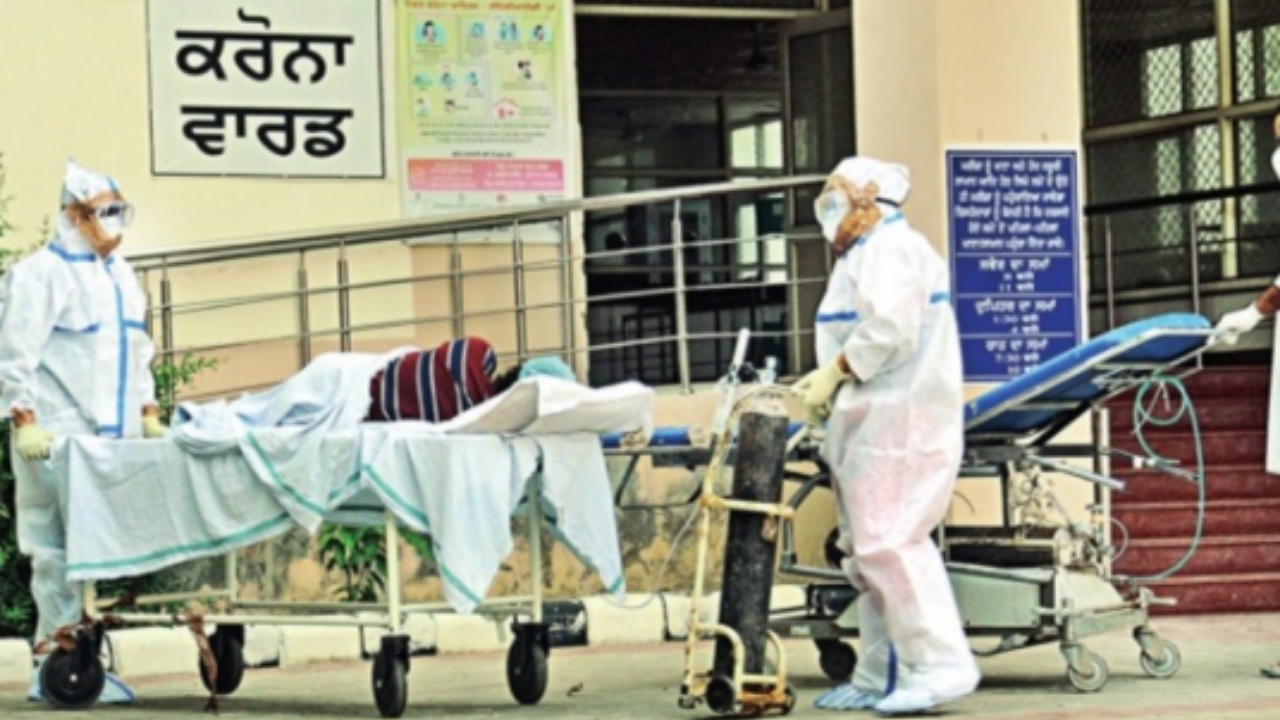
During the peak of the deadly second wave, the state broke records in hospital overcrowding, catching the state government totally unprepared which resulted in the shortage of oxygen, medicines, beds, and other infrastructure. The record-breaking number of hospitalisations pushed the daily demand for medical oxygen to 350 MT, resulting in an acute shortage that led to the deaths of four patients in a private hospital in Amritsar.

Medicines like remdesivir and immunoglobulins, which were used to treat critically ill patients, ran out of stock in health facilities, forcing the families of patients to frantically search for these medicines and many of them had to purchase them from the black market at exorbitant rates.

The use of steroids for saving the lives of infected patients, especially those who needed oxygen support, led to other serious illnesses such as Mucormycosis and post-Covid complications. About 700 Covid patients were infected by Mucormycosis, of which 51 died. Punjab also faced a shortage of amphotericin injections required to treat Mucormycosis. For effective treatment, a patient required around 60 injections over a period of one month.

As Punjab was recovering from the second wave, it was hit by the third wave of infection caused by the Omicron variant in the first week of January 2022. Though the Omicron variant spread more rapidly it is the less virulent and fatal version of Covid than the Delta and the data also points at the same.

Punjab noted a rapid rise in cases since the beginning of the current year, but the proportion of infected persons requiring care at healthcare facilities was far less than the count of patients admitted in hospitals during the devastating second wave last year. A total of 1,38,722 cases, at a daily average of 4,475, surfaced in January and was the second-highest monthly count since 1,96,634 at the peak of the second wave in May last year. January’s 608 Covid deaths account for 0. 43% of the pandemic cases reported that month, while in May 5,528 (2. 81%) infected people had died.

SENIOR CITIZENS BORE THE BRUNT

Though the lesser number of people died during the third wave, there has been a substantial rise in the percentage of Covid-19 deaths among elderly aged 70 years and above. Infections across all the age groups in the second and third waves remained almost the same with small changes.

The age comparison of Covid-19 deaths showed the percentage of deaths in the age group of 70 years and above went up from 23. 1% in the second wave to 37. 3%, whereas the percentage dropped from 28. 8% in the second wave to 24. 4% in the 61-70 years age group. Similarly, in the 51-60 years age bracket, the percentage slipped from 24. 2% to 17. 9% and 14. 7% to 9. 3% in the age group of 41-50 years. The death rate slightly went up from 2. 2% to 4. 4% in the age category of 21-30 years and 0. 2% to 1% in the 11-20 years age group.

In terms of cases, a rise from 20% to 26. 5% was noted in the 21-30 years age group and 21. 9% to 24. 5% in the 31-40 years age group. A slight drop has been recorded in the 41-50 years age category in which the proposition of cases slipped from 17. 3% to 15. 4%, 14. 7% to 12. 3% in 51-60 years, 10. 3% to 7. 1% in 61-70 years and 5. 6% to 4. 3% in above 70 years category.

HIGH DEATH RATE

Two years into the Covid-19 pandemic, Punjab is still holding on to the unwanted tag of high death ratio, raising questions on patient management. The state’s fatality

rate stands at 2. 3% which is nearly twice the national rate of 1. 2%. Even the worst-hit states have a case fatality rate lower than Punjab. Kerala has a case fatality rate of 1. 6% while 1. 9% of the total infected persons have died in Maharashtra, 1. 2% in Tamil Nadu and West Bengal.

The neighbouring states of Haryana (1. 1%) and Himachal Pradesh (1. 4%) are faring better than Punjab. Experts attribute the high mortality rate to factors like a higher percentage of the ageing population, high prevalence of comorbidity and delay in seeking treatment.

TRAILING SINCE BEGINNING

Punjab has been lagging in Covid vaccine coverage and even after more than one year since the start of the drive, the state is yet to cover it eligible population with the first dose. The neighbouring states Haryana and Himachal and the Union Territory of Chandigarh, on the other hand, in the region that has been witnessing the same pace and intensity of the pandemic outbreak, have done well.

So far, the state has covered 94% of its eligible population with the first dose and 68% with both the mandatory shots against the national average of 95% and 78%, respectively. Till date, as many as 3,91,31,878 — 2,25,45,663 first, 1,61,90,404 second and 3,95,811 precaution — doses have been administered, of which 2,07,08,331 have been given to male, 1,80,22,339 to female and 5,349 beneficiaries in other category. Contrary to Punjab, all its neighbours feature among the top-performing states/ UT with 100 % coverage of the first dose and are inching closer to fully vaccinating their entire eligible population.

The slow pace of the drive has cost Punjab dear as 88% of the deaths since July last year have been reported among unvaccinated individuals while 8. 7% of patients had taken one of the two mandatory shots and 3. 3% who died were fully vaccinated. Of the deaths among unvaccinated individuals, the majority were of seniors with underlying health conditions like diabetes, hypertension, heart disease, kidney disease and lung ailments.

WAY FORWARD

As the coronavirus pandemic is now stretching into its third year, the health experts have laid emphasis on sustained containment measures and ensuring full vaccination coverage at the earliest.

The caseload has dropped in the last few weeks, so has the guard. The government has lifted most of the restrictions and people have started taking the Covid safety protocols lightly. This can prove dangerous, warns Dr Rakesh Kumar Gupta, president of the Strategic Institute for Public Health Education and Research (SIPHER). “After the first wave subdued, enforcement of safety protocols dropped, and people stopped taking precautions which led to the second wave. The same happened after the curve of the second wave dropped and it caused the third wave,” Dr Gupta said, urging the government to ensure that safety norms are followed to prevent the next wave of infection.

As the vaccines are considered the safest method of gaining immunity against the virus, Punjabbased public health expert Dr Amandeep Aggarwal asked the government to provide both doses to all eligible at the earliest proactively. “Vaccines are important for the safety of people and the data of its efficiency makes it evident,” said Dr Aggarwal, who urged people to come forward to take both the shots.

Sign up to read this article
Read news from 100’s of titles, curated specifically for you.
Already a member? Sign in here
Related Stories
Top stories on inkl right now
One subscription that gives you access to news from hundreds of sites
Already a member? Sign in here
Our Picks
Fourteen days free
Download the app
One app. One membership.
100+ trusted global sources.