Parveena Khatun, 45, runs a tea stall on Baba Gangnath Marg in Delhi’s Munirka. The shortage of cooking gas cylinders has affected Parveena’s income.
When supplies fell in March, she kept her stall closed for a week but without the income, survival became difficult. Then, she built a brick stove (chulha), bought coal and gathered firewood. In Delhi’s intense summer, working throughout the day on a chulha is dangerous. Temperatures around the chulha remain high, leading to thermal discomfort and heat stress, and the set-up leaves Parveena gasping for breath at the end of the day. Her hands have burn marks—she’s never worked on a chulha before.

“Yesterday afternoon,” said Parveena, who moved to Delhi from Bihar’s Siwan in 2002, “the heat was so intense that between the smoke and the heat, I started feeling dizzy. I sat under a tree for a while and washed myself with cold water; my whole body was restless.” She was speaking of April 23, when Delhi saw a maximum temperature of 43°C.
The Commission for Air Quality Management issued an order on March 13, 2026, giving temporary permission to burn diesel and biomass (wood, dung cakes, and coal) and waste-derived fuel in Delhi-NCR, which has been extended until May 13, 2026.
Solid fuel like firewood, cow dung and dry grass are highly damaging to health, as IndiaSpend reported in April 2019. Cooking on traditional chulhas leads to incomplete combustion, and emission of particles such as suspended particulate matter, carbon monoxide, polyaromatic hydrocarbons, polyorganic matter and formaldehyde. All these are harmful for respiratory health.
Women and younger children who spend the most time at home are the most vulnerable, we had reported. Exposure to air pollution during pregnancy leads to outcomes such as low birth weight and stillbirth.
In 2022, India saw 113 deaths per 100,000 people due to household air pollution, according to the Lancet Countdown on Health and Climate Change report 2025. For the estimated population of 1.46 billion that year, this works out to 1.65 million deaths from indoor pollution. Household air pollution also contributes to 22-52 percent of ambient air quality, studies suggest.
And this is before the effects of heat are considered.
Each time a woman cooks over a chulha in this heat, her body is fighting two battles at once—trying to cool down while also breathing in harmful smoke, explains Vidhya Venugopal, professor of occupational and environmental health at the Sri Ramachandra Institute of Higher Education and Research, Chennai. "It is a killer combination. This is far more dangerous than either problem alone and can quickly lead to exhaustion, dizziness, and breathing difficulties. For women working long hours outdoors, this combination can become a serious health emergency."
A May 2025 study in Geo Health shows that risk of premature mortality during hot and polluted days was higher than normal days. “The compound increase in PM2.5 and temperature intensity could elevate the risk of fatality,” the study said.
Another study published the same month in Environment International, which analysed 3.6 million deaths across 10 Indian cities between 2008 and 2019, found that air pollution becomes much more dangerous as temperatures rise.
Shortage and the black market
The war in West Asia has led to stalled shipments, and India depends on imports for 60 percent of its liquefied petroleum gas (LPG) consumption. Domestic production rose 25 percent, and is being directed to household consumers, after which hospitals and educational institutions are being prioritised.
Since the first week of April, reports of migrant workers returning home from Delhi-National Capital Region began surfacing, with a large number of labourers seen heading back from Delhi’s railway stations.
By May 8, the government said, commercial LPG availability stood at 70 percent of pre-crisis levels. But many roadside eateries depend on the black market for their cooking gas needs.
India’s LPG consumption fell 16 percent this April, compared to April 2025, government data released by the Petroleum Planning and Analysis Cell show.
“At retail shops, gas is being sold for Rs 350-400 per kilogram,” Parveena said. “If I buy Rs 100 worth of gas for Rs 400, I would have to raise the price of a cup of tea from Rs 10 to Rs 40. Who would buy it?"

Prices for commercial cylinders, which stood at Rs 1,768.5 for 19 kg on March 1, rose to Rs 3,071 earlier this month.
“I have a domestic connection, but the cylinder ran out 15 days ago. I am using the chulha at both my stall and home,” said Parveena, whose elder daughter is studying for a bachelor’s degree and the younger just finished school. “I have booked a refill, but it hasn’t arrived yet.”
Reena Kumari, 30, living in the Coolie Camp of Vasant Vihar, was cooking on a chulha in the bright afternoon sun. The family does not have a gas connection, and earlier got the 5-kg cylinder refilled, but now shops have stopped refilling them. “Even where gas is available, it’s costing Rs 400 for one kg. I cannot afford it.
“I have two small children who get very distressed by the smoke and start crying. But I have to cook; I won't let the children starve.” Kumari’s husband is 34, and works as a cook in a hotel.

"Every time someone cooks over wood or coal in a closed kitchen, they breathe in smoke that is far more toxic than outdoor city pollution,” said Venugopal. “In the short term, this causes burning eyes, coughing, and headaches—but over the years, it quietly damages the lungs and heart, sometimes leading to serious diseases like COPD [chronic obstructive pulmonary disease] or even lung cancer. The tragedy is that for many families, there is simply no other option.”
The government has asked states to improve access to free-trade LPG cylinders, which hold 5 kg gas and have lower documentation needs. These are typically meant for consumers such as migrant workers and students. The government has doubled allocations to states and oil companies are organising awareness campaigns. Retail prices of refills have also increased.
The shift back to polluting cookstoves
Sanghamitra Patra, 28, who came to Delhi from Odisha in search of employment in 2022, runs Chandini dhaba in Munirka. Since the crisis began, she has been running it using two wood stoves. "While cooking on the chulha, the flames spread far. It feels like being thrown into a furnace,” she says.
Her family does not have an LPG connection. Earlier, she used to buy refills by paying delivery persons a little extra but now, a refill costs up to Rs 4,000 on the black market. “My two children go to school; I can't even make lunch for them. After school, they come here to the dhaba to eat."
"I had never cooked on a chulha before. Now I only make dal, roti, and rice because it takes much longer to cook on the chulha,” she said. “The dhaba gets filled with smoke, so many customers turn back. My income has decreased by half. It has become difficult to pay the rent for the shop and the house.”

“Women, especially those in low socio-economic status, are the ones standing over the fire for hours every day, so they breathe in the most smoke and feel the most heat,” Venugopal said. “When you add poverty, poor nutrition, limited healthcare, and no real choice of fuel, the body simply has fewer resources to cope and recover. These women are not weak, but they are being exposed to hazards—an impossible situation with no support."
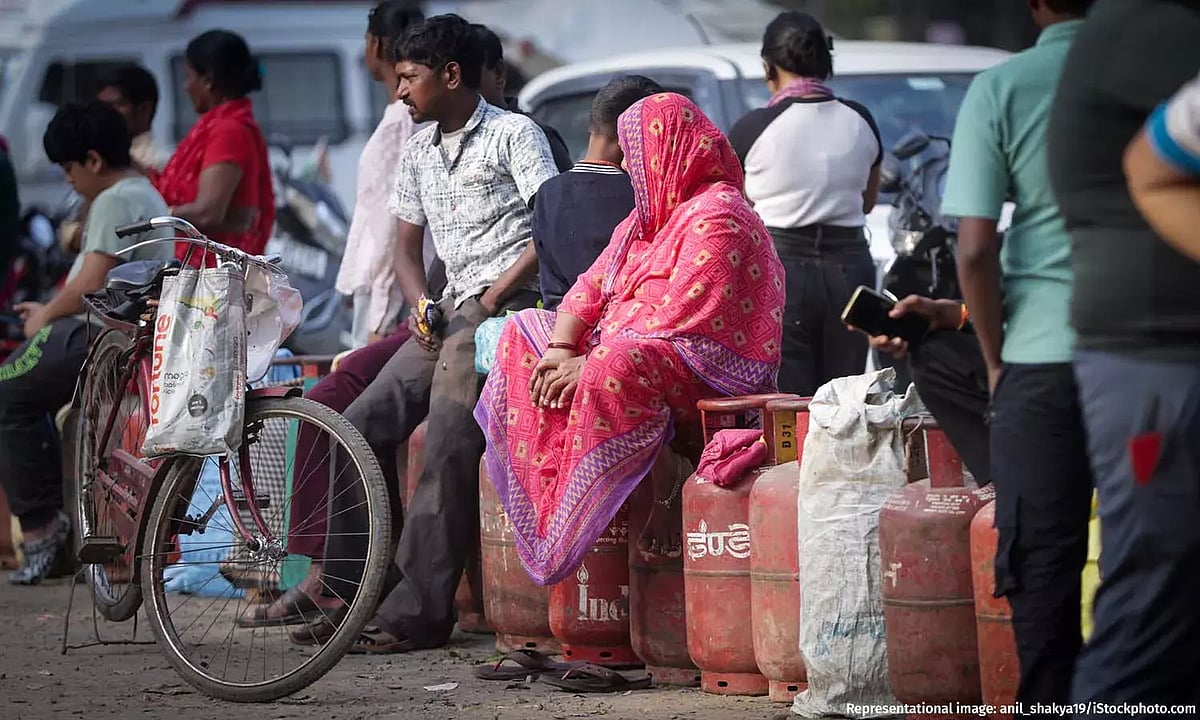
On April 24, the Union Ministry of Petroleum and Natural Gas stated in a press conference that the supply of domestic LPG remains smooth. Meanwhile, at an Indane gas agency in Masoodpur, near the Jai Hind Camp slum, long queues were seen on April 23 at 4 p.m. Ramveer, a gas mechanic at the agency, explained that the crowds were there to resolve persistent technical issues with their bookings. When asked about the 5 kg cylinders, he said they are not seeing many new applications.
We reached out to the ministry for comment on the challenges faced by migrant workers and concerns over the affordability of the 5 kg cylinders. We will update this story when we receive a response.
The poorest are worst affected
Urban slums suffer from a double burden of pollution. They are exposed to the high ambient particulate matter of cities and the household air pollution from unclean cooking fuels. According to a survey report by CEEW, 45 percent of urban slum households in India use traditional fuel like dung cakes and firewood for cooking.
"Migrant workers were never adequately covered by clean fuel access even under conditions of good LPG supply,” said Kalpana Balakrishnan, professor and dean (research) at SRIHER. “The crisis has heightened the need for expanding clean energy access to all vulnerable populations, including the urban poor, who often face risks greater than the rural poor.
“In lower socio-economic status households, cooking expenses account for more than 30 percent of their limited income. Any financial shock forces them to look for alternatives,” Balakrishnan added. “However, India has made significant progress in clean cooking, especially through the Pradhan Mantri Ujjwala Yojana. Despite this, it has been challenging to bear the costs of increasing usage and to reach the bottom 10 percent of the poorest population. Now, the rising number of people reverting to solid fuels has made the situation even more serious."
"Those who can afford to switch to solar should be encouraged, freeing up LPG for the most vulnerable,” she added. “Cities like Delhi can rebalance energy use through redesigned, smarter subsidy structures and lead the transition to renewable cooking nationwide."
This story is republished with permission from IndiaSpend, a data-driven, public-interest journalism non-profit. It has been lightly edited for style and clarity. All images courtesy Shivam Bharadwaj.
We take no ads, bow to no government or corporation, and answer only to you. This Press Freedom Month, pay to keep news free.
Newslaundry is a reader-supported, ad-free, independent news outlet based out of New Delhi. Support their journalism, here.