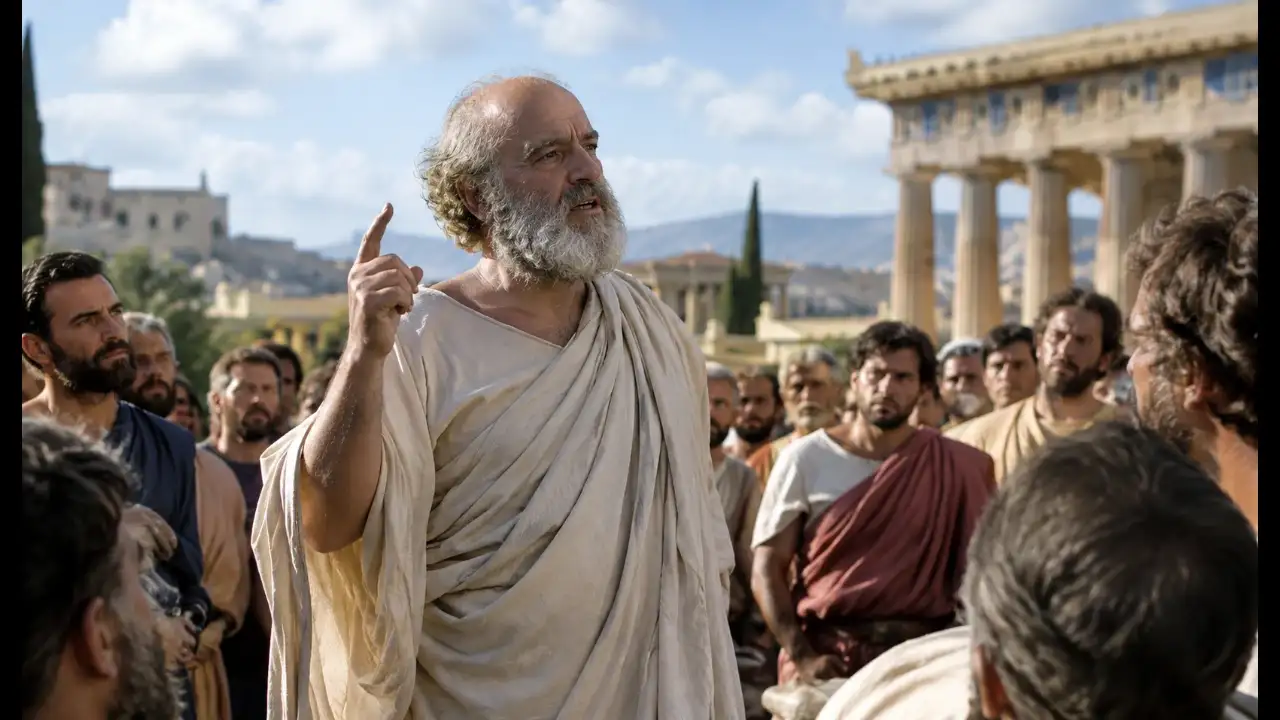
The Battle of Arginusae should have been a moment of triumph for Athens. The city’s navy secured a vital victory against Sparta, but a sudden, violent storm trapped hundreds of drowning sailors at sea. When news reached the city that commanders failed to recover the stranded crews and honor the dead, grief quickly turned into unyielding fury.
An enraged public assembly demanded immediate retribution, pushing to try all eight commanders together in a single mass execution vote. This collective trial directly violated Athenian law, which explicitly guaranteed every citizen an individual defense. The crowd did not care about procedure. They threatened to execute anyone who stood in the way of their anger.

By random rotation, Socrates held the presidency of the citizen council on that exact day. Standing alone against a screaming mob, he refused to put the illegal motion to a vote. Citizens shouted for his immediate arrest, yet he remained steadfast, insisting he would not break his oath to the law.
His stance delayed the vote for just one day until a compliant official took over. The assembly executed six generals, only to regret the decision months later. Socrates proved that true civic duty often requires standing against popular rage, even when the crowd demands blood.
What happened when Athens demanded a mass trial?
The episode followed the Battle of Arginusae, a major Athenian naval victory during the Peloponnesian War. The Athenians had defeated a Spartan fleet, but a storm prevented the commanders from properly recovering many of their dead and rescuing sailors from damaged ships. The failure caused outrage in Athens, where the commanders were accused of neglecting their responsibilities.
The political response quickly became heated. Rather than considering the commanders individually, the Assembly moved toward judging them collectively. Socrates, who was serving as one of the presiding officials of the Assembly at the time, opposed the procedure because he believed it violated established legal requirements.
The danger was not simply that Socrates disagreed with the majority. The Assembly was prepared to punish those who resisted its demand, creating a direct conflict between popular anger and the procedures intended to govern Athenian justice.
Socrates nevertheless refused to approve the collective trial. According to later accounts, the officials presiding over the Assembly were pressured and threatened, but Socrates maintained his objection even as the political atmosphere became increasingly hostile.
Why did the Arginusae trial matter to Socrates?
The incident is important because it complicates the modern image of Socrates as merely a philosopher who spent his days asking abstract questions. His engagement with Athenian public life could have real political consequences, even though he did not identify himself consistently with either democratic or oligarchic factions.
The sources portray him as someone who could support or oppose particular actions regardless of which political group backed them. That independence was unusual in a city where political participation was an important part of citizenship and public reputation.
His conduct during the Arginusae crisis also helps explain why his later trial cannot be understood simply as a conflict between an individual thinker and an oppressive government. Socrates had lived within Athens's political system, participated in civic institutions and served as a soldier. His relationship with democracy was more complicated: he could respect the city's laws while challenging decisions he considered unjust.
How did Socrates become such a strange figure in Athens?
Much of what made Socrates distinctive was visible long before his trial and execution in 399 B.C. Contemporary and near-contemporary sources describe a man who looked and behaved very differently from the idealized Athenian citizen.
He was famously unattractive by the standards of his time, with features that ancient writers compared to those of a satyr. He reportedly went barefoot, wore the same clothing day and night and often appeared unconcerned with conventional standards of grooming or status. His physical appearance became part of the larger image of a man who seemed deliberately out of step with his surroundings.
His lifestyle was even more unusual. While ambitious Athenian men could pursue wealth, public office, reputation and influence, Socrates did not charge money for his conversations. He also rejected the idea that he was a conventional teacher. Instead, he questioned people until they confronted gaps in their own knowledge.
That method could be uncomfortable. Socrates often began conversations by presenting himself as someone seeking knowledge, only to expose contradictions in the other person's argument. Young Athenians reportedly imitated his style, which made some older citizens suspicious of the influence he was having on the city's youth.
Why is it difficult to know the real Socrates?
There is a fundamental problem at the heart of almost every account of Socrates: Socrates wrote nothing himself . What survives comes from people who knew him, portrayed him or interpreted him after his death.
The three most important ancient sources are Aristophanes, Xenophon and Plato, and they do not present exactly the same man. Aristophanes' comedy Clouds portrays Socrates as a bizarre intellectual associated with unconventional natural theories and deceptive argument. Xenophon presents a far more practical figure, often offering useful advice about everyday conduct.
Plato's Socrates is the most philosophically influential version. Through dialogues such as Apology , Crito , Meno , Symposium and Phaedo , Plato presents Socrates questioning assumptions about justice, knowledge, virtue and the good life. Yet scholars cannot simply assume that every argument spoken by Plato's Socrates represents the historical man's actual beliefs.
This uncertainty is known as the Socratic problem . Scholars have spent centuries trying to determine where the historical Socrates ends and the literary, philosophical or dramatic creations of his interpreters begin.
What does the trial of Athens' generals reveal about him?
The 406 B.C. episode provides a rare example in which Socrates appears not merely as a character in a philosophical discussion but as a participant in a real political confrontation. His refusal to endorse the collective prosecution of the generals illustrates the tension between democratic majority rule and the legal procedures that were supposed to constrain it.
That tension would become even more significant three years later. In 399 B.C., Socrates himself was tried and executed by Athens after being accused of impiety and corrupting the city's young men. Plato's Apology presents him defending his lifelong practice of examining himself and others, while the broader historical record remains complicated by the political turmoil Athens had experienced.
The contrast is striking without requiring Socrates to be turned into either a flawless defender of democracy or its enemy. He participated in Athenian civic life, respected aspects of its legal order and yet resisted particular decisions when he believed they violated justice or proper procedure.
His importance therefore rests not only on the philosophical doctrines later associated with his name. It also lies in the example of a citizen who treated questioning as a civic responsibility. The historical Socrates remains difficult to reconstruct with certainty, but the surviving accounts consistently preserve one unusual feature: he was willing to make himself uncomfortable, and sometimes unpopular, rather than stop asking whether the accepted answer was actually justified.