The impact of green facades can influence the thermal sensations of an outdoor environment, although the impact varies between buildings. In a 2025 study, Assessing green walls' effects on outdoor human thermal exposure in temperate climate cities (Scientific Reports, DOI: 10.1038/s41598-025-26214-7), scientists from Palacký University Olomouc and the Institute of Computer Science of the Czech Academy of Sciences investigated five green wall case studies in Czech cities, measuring air temperature and three human thermal exposure indices: MRT (mean radiant temperature), UTCI (universal thermal climate index) and PET (physiologically equivalent temperature). The study was published in Scientific Reports in November 2025, based on fieldwork carried out during hot summer days in 2024, with measurements conducted 0.5 metres from the investigated walls. Of the five sites investigated, the largest decrease in radiant heat load was found in the Holešovice district of Prague.
Holešovice recorded a 6.4 K lower Mean Radiant Temperature
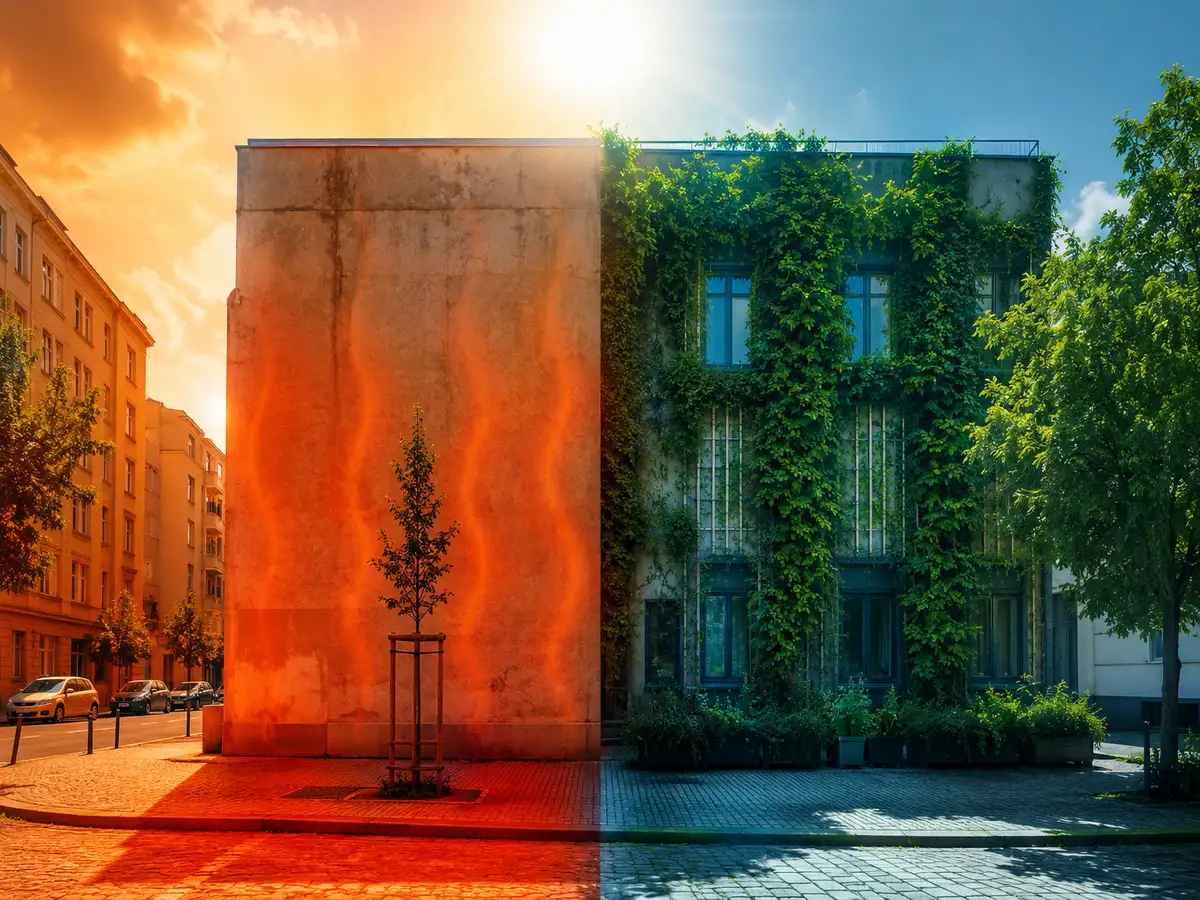
In the Holešovice-Apartments test location, a green facade was compared to a white insulated wall. For the green facade, the direct greening involved the use of Parthenocissus tricuspidata, popularly referred to as Boston ivy. The plants were rooted in the ground, unlike the potted plants used in some of the living-wall sites. At the Holešovice‑Apartments site, the MRT near the green facade was found to be 6.4 K lower than that near the white insulated wall. MRT is the radiation effect of the surroundings and thus an important aspect of the outdoor thermal environment. In terms of air temperature, the difference was considerably smaller. In the same Holešovice site, air temperature near the green wall was 0.7 K lower compared to the air temperature near the white wall. This large difference between the MRT of the two sites suggests that the most pronounced difference between them lies in the radiation environment, not in the air temperature around them.
According to the same study, both indicators of thermal comfort decreased. The value of UTCI was 2.1 K lower, while PET was 4.1 K lower near the green wall in comparison to the white insulated wall. Such a decrease in the value of UTCI could be explained by the lack of strong heat stress on the green wall during measurement; PET decreased during the period of heat stress. The Holešovice result is an example of the largest MRT reduction in Czech research, but not of an ordinary performance measure of green facades. In all five case studies, the difference in MRT measured in green walls ranged from −6.4 K to +3.3 K in relation to the normal facades. Across the five case studies, the differences in air temperature ranged from approximately −1.2 to +0.1 K, UTCI from −2.1 to +0.2 K and PET from −4.1 to +0.2 K. This diversity can be seen even when it comes to individual locations. For example, in the building called Envelopa Hub, located in Olomouc, the living wall with indirect greening showed an average MRT of 2.4 K less in comparison with the metal grid wall but 3.3 K greater in comparison with the glass wall.
Also, in Cinema Mír in Opava, the green facade possessed an average MRT of 2.5 K greater than the grey roughcast facade. It shows why it is incorrect to evaluate the influence of green walls without taking into account the facade as a reference object. Besides, the scientists noted the higher variation of MRT in contrast to air temperature because cloud shading and wind gusts influenced the radiant measurements.
Vegetation arrangement helped determine the thermal result
The comparison made in this study highlights an important distinction between green facades and living walls. The maximum cooling effect was achieved in the case of directly greened facades without any support structure, such as facade plants Parthenocissus quinquefolia and Parthenocissus tricuspidata. In turn, the living walls studied here used black pots for plants, placed on support structures and usually failed to provide cooling to the same extent as directly greened facades. It is important to note that not every directly greened wall will reduce temperature by 6.4 K. As it was mentioned above, the study included different wall materials, directions, plant arrangement and environmental conditions affecting the comparison. The study concluded that, under Central European temperate conditions, the cooling effect of green walls was limited and highly site‑specific and could not be regarded as a universal heat‑mitigation solution.