What happens to a wind turbine blade when it reaches the end of its working life? The EU-funded REWIND project is developing technologies to dismantle, repurpose and recycle end-of-life wind turbine blades, with the aim of increasing their circularity and expanding the industrial applications of recovered composite materials.
REWIND officially began on May 1, 2024, and is scheduled to run until April 30, 2028. The project is funded under the EU's Horizon Europe programme and has an EU contribution of nearly €4 million.
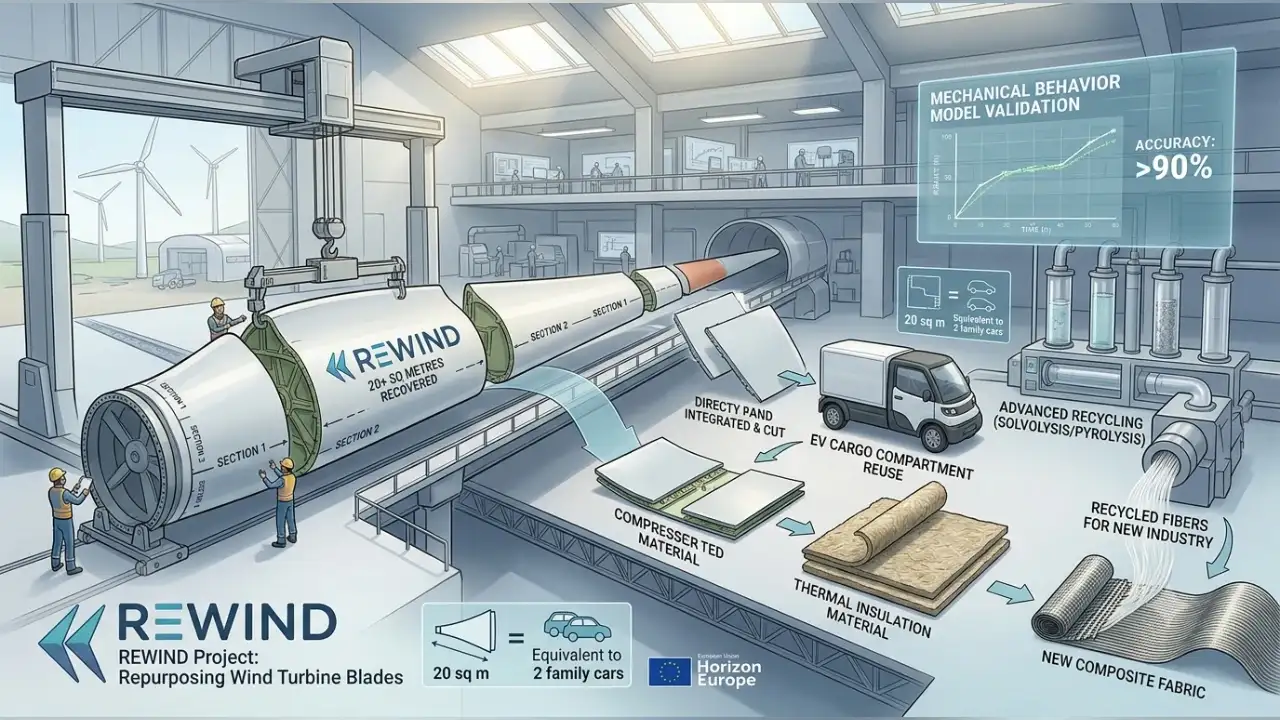
More than 20 square metres of recovered wind turbine blade sections have also been provided for the initial validation of the project's circular strategies. The sections are being used to validate their reuse in applications such as electric vehicles and insulation materials, according to the project's July 2026 update.
More than 20 square metres of blade sections recovered
During its first two years, REWIND says it achieved its first two technical milestones.
The first milestone, led by SUEZ, ensured the availability of undamaged and dismantled end-of-life wind turbine blades for repurposing and recycling activities. More than 20 square metres of blade sections were provided for the initial validation of the project's circular strategies.
REWIND says the recovered sections are being given a second life through applications including electric vehicles and insulation materials. The recovered area is equivalent to the surface area of two family cars.
Wind turbine blades explored for new uses
According to CORDIS, REWIND aims to develop technologies for dismantling end-of-life wind turbine blades and new methodologies for repurposing and recycling composite materials. The project plans to demonstrate potential applications in the wind energy, construction and automotive sectors.
The project is also working on ways to determine whether composite parts from end-of-life products should be repurposed or recycled, depending on their value and material properties.
The REWIND project's July 2026 update details work by several consortium members. SUEZ has developed and validated dismantling technologies and non-destructive material identification methods, while TEKNIKER has advanced cutting optimisation software and long-fibre delamination technologies capable of producing continuous composite tapes.
Miljøskærm is developing thermal insulation materials from recycled glass fibres. ALKE is demonstrating direct reuse by integrating repurposed composite panels into electric vehicle cargo compartments, while DITF has produced unidirectional fabrics based on recycled glass fibre yarns for future composite applications.
New recycling technologies target wind turbine blades
REWIND is also developing pyrolysis and solvolysis methods for parts of the composite material that cannot be repurposed. CORDIS says these processes are intended to reduce processing temperature and time while improving the quality of recovered materials.
The project expects recovered secondary raw materials to be used in two wind-energy demonstrators: a small wind blade root section and composite patches for repairing blades.
The July 2026 project update also describes work by AIMPLAS, BCIRCULAR, R-Nano and Composite Patch on material separation, pyrolysis, recycled fibres and recycled composite repair solutions.
REWIND validates model for recovered blade materials
The consortium has also validated a model capable of predicting the mechanical behaviour of recovered materials with more than 90% accuracy.
The second technical milestone, led by IPC, involved validating a material model designed to predict the residual mechanical properties of damaged end-of-life wind turbine blade components.
According to the REWIND update, the model showed less than a 10% deviation between simulated results and the actual mechanical behaviour of the tested blade sections.
Project aims to scale circular wind-blade technologies
REWIND's broader objective is to develop technologies that can be scaled to process larger volumes of end-of-life wind turbine blade waste. CORDIS says the project is intended to increase the industrial applications of end-of-life composites while reducing reliance on landfilling or incineration.
Following its first two technical milestones, the consortium says its next focus will be scaling up the technologies, validating industrial demonstrators and accelerating the market uptake of circular solutions for wind turbine composites.
REWIND stands for “Efficient Decommissioning, Repurposing and Recycling to Increase the Circularity of End-of-Life Wind Energy Systems.” The project has Grant Agreement No. 101147226 and is coordinated by AIMPLAS.