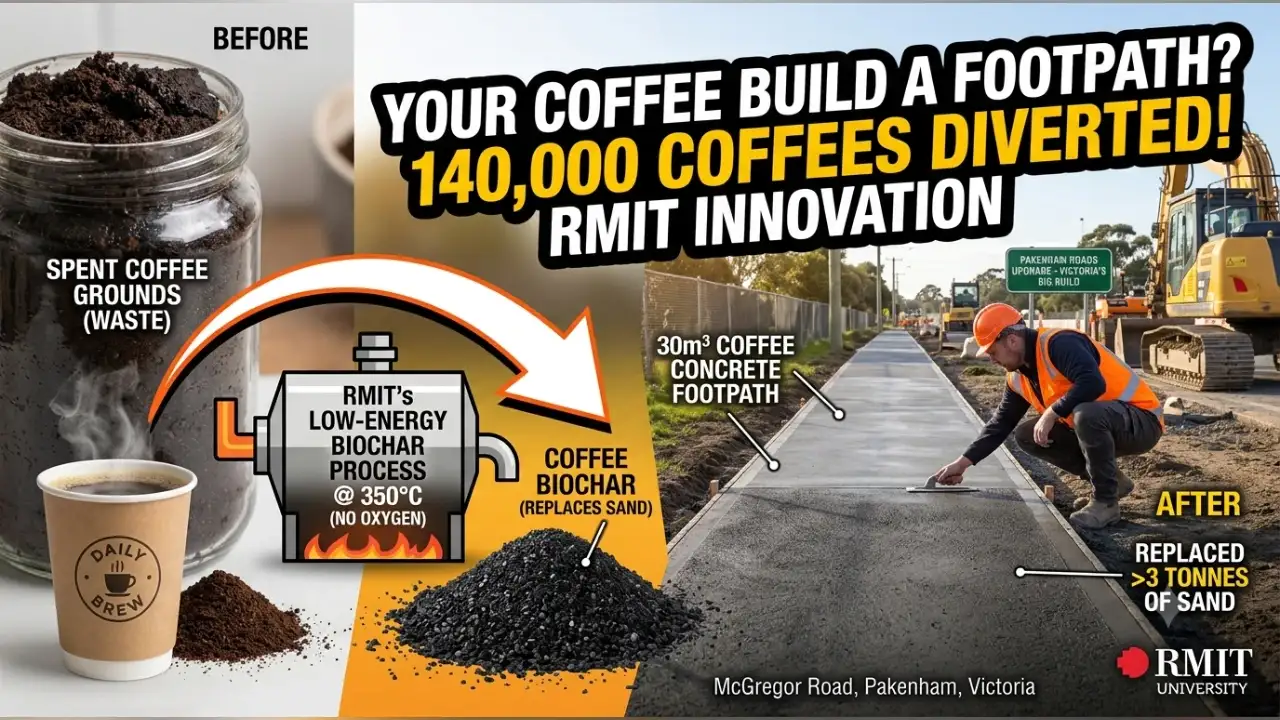
Coffee concrete : What if your morning coffee could end up helping build a footpath? That is what happened in Pakenham, Victoria, where spent coffee grounds were turned into biochar and used in concrete as part of a major infrastructure project. In 2024, an innovation developed by researchers at RMIT University was used for the first time in a major infrastructure project. Major Road Projects Victoria and contractor BildGroup used concrete containing biochar made from spent coffee grounds in the Pakenham Roads Upgrade, part of Victoria’s Big Build.
The coffee grounds were not mixed directly into the concrete. Instead, they were converted into biochar, which replaced part of the river sand normally used in the concrete mix.

For the project, Earth Systems processed 5 tonnes of spent coffee grounds, about 140,000 coffees’ worth, into 2 tonnes of usable biochar. The material was then used in a 30-cubic-metre footpath along McGregor Road. BildGroup CEO Stephen Hill said the project diverted an estimated 140,000 coffees from landfill and saved more than 3 tonnes of sand, as per a RMIT University report.
How coffee grounds were turned into concrete biochar
Spent coffee grounds cannot simply be added to concrete. The organic material would decompose over time and weaken the building material.
RMIT researchers developed a way to turn the waste into biochar before it is added to concrete. Their technique uses a low-energy process without oxygen at 350 degrees Celsius.
The RMIT team found that concrete made using biochar produced through this technique could be 30% stronger.
That 30% figure comes from the team's research technique, rather than being a claim about the strength of the concrete used in the Pakenham footpath.
There was also a supply issue during the earlier Gisborne trial. RMIT said the team could not use its low-energy process to produce the biochar, and the coffee concrete used in that trial had a similar strength to standard concrete.