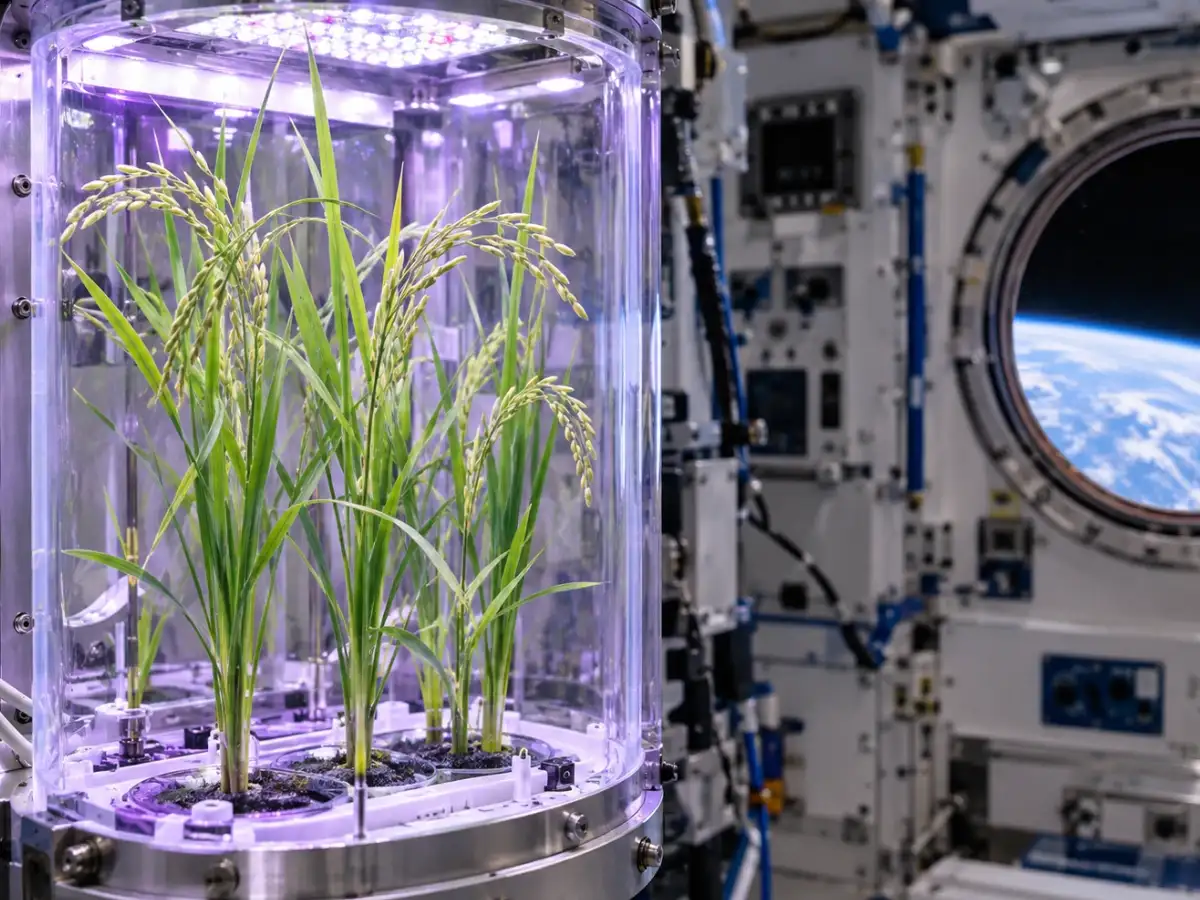
Chinese astronauts once brought back something strange from space: the world's first rice seeds ever grown from seed to seed in orbit, according to the Chinese Academy of Sciences. In 2022, six rice seeds spent 120 days aboard the Tiangong space station. By the end, those six ended up becoming 59. Years later, their descendants produced a third generation on Earth.
A small lab, a big goal
The rice seeds traveled aboard the Wentian lab module, which launched and docked with China's Tiangong space station in July 2022. The rice-growing experiment itself began a few days later, on July 29. Once in orbit, the caretaking duties were taken over by the crew of the Shenzhou-14, astronauts Chen Dong, Liu Yang and Cai Xuzhe. They aimed to direct the seeds through the complete life cycle of rice: germination, growth, flowering and finally new seeds. And as the Chinese Academy of Sciences report notes, only a few plants, including thale cress, rapeseed, peas and wheat, ever completed a full life cycle in space before. Rice, the food of billions of people, had never made that list.
120 days, no gravity to guide it
The experiment began on 29 July 2022 and lasted for 120 days. On Earth, gravity tells a plant which way is down and which way is up. That signal isn’t there in orbit, so it’s not easy to grow rice in those conditions. The module's space was tight and the whole environment artificial, making it difficult to complete the crop's full cycle, Zheng Huiqiong, a researcher at the Center for Excellence in Molecular Plant Sciences, told Space.com. But the plants lived on. By the time the astronauts returned to Earth in December 2022, the original six seeds had grown to 59.