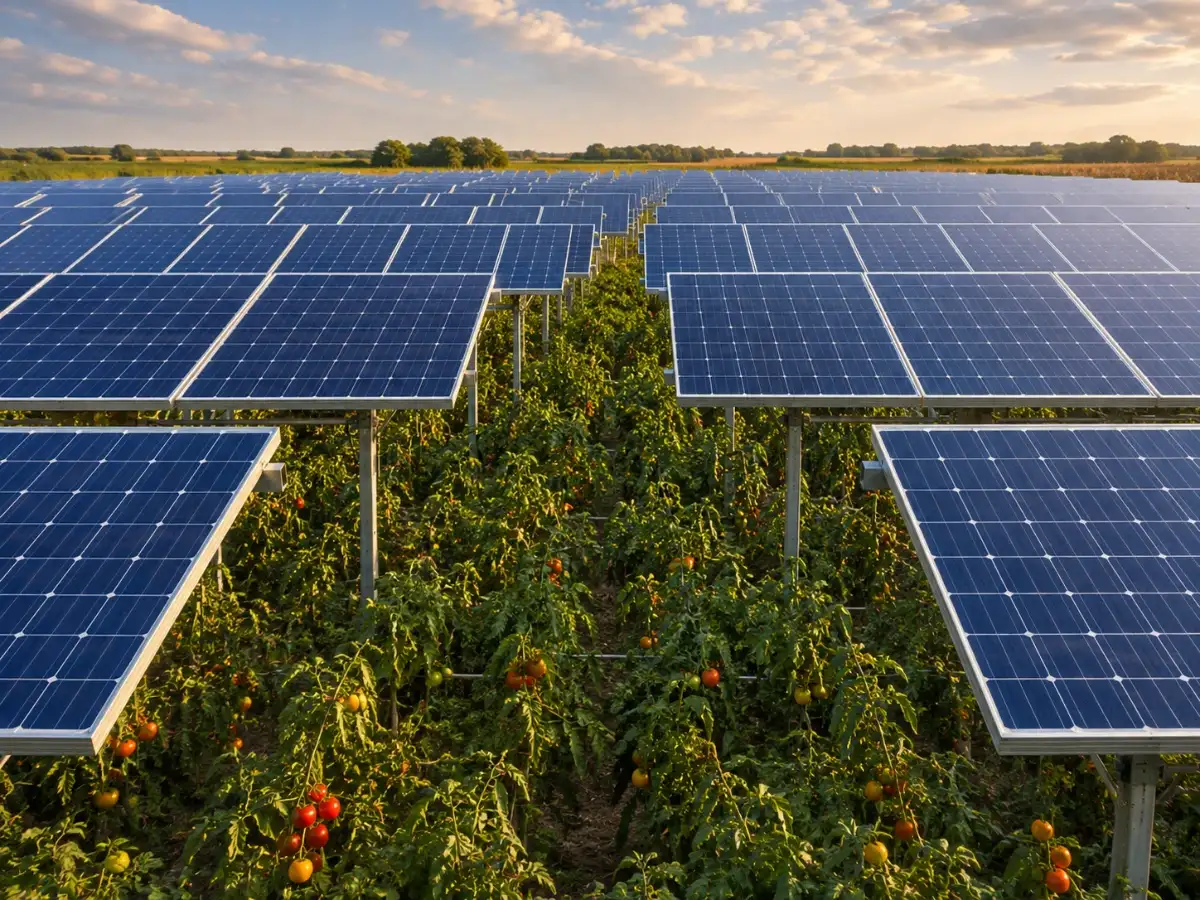
What if the same piece of land could produce food and generate solar power? That is what the principle of agrivoltaics involves: the coexistence of photovoltaics and agriculture. However, a field test by Bar-Ilan University in Israel shows that combining the two practices is more complex than simply placing panels above a crop field. According to the December 12, 2025, Scientific Reports study ‘Agri-Photovoltaic technology allows dual use of land for tomato production and electricity generation,’ researchers found that the amount of sunlight reaching tomatoes varied by their position relative to the solar panels, with greater shading generally linked to lower productivity.
The experiment was built around moving solar panels

The researchers conducted two field experiments, one in spring 2022 and one in spring 2023, at Bar-Ilan University in Israel. They grew two varieties of processing tomatoes, Heinz 1648 and Heinz 4107, in seven north-south rows between two arrays of photovoltaic panels. The system consisted of 24 single-axis east-west oriented sun-tracking modules, installed at a height of 1.7 meters above the ground. The panels tracked the sun's angle throughout the day, but their physical position over the rows stayed fixed, so rows directly beneath them consistently received the least light regardless of the hour. This configuration allowed the researchers to compare tomatoes receiving different amounts of sunlight in the same agrivoltaic system. The internal control was the central T4 row, with the highest light availability in the system. Its light level was only 1.96% lower than that of nearby open-field plants. The tomatoes were harvested 95 to 98 days after planting.
The darkest rows produced far fewer tomatoes
The clearest effect was seen in the rows located just below the solar panels. Rows T1 and T7 were shaded the most, resulting in losses in fruit yields by 42% and 57%, respectively, when compared with the control row T4. As sunlight increased, the yield losses became smaller. Row T2 had a 13% yield loss, while T6 had a 20% loss. Rows T3 and T5, which received almost full sun, had 0% and 6% loss, respectively. Overall, in the seven rows, there was a 19.4% reduction in fruit yields when compared with conventional cultivation. The study also found that chlorophyll content, total plant biomass, fruit yield, and fruit quality declined as shading increased. The results showed a positive correlation between available light and tomato productivity.