Get all your news in one place.
100's of premium titles.
One app.
Start reading
The Economic Times
The Economic Times

In 2021, Australia's RMIT helped Coles put 900,000 pieces of soft plastic into concrete. 1 year later, another Coles development was set to reuse 6.5 million pieces through Polyrok

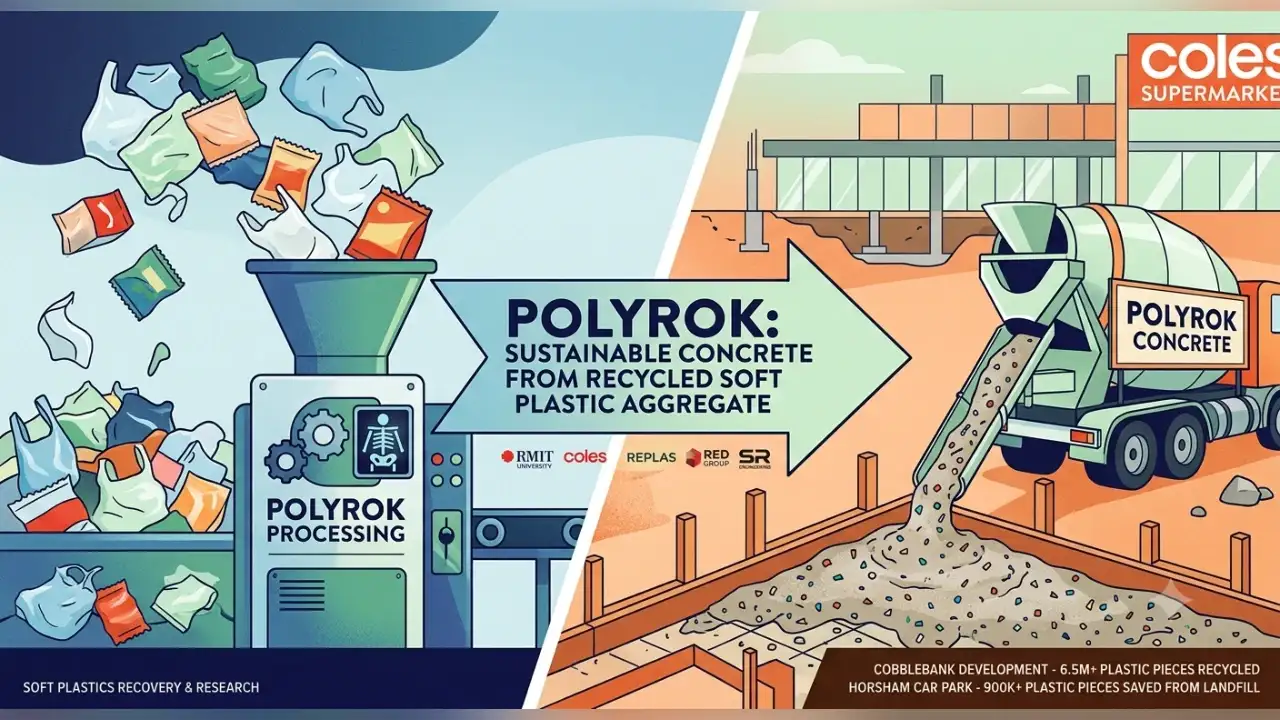
Soft plastic such as wrappers, cling wrap and plastic bags has been difficult to recycle. RMIT University worked with Coles and Victorian recycling organisations to develop Polyrok, a plastic aggregate made from recycled soft plastics for use in concrete.

The material was first used commercially at a Coles car park in Horsham. A larger application was announced in February 2021 for a Coles supermarket development at Cobblebank in Melbourne, where more than 6.5 million pieces of soft plastic were set to be recycled through Polyrok.

How Polyrok was developed

RMIT engineers worked with Replas, RED Group and SR Engineering to develop the mix methodology and characterise the Polyrok material.

The project was led by RMIT Senior Lecturer Dr Jonathan Tran and his team from the School of Engineering.

One of the challenges was getting plastic and concrete to bond effectively. He said, “Glass can be easily recycled and turned into things such as sand replacement, but plastic is much harder,” adding, “Mixing concrete and plastic is difficult, as the two don’t naturally bond," as quoted by RMIT.

Researchers used X-ray computed tomography to help design the concrete mix, with the aim of optimising its strength and acoustic energy absorption.

RMIT described Polyrok as a sustainable aggregate alternative with enhanced durability that was lighter to work with.

READ ALSO: In 1972, FHWA used 5 inches of scrubber waste in a parking-area base at Washington's Dulles Airport. 2 years later, wet weather caused the experimental base to soften and be replaced

The Horsham car park

The Coles Horsham car park was the first commercial construction project in Australia to use Polyrok.

The material was made from plastic bags and soft plastic packaging recovered through the REDcycle program and used as an alternative to aggregate minerals in concrete.

RMIT reported that more than 900,000 pieces of plastic packaging were saved from landfill and incorporated into the car park concrete.

The Cobblebank development

On February 15, 2021, Coles announced that more than 6.5 million pieces of soft plastic would be recycled through Polyrok as part of its supermarket development at Cobblebank in Melbourne's west.

Coles described the project as the largest-ever commercial application of Polyrok at the time.

The soft plastic came from plastic bags and packaging recovered through the REDcycle program.

READ ALSO: In 1977, Pennsylvania tested an 800-foot road base made with power-plant scrubber sludge; its strength rose from 720 to 1,014 PSI over seven years

A larger opportunity for soft plastic recycling

Since the partnership began, Tran said Replas, RED Group and Coles had diverted more than 1.3 billion pieces of soft plastic from landfill.

He also said there was potential for 105,000 tonnes of soft plastics to be converted into dense plastic aggregate each year at a local factory in Melbourne, as quoted by RMIT.

The RMIT research team included Tran and research fellows Dr Rajeev Roychand and Dr Thomas Loh.

Tran said the team hoped to explore producing sustainable concrete structures using a new large-scale concrete 3D printer at RMIT's Bundoora campus.

Sign up to read this article
Read news from 100's of titles, curated specifically for you.
Already a member? Sign in here
Related Stories
Top stories on inkl right now
One subscription that gives you access to news from hundreds of sites
Already a member? Sign in here
Our Picks
Fourteen days free
Download the app
One app. One membership.
100+ trusted global sources.