
Get all your news in one place.
100's of premium titles.
One app.
Start reading
The Economic Times
The Economic Times
Team Global

In 2020, Australian researchers burned discarded human hair into carbon dots for OLEDs; the dots reached 87% quantum yield, and rigid displays hit 700 cd/m²

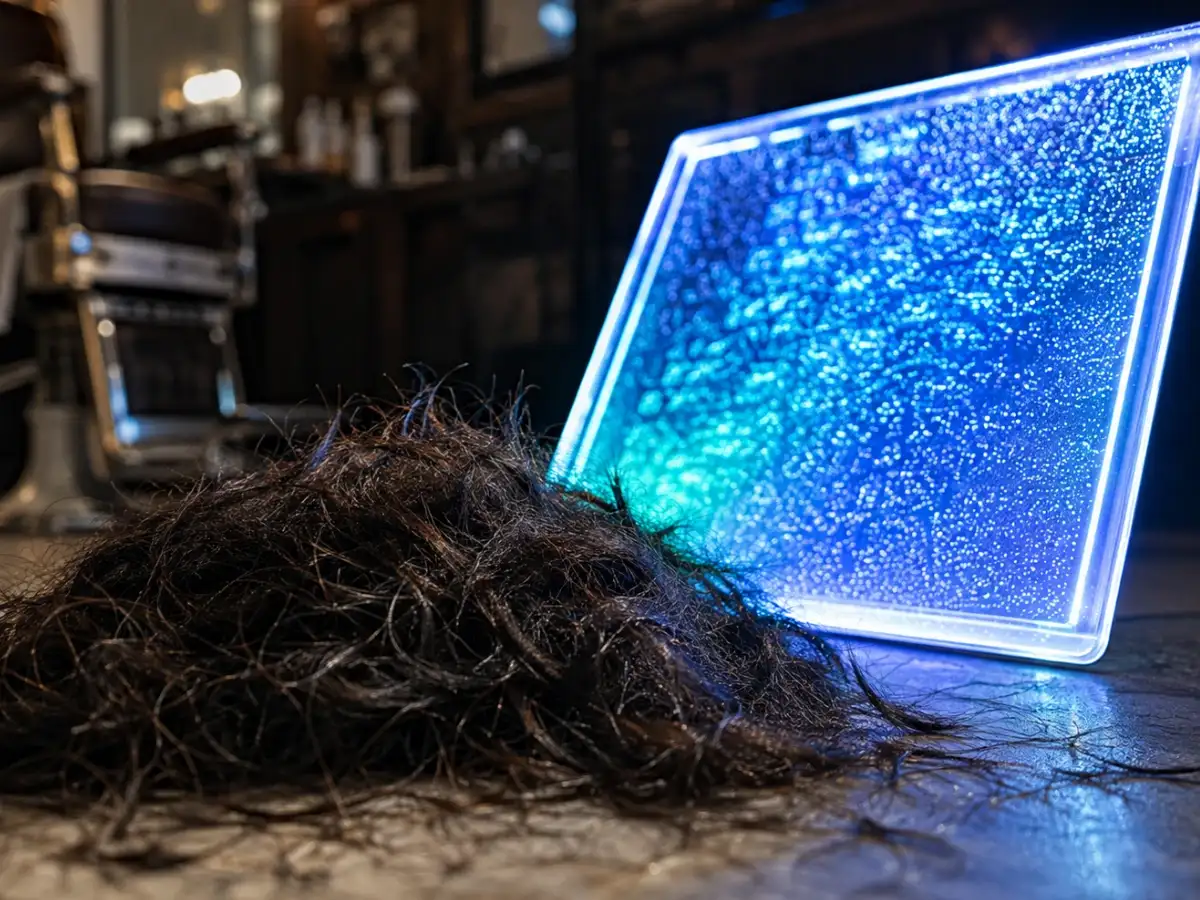
Every time you get a haircut, a pile of hair ends up in the trash. Most people probably do not pay much attention to this, but a group of researchers in Australia examined that very pile of hair and found an innovative material for screens in the future. In a study conducted by scientists at Queensland University of Technology (QUT) and Griffith University and published in the journal Advanced Materials, scientists turned waste hair into tiny glowing particles known as carbon dots and built them into OLED displays, similar to the display technology currently used in many phones and televisions.

From hair clippings to glowing dots

The process itself is actually quite simple. According to the QUT research news announcement, the hair samples were taken from an actual barbershop in Brisbane, and the laboratory process involved a two-step method: breaking up the hair and then heating it to about 240 degrees Celsius. The end product was the creation of carbon nanodots, small particles that start glowing when a low voltage is passed through them. This material is well suited to the application because it is naturally rich in carbon and nitrogen.

Why the brightness number actually matters

Carbon dots have been around in labs for quite some time now, but there is one major disadvantage with most of them. When you pack them close together to build a screen, they tend to dim each other out. Scientists call this solid-state emission quenching. These newly created carbon dots from hair attained a quantum yield of 87%, which means that they emit a very large percentage of the energy absorbed as light, instead of losing it as heat. These carbon dots were then organized in two-dimensional arrangements known as nano-islands, which helped the dots keep their brightness even when packed tightly. That tightly packed, self-organized nano-island arrangement was the trick of engineering that allowed the researchers to develop two functional prototypes. The first prototype had an organic light-emitting diode (OLED) on a flexible plastic substrate, whose maximum brightness was 350 candela per square meter with the emission of a constant blue-cyan light. The other prototype was a rigid device built on a glass substrate whose maximum brightness was 700 candela per square meter, twice as high as the first. In context, this is bright enough for a smaller indoor display, but below what is required for a TV screen.

Sign up to read this article
Read news from 100's of titles, curated specifically for you.
Already a member? Sign in here
Related Stories
Top stories on inkl right now
One subscription that gives you access to news from hundreds of sites
Already a member? Sign in here
Our Picks
Fourteen days free
Download the app
One app. One membership.
100+ trusted global sources.


