Get all your news in one place.
100's of premium titles.
One app.
Start reading
The Economic Times
The Economic Times
Team Global

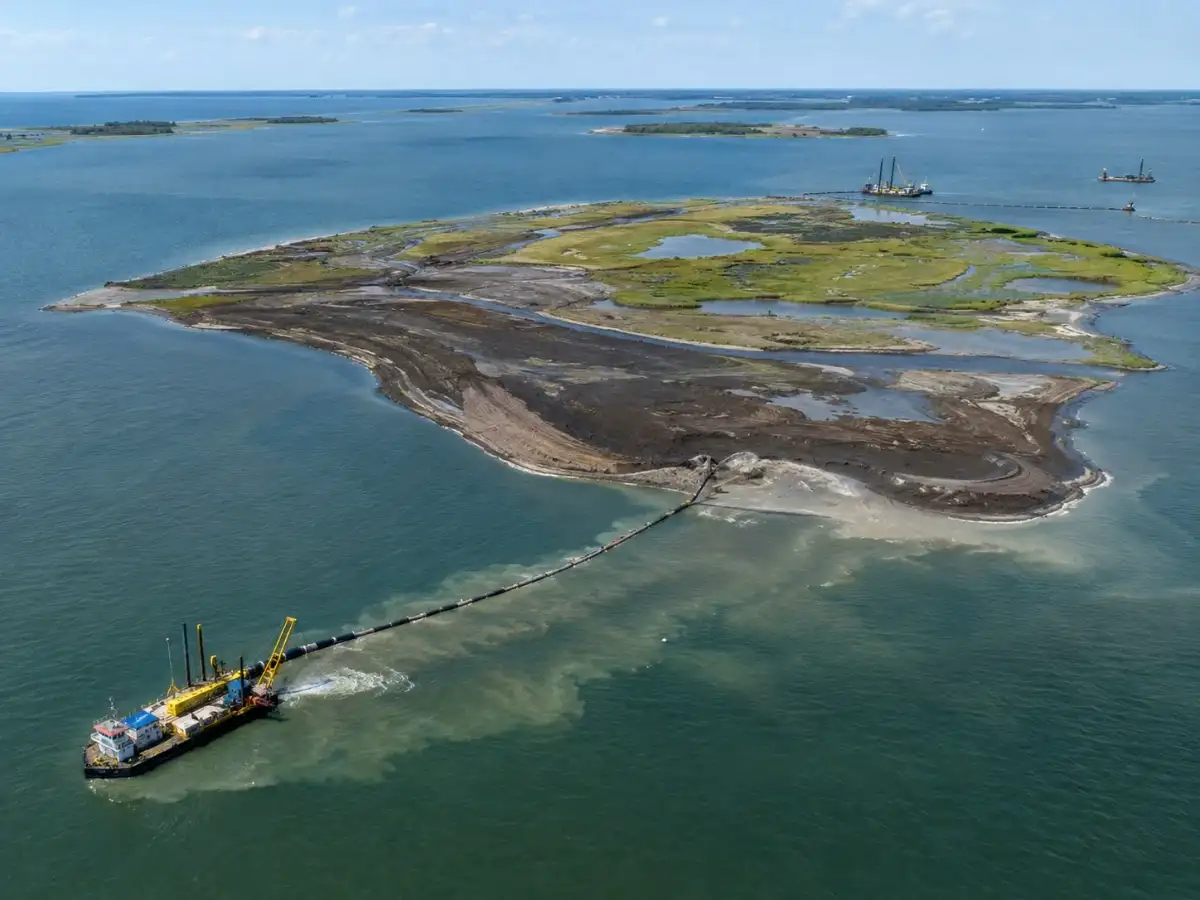
In 2019, Maryland pumped 60,000 cubic yards of dredged mud onto eroding Swan Island; the material rebuilt about 12 acres of marsh and dunes with 200,000 plants

Shipping channels in the Chesapeake Bay require periodic dredging, and all that gray, heavy mud has to go somewhere. According to Jenny Davis and her co-authors in their 2024 peer-reviewed paper titled “Beneficial use of sediments to restore a Chesapeake Bay marsh island,” published in the journal Frontiers in Sustainability, it has previously been dumped in upland containment or the open ocean. Both have removed sediment from coastal systems that need it to keep pace with rising seas. At Swan Island, a 25-acre parcel of marsh in the Bay, federal engineers took an alternative approach by using this material in the environment.

The same study reports that the U.S. Army Corps of Engineers' Baltimore District placed about 60,000 cubic yards of sediment on 12 acres of the island in 2019. Scientists monitored this plot for three years to see how things went. On paper, it sounds like a tidy win, but in reality the situation is more complicated, and more interesting.

A tiny island with a big job

Swan Island is uninhabited but nevertheless works daily. According to Davis et al., the island acts as a natural wave break for the town of Ewell on the nearby Smith Island. Before the restoration, it had been eroding and subsiding for years, and its interior marsh had broken into fragments, threatening the loss of the whole island. NOAA's National Centers for Coastal Ocean Science documented the restoration as it happened: from October 2018 to April 2019, the Baltimore District dredged the navigation channel serving Ewell and placed roughly 60,000 cubic yards of the dredged material onto Swan Island, then, in June and July of 2019, planted approximately 200,000 marsh and dune plugs by hand, the same figures later reported by Davis et al. In recent years, the alternative of dumping dredged material in upland containment or the open ocean has proved increasingly costly, on top of the sediment loss it causes downstream.

The part you may have skipped

Some of this worked, as high-marsh grass took root, and most monitoring plots in this area had over 50% cover by September 2020. However, after three years, 22 of 30 low-marsh plots were still bare, meaning only about 8 of the 30 had established meaningfully, and a concrete sill along the northeast shore was too low to serve its purpose. Sediment spilled past that barrier and buried more than two acres of underwater grass habitat nearby: a clear, negative side effect of the project, not merely a hypothetical one.

Sign up to read this article
Read news from 100's of titles, curated specifically for you.
Already a member? Sign in here
Related Stories
Top stories on inkl right now
One subscription that gives you access to news from hundreds of sites
Already a member? Sign in here
Our Picks
Fourteen days free
Download the app
One app. One membership.
100+ trusted global sources.