Get all your news in one place.
100's of premium titles.
One app.
Start reading
The Economic Times
The Economic Times

In 2019, an international team began monitoring Greenland's Petermann Glacier's floating ice tongue from space. 7 years later, 76.4 sq km broke away, creating a Manhattan-sized ice island, while two more could reduce the tongue by 254 sq km

For seven years, scientists have been watching Greenland's Petermann Glacier from space, tracking cracks and other signs of instability in its floating ice tongue.

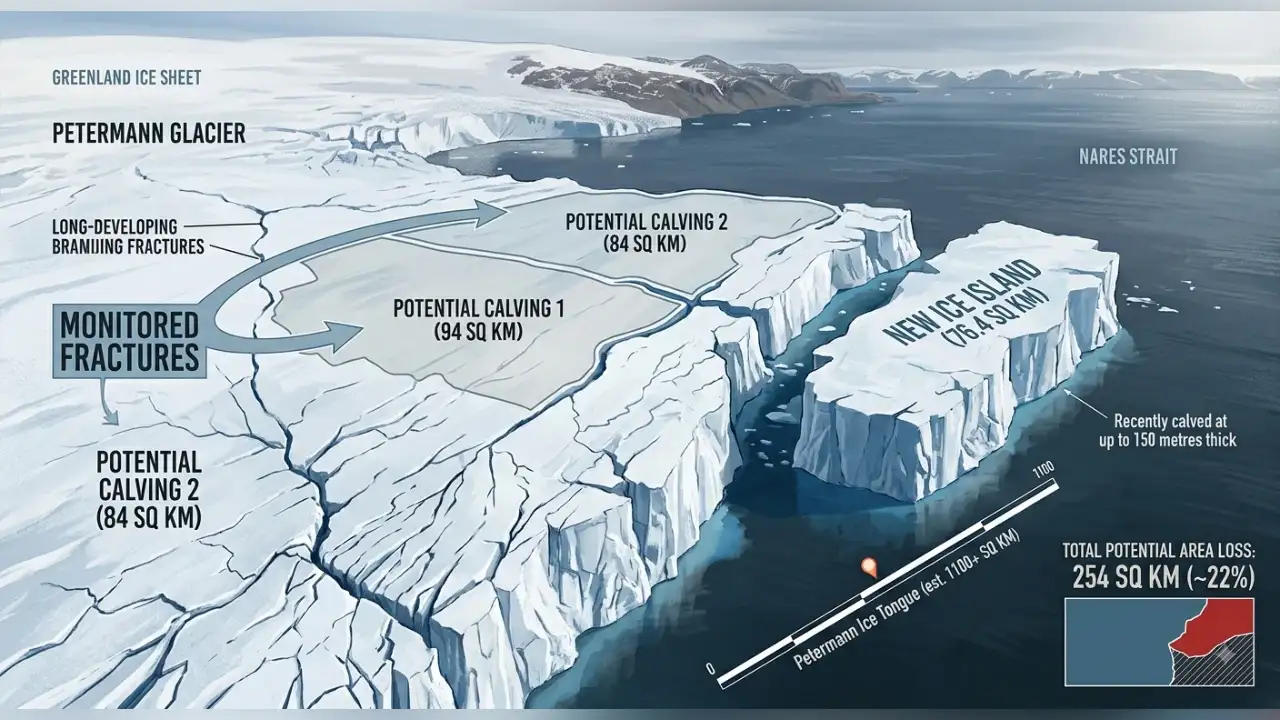
That long-running monitoring captured a major break on August 4, when a 76.4-square-kilometre section of the glacier's floating ice tongue broke away, creating a huge tabular iceberg roughly the size of Manhattan, as per a report.

Researchers say the event was Petermann Glacier's largest loss of floating ice since 2012 and the largest Arctic calving event since 2020 and the newly formed ice island may not be the last major piece to separate, as per The Herald report.

Scientists expect two more large ice islands to break away from Petermann Glacier in the near future. If that happens, the three events together would remove about 254 square kilometres from the glacier's ice tongue, or roughly 22% of its area.

Scientists had been watching Petermann Glacier since 2019

The international team began tracking changes at Petermann Glacier in 2019 using long-term satellite observations.

Researchers followed the glacier's floating ice tongue, documenting fractures and monitoring signs of instability as they developed over several years.

The calving event was detected by Adam Garbo, a PhD student in glaciology at the University of Ottawa, as part of an international collaboration involving the University of Ottawa, the University of Stirling, Environment and Climate Change Canada, Lancaster University and the University of Leeds.

Satellite imagery from the European Space Agency's Sentinel-1 mission showed clear deterioration along the centreline of the ice tongue on August 3, as per The Herald report.

By the following day, the new ice island had separated from the eastern side of the glacier. Garbo said, "Petermann Glacier has long been one of Greenland's largest remaining ice tongues. We've anticipated this break for years and seeing it finally happen is remarkable," as quoted by The Herald.

READ ALSO: In 2024, passengers endured 3.5 hours inside a Boeing 777 without air conditioning while it sat on the Athens tarmac. The incident revealed how little aviation law specifically protects travelers from extreme cabin temperatures

The new ice island gives scientists a rare chance to study Arctic ice

The newly detached iceberg is estimated to be up to 150 metres thick. Researchers say it offers a rare opportunity to study how large Arctic ice masses form, drift and eventually break apart.

Dr Anna Crawford, Senior Lecturer in Physical Geography at the University of Stirling, said, "While large, tabular icebergs are relatively common in the Southern Ocean that surrounds the Antarctic Ice Sheet, Arctic ice islands are far rarer. By studying Arctic ice islands, we will gain knowledge that can be transferred across Polar regions," as quoted by The Herald.

The University of Stirling team includes Crawford and Dr Iain Wheel, who are part of the international group monitoring the glacier.

Two more large ice islands could break away

Scientists say the latest calving event is unlikely to be the last major separation from Petermann Glacier.

Two additional large ice islands are expected to detach as long-developing rifts continue to cut across the floating ice tongue.

The projected ice islands measure approximately 94 square kilometres and 84 square kilometres. If both break away, the combined area lost through the three events would reach about 254 square kilometres. That would represent roughly 22% of the Petermann ice tongue.

Researchers are continuing to monitor the glacier as those fractures develop.

READ ALSO: Earlier this year, a 29-year-old Argentine engineering student mixed iron fillers into ordinary plaster to create a magnet-friendly wall finish. Now it could appeal to 45 million U.S. renter households looking to hang objects without drilling holes

The new ice island could also create a shipping hazard

The newly formed ice mass is not only of interest to scientists. As massive pieces of ice drift away from the glacier and gradually fracture, they can create hazards for shipping and offshore operations.

Researchers will continue tracking what happens to the ice island after its separation. The team plans to use satellite imagery, aerial observations, and tracking data to follow the aftermath and better understand the mechanisms behind the calving and retreat of Arctic ice shelves, as per The Herald report.

Sign up to read this article
Read news from 100's of titles, curated specifically for you.
Already a member? Sign in here
Related Stories
Top stories on inkl right now
One subscription that gives you access to news from hundreds of sites
Already a member? Sign in here
Our Picks
Fourteen days free
Download the app
One app. One membership.
100+ trusted global sources.