Get all your news in one place.
100's of premium titles.
One app.
Start reading
The Economic Times
The Economic Times
Debjit Sinha and ET Science Desk

In 2018, Victoria put the equivalent of 40 million discarded bottles into a freeway; 8,000 tonnes of crushed glass went into one widening project

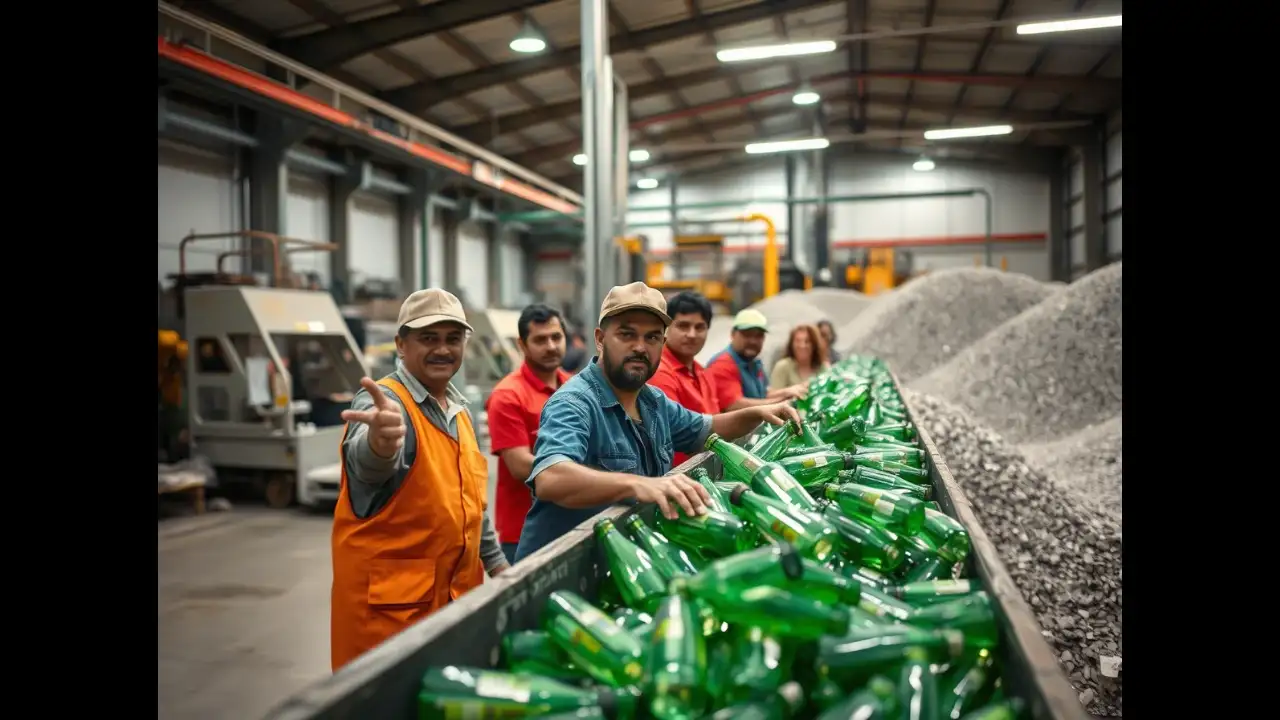
In 2018, an extraordinary recycling experiment in Victoria, Australia, turned millions of discarded glass bottles into part of a major piece of road infrastructure. Around 8,000 tonnes of recycled glass—equivalent to roughly 40 million waste glass bottles—were used in the Bulla Road to Power Street section of the Tullamarine Freeway widening project. The figure comes from the Victorian Auditor-General’s Office (VAGO), which documented the initiative in its 2019 Recovering and Reprocessing Resources from Waste audit. Rather than allowing valuable material to become landfill waste, Victoria found a practical way to put recovered glass back into the economy as a construction resource.

The project is a striking example of what a circular economy can look like in practice. Glass bottles are commonly treated as household recycling, but recovered glass can have applications far beyond conventional bottle-to-bottle recycling. When processed to meet appropriate specifications, recycled glass can become an input for infrastructure and construction projects. In this case, Sustainability Victoria reported that its Market Development Strategy for Recovered Resources helped enable the direct use of Victorian recyclables in major projects. The Tullamarine Freeway widening became one of the clearest demonstrations that material once considered waste could instead become part of the infrastructure people use every day.

READ ALSO: In 1936, temperature in 48 states of U.S. peaked during deadly Dust Bowl, 90 years later climate experts sound red flag

Victoria’s Wider Waste Problem

The scale becomes even more remarkable when placed against Victoria’s wider waste problem at the time. VAGO reported that Victorians generated nearly 12.9 million tonnes of waste in 2016–17, with metropolitan Melbourne responsible for about 80 per cent of that total. Sustainability Victoria estimated that 67 per cent was recovered for recycling, while the remaining 33 per cent went to landfill. Glass was one of several material streams that could potentially be recovered, alongside paper and cardboard, plastics, metals, tyres, organic waste and construction materials. The freeway project therefore represented more than a single construction application—it illustrated the broader potential of finding reliable markets for recovered materials.

The timing was particularly important because Victoria’s recycling industry was facing major disruption. China’s National Sword policy sharply restricted the import of contaminated recyclable materials, exposing weaknesses in Australia’s reliance on overseas recycling markets. VAGO’s 2019 audit found that the change had contributed to a significant decline in Victorian waste exports and increased pressure on councils and recycling operators. The audit concluded that Victoria needed stronger planning, infrastructure and local markets capable of processing recovered materials. Against that backdrop, using 8,000 tonnes of recycled glass in a freeway project demonstrated one possible answer: create domestic demand for materials that might otherwise accumulate, be exported or end up in landfill.

Sign up to read this article
Read news from 100's of titles, curated specifically for you.
Already a member? Sign in here
Related Stories
Top stories on inkl right now
One subscription that gives you access to news from hundreds of sites
Already a member? Sign in here
Our Picks
Fourteen days free
Download the app
One app. One membership.
100+ trusted global sources.