Get all your news in one place.
100's of premium titles.
One app.
Start reading
The Economic Times
The Economic Times

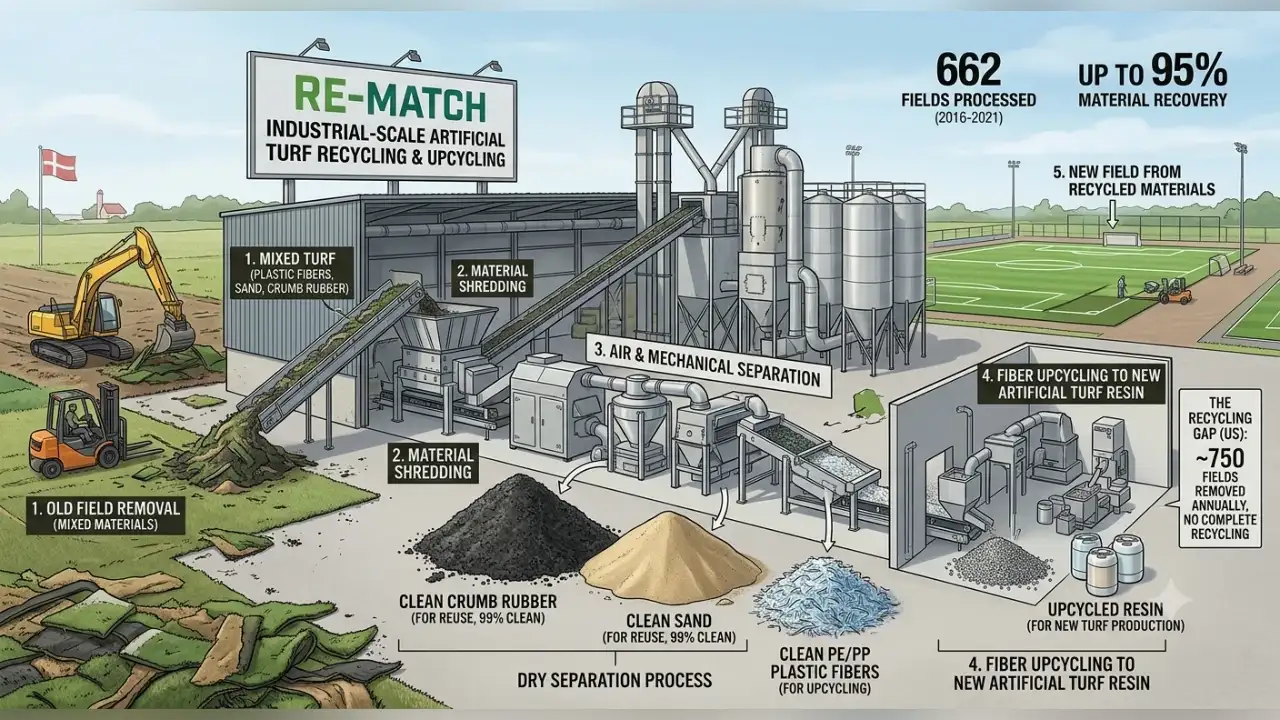
In 2016, Denmark opened a plant using dry separation to recycle artificial turf. 5 years later, it had processed 662 fields and recovered up to 95% of their materials

Artificial turf may look like a simple plastic surface, but an old field contains several materials that have to be separated before they can be recovered.

The turf is made from plastic fibers, while sand and crumb rubber are used as infill. After years of use, these materials become mixed together, turning the removal of an old field into a difficult recycling problem.
Denmark began tackling that challenge in 2016 when Re-Match built what it described as the world's first recycling facility for synthetic turf on an industrial scale, as per an Innovayt report.

Since opening in 2016, the facility has been used to recycle end-of-life artificial turf, with Re-Match saying its process can recover up to 95% of the material.

Why artificial turf is difficult to recycle

A standard field contains about 40,000 pounds of carpet and roughly 400,000 pounds of infill.

The grass fibers are made from plastics such as polyethylene and polypropylene. Sand provides ballast, while crumb rubber offers shock absorption and helps keep the blades upright.

But the infill does not stay neatly separated from the carpet.

Over years of use, studs and rain drive the sand and rubber down into the tufts. When the field is removed, the carpet, infill and other material can come out together as one mixed load.

That mixture has to be separated before the individual materials can be recovered.

READ ALSO: In 2001, protected tropical forests entered a global wildfire study spanning 24 years. 23 years later, more than 4 million hectares had been destroyed by fire, twice the size of Wales, with annual losses roughly 9 times higher after 2016

How Denmark separates the materials

Re-Match was founded in Denmark in 2013 with the goal of developing an environmentally friendly way to recycle synthetic turf on an industrial scale.

In 2016, the company built its first recycling facility, using a dry-separation process to divide old turf into plastic fibers, sand and rubber.

The company says the process can recover up to 95% of the material from end-of-life artificial turf, with the recovered sand and rubber coming out up to 99% clean.

Instead of treating an entire removed field as a single waste stream, the process separates its main components so they can be recovered individually.

Turning old turf into new materials

Re-Match says its process produces rubber, sand and plastics from end-of-life turf.

The company has also worked on a method for upcycling used plastic turf fibers into high-quality resin that can be used to make new artificial turf.

The aim is to create a more circular system in which materials from old fields can be returned to production rather than discarded.

In early 2020, Re-Match and Innovayt prepared a funding proposal for the European Union's EIC Accelerator programme. Re-Match subsequently secured a €2.5 million grant to help develop the plastic upcycling process.

READ ALSO: In 1901, Wuppertal opened a railway suspended 26 to 40 feet above the city. 125 years later, the 8.3-mile Schwebebahn remains the backbone of local transport, carrying more than 80,000 passengers every day

The recycling gap in the US

The scale of artificial turf installations shows why recycling capacity matters.

There are roughly 19,000 artificial turf fields in the United States, with as many as 1,500 installed each year. About half of those installations replace older fields, meaning around 750 fields could be removed annually.

There is no comparable recycling plant in the United States.

A California state review found that landfill disposal was by far the most common route for removed artificial turf, as per The Pulse report. It also reported no complete example of an actual recycling project for a removed field anywhere in the state.

The sheer weight of the material adds to the challenge. A standard field contains about 40,000 pounds of carpet compared with roughly 400,000 pounds of infill.

A different future for old artificial turf

Re-Match's Danish facility shows how dry separation can turn an old field from a mixed waste stream into separate materials that can be recovered.

Five years after the plant opened, it had processed 662 fields and recovered up to 95% of their materials.

The company is also working to upcycle plastic turf fibers into resin for new artificial turf, moving its approach beyond separation and toward reuse of the materials recovered from old fields.

READ ALSO: In 1876, Rev. T. De Witt Talmage warned Americans that summer novels were “literary poison.” 150 years later, BookTok’s nearly 2 billion users have turned summer reading into a major cultural phenomenon

Sign up to read this article
Read news from 100's of titles, curated specifically for you.
Already a member? Sign in here
Related Stories
Top stories on inkl right now
One subscription that gives you access to news from hundreds of sites
Already a member? Sign in here
Our Picks
Fourteen days free
Download the app
One app. One membership.
100+ trusted global sources.