Get all your news in one place.
100's of premium titles.
One app.
Start reading
The Times of India
The Times of India
World
TOI World Desk

In 2015, helicopters began dropping logs into Washington's Queets-Clearwater watershed, helping crews rebuild 8 miles of critical salmon habitat

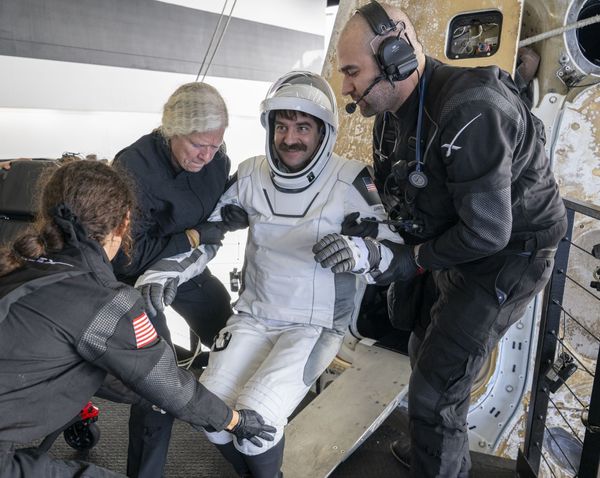
Imagine a helicopter flying through a dense Washington forest with no roads in sight, carrying a full-sized log like cargo. That log is headed straight into a river, not a lumber mill. According to NOAA Fisheries , the federal agency that oversees America’s ocean and river life, the Quinault Indian Nation and its partners are doing just that. On Washington’s Olympic Peninsula, they are using helicopters to fly logs to remote tributaries to restore salmon habitat destroyed by logging generations ago.

Get breaking news anytime, anywhere. Download the TOI app now!
A crisis that forced action

In 2015, the problem became impossible to ignore. That year, there weren’t enough coho salmon to spawn in the Queets-Clearwater watershed, and the Quinault Indian Nation had to close its own salmon fisheries. That was a major setback for a tribe that relied on salmon for food and income. In the NOAA feature, tribal spokesperson Cleve Jackson said the closure meant no income for fishermen and no food for their people.

So why were the fish vanishing? The answer goes back decades to when enormous old-growth trees were cut down in the region. Those big trees themselves used to fall into rivers. When they got into the water, they slowed the current, trapped gravel, and created deep pools. All this is important to salmon. Without fallen wood, rivers turn into fast, shallow channels with nowhere for fish to rest, hide, or lay eggs.

Why helicopters

Much of the Olympic Peninsula has no roads at all. Building new roads just to haul in logs would mean clearing more forest, which defeats the purpose. So, the Quinault Indian Nation partnered with Trout Unlimited and The Nature Conservancy, funded by NOAA’s Office of Habitat Conservation, to bring logs in by helicopter to these remote streams. According to NOAA Fisheries, together they have constructed more than 130 engineered log jams across 8 miles of habitat in the Queets-Clearwater watershed.

This approach is not limited to a single river or tribe. A similar, and even bigger, effort has been underway on the Yakama Reservation in central Washington, where the Yakama Nation has placed more than 6,000 logs along roughly 24 miles of streams, according to reporting from Oregon Public Broadcasting. Yakama Nation habitat biologist Scott Nicolai told OPB that decades ago, his job was to pull logs out of streams, since biologists once believed logjams blocked fish. Today, he helps put them back in.

What the science really shows

The study, ‘Food-web dynamics of a floodplain mosaic overshadow the effects of engineered logjams for Pacific salmon and steelhead’ led by researcher James Paris and colleagues and published in Ecological Applications , tracked insect and fish production in several channels of the Methow River in north-central Washington, comparing conditions in 2009- 2010 with 2015-2016. The study finds that in some cases, the natural annual variations in floods and food supply were more important than the engineered logjams themselves, even after they were installed.

The food supply is as important as shelter. In research published in PLOS ONE , Carson Jeffres and colleagues measured zooplankton, an important food source for young salmon, in a flooded Sacramento River floodplain in California. The animals were 53 times more abundant in the slow floodplain water than in the fast-moving river. In that floodplain, too, juvenile Chinook salmon grew about five times faster than fish in the river channel. That finding suggests that restoring rivers to slower side channels can be as important as adding logs.

What this means for US rivers

Floods, droughts and changing channels can obscure or exaggerate a project’s true impact, so NOAA and its partners are measuring results over many seasons, rather than judging success after just one year.

But projects like the one on the Queets-Clearwater watershed show what can be accomplished when tribal leadership, federal dollars and conservation groups work together. Not all habitat restoration requires heavy machinery or paved roads. Sometimes it takes a helicopter, a couple thousand logs, and a whole lot of patience.

Sign up to read this article
Read news from 100's of titles, curated specifically for you.
Already a member? Sign in here
Related Stories
Top stories on inkl right now
One subscription that gives you access to news from hundreds of sites
Already a member? Sign in here
Our Picks
Fourteen days free
Download the app
One app. One membership.
100+ trusted global sources.