Get all your news in one place.
100's of premium titles.
One app.
Start reading
The Economic Times
The Economic Times
Debjit Sinha and ET Science Desk

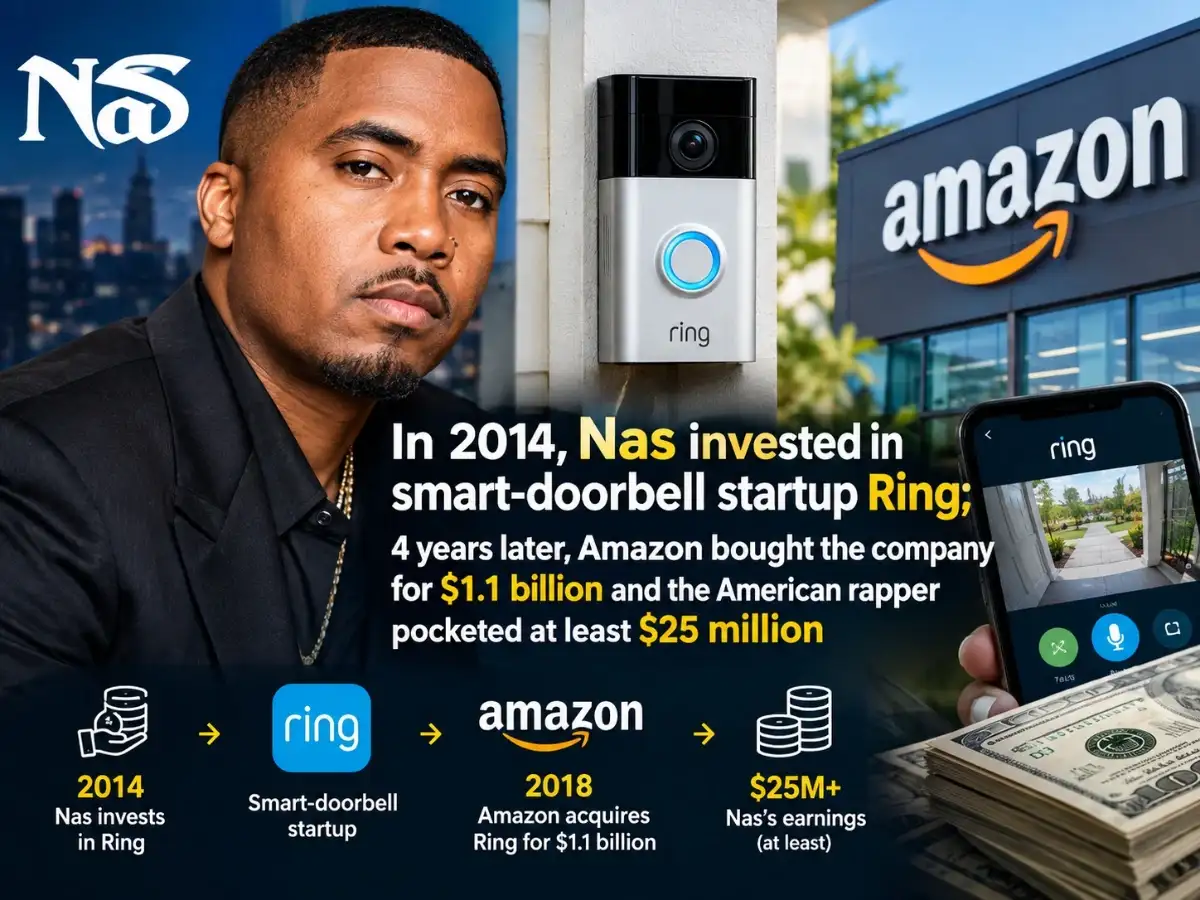
In 2014, Nas invested in smart-doorbell startup Ring; 4 years later, Amazon bought the company for $1.1 billion and the American rapper pocketed at least $25 million

In 2014, Nas made an investment that demonstrated how the business instincts of a hip-hop artist could extend far beyond music. Through QueensBridge Venture Partners, the venture fund he co-founded, the rapper became an early investor in Ring, a startup developing smart video doorbells and connected home-security technology. Four years later, that relatively early bet became one of the most remarkable celebrity investment stories of the decade when Amazon acquired Ring. Contemporary reports put the headline value of the transaction at about $1.1 billion, while Amazon’s regulatory filings later recorded approximately $839 million in cash consideration net of cash acquired. Forbes subsequently reported that Nas personally pocketed at least $25 million from the transaction, turning a technology investment into a major financial success.

The story is particularly interesting because Nas was already famous as one of hip-hop’s most influential artists, but his investment activity showed a different side of his career. In 2013, he founded QueensBridge Venture Partners, named after the Queensbridge housing projects in New York where he grew up. Rather than limiting his financial interests to entertainment, Nas and his investment partners began backing young technology companies, often at an early stage when their future was uncertain.
Forbes reported that QueensBridge had invested in more than 100 companies, including Dropbox, Lyft, FanDuel, Casper and Genius. Ring was part of this broader strategy: identifying startups with potentially transformative products before their businesses became household names.

READ ALSO: In 2003, Mexico's Salinas Victoria used landfill methane to tackle waste pollution; the result made 7 MW, powering 25,000 homes and Monterrey’s public transport network daily

Ring itself represented a powerful idea at a time when the smart-home industry was rapidly developing. The company built connected security products that allowed homeowners to see, hear and communicate with people at their doors remotely. Its video doorbell combined a familiar household object with cameras, internet connectivity and smartphone access, helping turn the front door into another connected point in the emerging smart home.

By 2018, the concept had attracted Amazon's attention as the technology giant expanded its presence in connected-home devices. Amazon and Ring officially completed their acquisition on April 12, 2018, with Amazon saying the companies would work together to accelerate Ring’s mission of making home-security products and services more accessible.

For Nas, the Ring transaction illustrated why early-stage investing can create opportunities that are difficult to see from the outside. A startup investment does not simply depend on whether a product is popular; investors are effectively betting on a company’s technology, market opportunity, leadership and ability to scale. Ring eventually became valuable enough to attract one of the world’s largest technology companies.

Forbes reported that QueensBridge’s investment in Ring came in 2014 and that Nas ultimately received at least $25 million from the sale. The exact amount of his personal proceeds was not publicly established in the Forbes report, making the “at least” qualification important when discussing the rapper’s financial return.

The Ring acquisition also reflected Amazon’s broader interest in building an ecosystem around the connected home. Amazon said at the time that Ring, Blink and Amazon Cloud Cam would continue operating under their respective brands, while the companies worked together on home-security products and services.

READ ALSO: Nokia began in 1865 as a paper mill, expanded into rubber and cables, launched its first handheld in 1987 and led mobile phones by 1998; after 149 years, its handset business was sold to Microsoft in 2014

Amazon’s acquisition strategy was not limited to acquiring a recognizable consumer product; its own filings state that acquisitions were intended to obtain technologies and know-how that could help Amazon serve customers more effectively. Ring therefore fit into a wider technology strategy involving devices, services and the increasingly connected relationship between homes and the internet.

Nas’s Ring investment became even more notable because it was not an isolated technology bet. His QueensBridge portfolio included companies from a variety of sectors, demonstrating an approach centered on identifying emerging businesses rather than simply investing in established entertainment brands.

Forbes also highlighted his early investment in Coinbase, which later became extremely valuable when the cryptocurrency exchange went public through a direct listing in 2021. The Ring and Coinbase stories helped reinforce Nas’s reputation as a celebrity investor who was willing to participate in technology ventures long before their eventual scale became obvious to the broader public.

There is also a broader lesson in the timeline. In 2014, Ring was still a startup operating in a developing smart-home market. By 2018, Amazon had completed its acquisition, transforming an early investment into a major exit. That four-year period demonstrates how rapidly technology companies can evolve when consumer behavior, innovation and large-scale distribution converge.

READ ALSO: In 2017, Gloucestershire processed 35,000 tonnes of food and farm waste into biogas; the result generated 4.56 GWh of power for 1,400 homes at Rose Hill Recycling

At the same time, the story should not be interpreted as evidence that every early startup investment will produce a spectacular return. Venture investing involves substantial uncertainty, and successful exits represent only one part of a much larger landscape of companies and investments.

Nas and Ring story is about the changing boundaries between entertainment, technology and entrepreneurship. Nas entered the investment world through QueensBridge Venture Partners and became an early backer of companies whose products addressed emerging consumer trends.

Ring’s eventual acquisition by Amazon gave the rapper one of his most visible investment wins, with Forbes reporting that he personally pocketed at least $25 million. The episode helped establish a compelling chapter in Nas’s business career: an artist known for recording music had also recognized the potential of a smart-home technology company years before it became part of Amazon’s global technology ecosystem.

Sign up to read this article
Read news from 100's of titles, curated specifically for you.
Already a member? Sign in here
Related Stories
Top stories on inkl right now
One subscription that gives you access to news from hundreds of sites
Already a member? Sign in here
Our Picks
Fourteen days free
Download the app
One app. One membership.
100+ trusted global sources.