Get all your news in one place.
100's of premium titles.
One app.
Start reading
The Times of India
The Times of India
World
TOI World Desk

In 2013, California’s Rim Fire burned across the Sierra Nevada; more than a decade later, crews are planting 125,000 trees, including giant sequoias, across parts of the burn scar

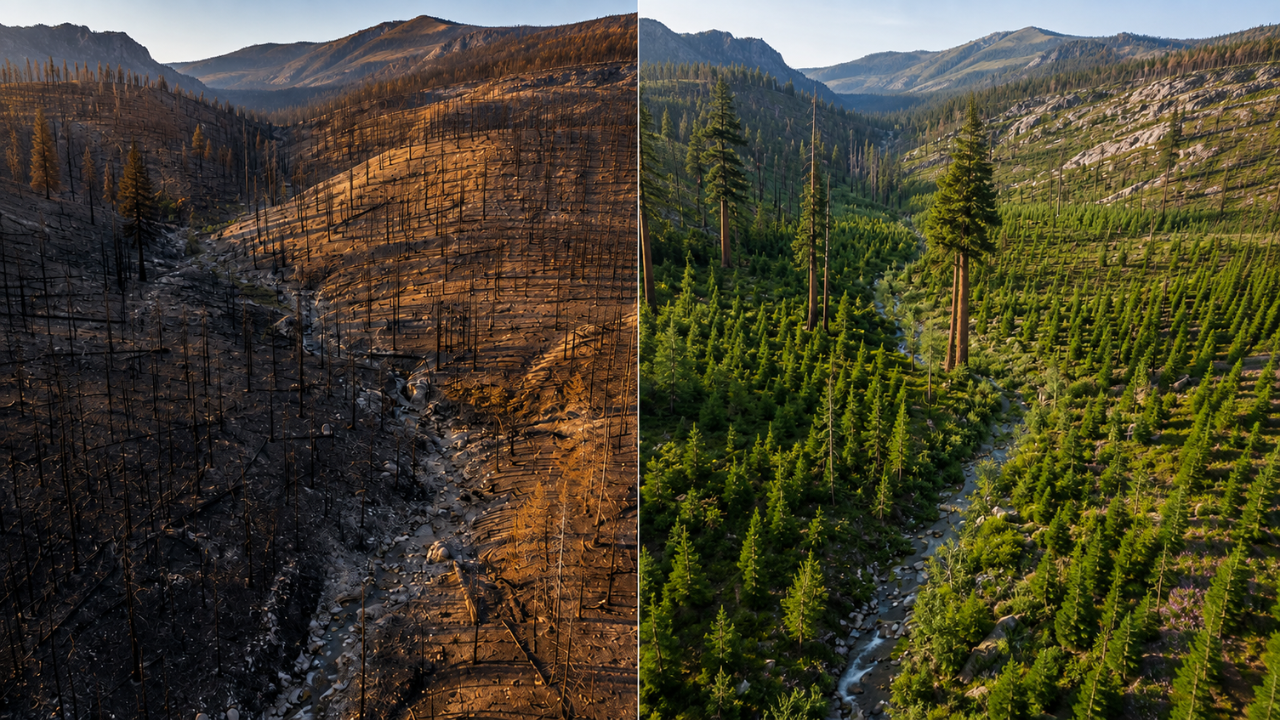
If you've driven through Yosemite on Highway 120, you may have passed through land still affected by one of California's largest recorded wildfires. According to American Forests , the conservation nonprofit that works with Ecosia, crews planted 125,000 trees from May to June in the Rim Fire burn scar in the Sierra Nevada, including fire-resistant giant sequoias. For a generation that has grown up watching wildfire smoke turn American skies orange every summer, this project is a rare, hands-on look at what recovery actually involves on the ground.

Get breaking news anytime, anywhere. Download the TOI app now!

A fire that changed the Sierra Nevada forever

The Rim Fire started as an illegal campfire on August 17, 2013 and soon became one of the biggest wildfires on record in the Sierra Nevada. The blaze burned approximately 257,000 acres, mostly in Stanislaus National Forest and parts of Yosemite National Park. More than one-third of the area burned at high intensity, meaning that in some places almost nothing survived, including seed-bearing trees.

Why nature alone can't always regrow the forest

It may seem that forests can simply regrow on their own after a fire. Often they do just that. However, a high-intensity fire sets a new challenge. A study conducted by researchers from UC Davis and the US Forest Service published in the journal Ecosphere examined nearly 1,500 plots in burned areas in California and found that 43% showed no evidence of natural conifer regeneration even five to seven years after the fire. The study notes that when a fire kills nearby seed-producing trees, there may be nothing left to naturally reseed the land. That is precisely the gap that hand-planting efforts like the one in the Rim Fire scar are designed to fill.

Sequoias need a helping hand too

Giant sequoias are known to survive fires well because of their very thick, spongy bark and cones, which open to release seeds when heated. However, even sequoias have a breaking point. A report by scientists from the US Geological Survey and National Park Service estimated that the 2020 Castle Fire resulted in the death of 10-14% of all sequoias over a certain size range in California. This means that somewhere around 7,500-10,600 of these ancient trees perished due to that single fire. According to the scientists, once fires are hot enough to burn the tree crowns and cones, it becomes difficult for the trees to reproduce. This is one of the reasons why sequoia seedlings are now planted in areas such as the Rim Fire scar.

What this means beyond one burn scar

This project is about more than pretty trees. American Forests notes that this newly planted forest is not only meant to protect the Hetch Hetchy watershed that supplies clean drinking water to the greater San Francisco Bay Area, by anchoring soil and reducing erosion and runoff into the reservoir, but also to cool down and store carbon, as the trees play a crucial role in climate change mitigation efforts. Planting a mix of species, rather than just one, is meant to make the new forest more resistant to the next fire and less likely to repeat what burned before.

The bigger picture for a generation watching wildfires grow

Millennials and Gen Z may not have invented climate anxiety, but they are living with the consequences of decades of warming and increasingly damaging fire seasons. This project will not reverse decades of damage overnight, and a single tree-planting effort cannot outpace climate change. But restoration scientists point out that how well these seedlings ultimately survive depends on the weather in the years ahead.

Still, planting 125,000 trees, including sequoias, is a concrete step grounded in data about where and why forests fail to regenerate on their own, even if their long-term success still hinges on conditions no one can fully control. Slow, painstaking efforts like these will help shape what the Sierra Nevada looks like by the time millennials' children are old enough to visit Yosemite.

It will still take many years before the Rim Fire scar resembles the ancient forest it once was. However, thanks to hard work on the ground and science guiding where planting should take place, it is now not only a scar but also a growing forest.

Sign up to read this article
Read news from 100's of titles, curated specifically for you.
Already a member? Sign in here
Related Stories
Top stories on inkl right now
One subscription that gives you access to news from hundreds of sites
Already a member? Sign in here
Our Picks
Fourteen days free
Download the app
One app. One membership.
100+ trusted global sources.