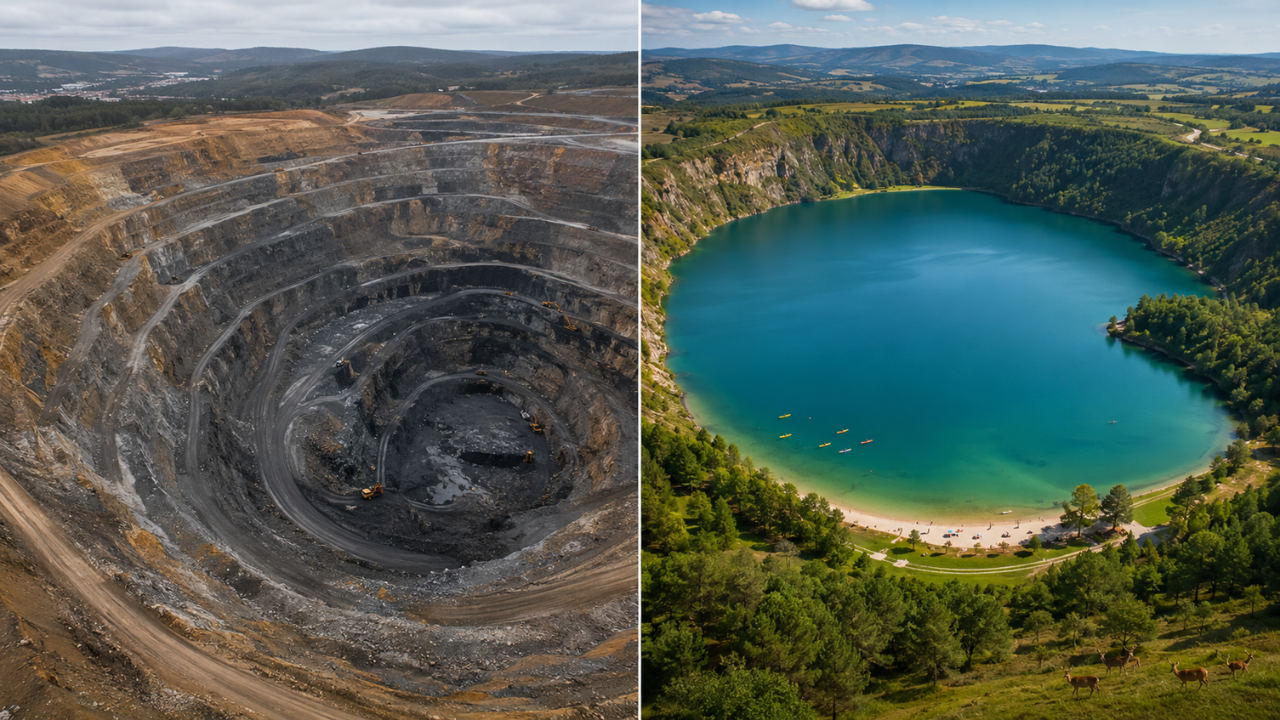
Think of the biggest hole you’ve ever seen. Now make it nearly as deep as the Eiffel Tower is tall and spread it out over an area about the size of 1,600 American football fields. This was the hole left in northwest Spain after nearly 60 years of coal mining. Then, in 2008, engineers did something almost no one expected: they filled it with water. According to a 2023 engineering study, ‘ Environmental recovery of As Pontes mine pit lake ,’ published in the journal Boletín Geológico y Minero, the pit held about 547 billion litres of water. A little over four years after this, Spain gained its new lake, which became one of the largest artificial lakes in Spain.
Get breaking news anytime, anywhere. Download the TOI app now!

A coal mine that ate the landscape for 60 years
The story begins in the 1940s, when a state-run company started extracting lignite, a kind of brownish coal, from the area around As Pontes in Galicia. By 1972, the mine and the power plant situated next to it were owned by Endesa, one of Spain’s leading electricity providers. Industry records describe that plant as the biggest coal-fired power station in Spain at the time. In just over 60 years, workers excavated roughly 260 million tonnes of lignite from the earth, creating a hole over 300 metres deep.
Why lignite specifically leaves such a mess behind
Lignite is often called "brown coal" because it's the youngest and least energy-dense form of coal, formed under less heat and pressure over a shorter geological timescale than harder coals like anthracite or bituminous coal. That lower energy density means power plants have to burn far more lignite to produce the same amount of electricity, which is part of why lignite mining tends to involve moving enormous volumes of earth relative to the fuel actually extracted. Lignite deposits also often sit closer to the surface, which is why they're typically extracted through vast open-pit mining rather than underground shafts, the same method used at As Pontes. That combination, shallow deposits and high fuel volume needed, is a major reason lignite mining tends to leave behind the kind of massive open pits seen not just in Spain but across similar coalfields in Germany, Poland, and the western United States.
In 2007, due to stricter regulations regarding air pollution established by the European Union, the mine was shut down permanently. While closed mines often leave lasting damage, As Pontes’ case was different. Endesa's own account of the project details how the closure was treated as the start of a rehabilitation effort, not the end of the story.
Turning a scar into a lake, on purpose
Filling a hole like this is far more complicated than simply turning on a tap. Engineers had to figure out where the water would come from, how fast it could safely rise and what would happen to the chemistry once it settled. This is what the research team behind the Boletín Geológico y Minero paper were trying to analyse. The study, by engineers Francisco Rivas, Javier Samper and Luis Montenegro from the University of A Coruña, follows the filling process from start to finish.
Filling was completed on 18 April, 2012, a little over four years after it began. The total volume of water pumped was about 547 billion litres. A separate study, ‘ Hydrochemical Evolution of the filling of the Mining Lake of As Pontes (Spain), ’ published in the journal Mine Water and the Environment, followed the water quality through the process and confirms both dates.
Why the water forms two different layers
According to the same study in Mine Water and the Environment, the lake formed two separate layers divided by a line scientists call a chemocline, an invisible barrier in the water. The first layer is only mildly acidic and high in oxygen, similar to a freshwater lake. The second layer, hundreds of metres down, has almost no oxygen and is far more acidic, with a much lower pH than the layer above it. The result is one lake with two distinct layers stacked on top of each other. This, the authors of the study say, is because the water came from more than one source and slight differences in temperature and mineral content prevented the layers from mixing.
From strip mine to swimming spot
Today, the lake covers 865 hectares. It features a sandy beach and nature trails, and it has earned Blue Flag certification, an eco-label that monitors water quality, safety and other factors. According to Endesa's website, four distinct habitats like meadow, scrub, woodland and wetland, have formed naturally around the shoreline, and deer now roam slopes that were once waste rock. People now kayak and canoe in waters that were once 300 metres below the mining machinery. The company says tourism has become an important source of income for a town that once depended heavily on the mine for jobs.
Why this matters well beyond Spain
As Pontes is not a unique case. Old surface mining operations have left similar holes across the world, from Lusatia lignite fields in Germany to old coal mines and mineral pits in Australia, Nevada, Montana, and West Virginia. Not all of these sites have been engineered properly, like As Pontes, and some of them are still either toxic or acidic today. Scientific research on pit lakes has helped improve understanding of how to manage such sites safely. As more coal mines and coal-fired plants shut down worldwide, As Pontes offers a practical example of how careful chemistry, patience and planning can turn a former mine into a place people want to visit on weekends.