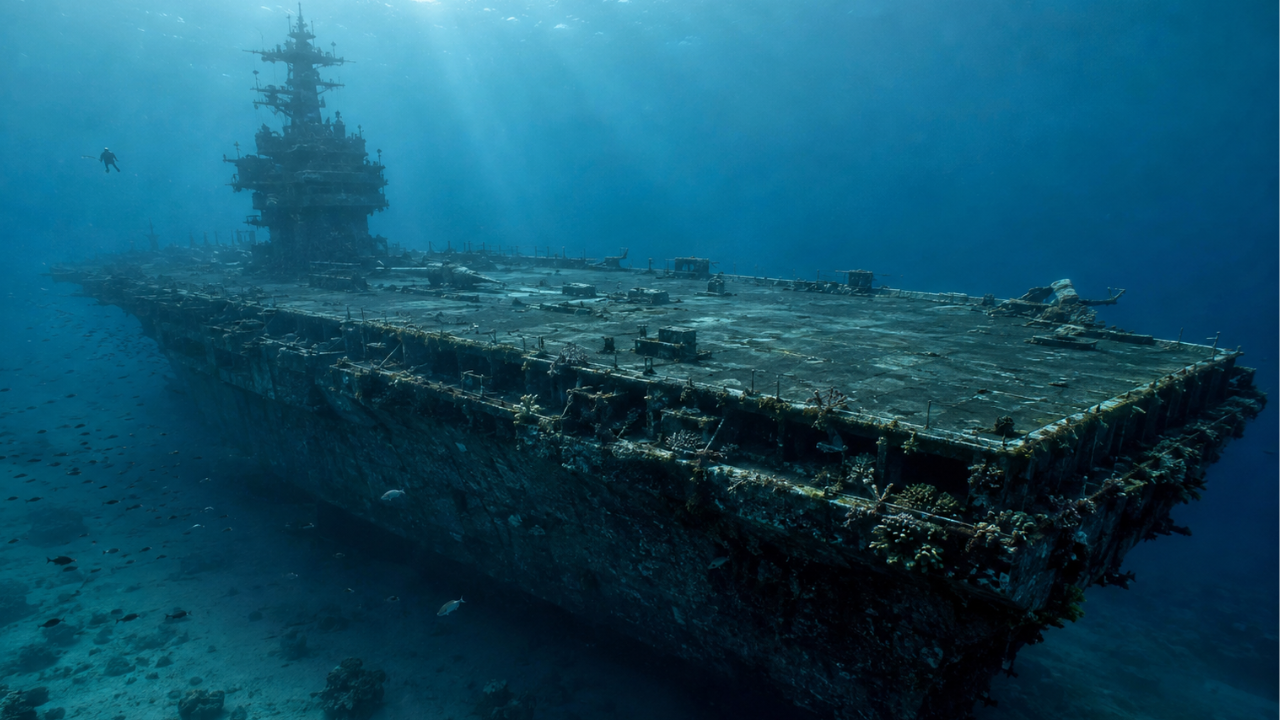
Most shipwrecks happen by accident. This one was deliberate. On May 17, 2006, the U.S. Navy sank the 911-foot aircraft carrier USS Oriskany in the Gulf of Mexico about 22.5 nautical miles off Pensacola, Florida. It settled on the seabed at 212 feet. According to the Florida Fish and Wildlife Conservation Commission (FWC) , which helped run the project, the "Mighty O" remains the largest artificial reef and the largest warship ever intentionally sunk in U.S. waters.
Get breaking news anytime, anywhere. Download the TOI app now!

The Oriskany wasn't some retired barge. Built just after the Second World War, it served for 25 years, mostly in the Pacific. She earned two battle stars for the Korean War, ten for the Vietnam War, and could carry as many as 80 aircraft. The Oriskany was retired in September 1976 and then remained unused for years before officials decided what to do with it.
Turning a warship into a reef made sense
The scrapping of a ship this size can be expensive and slow. Sinking it on purpose, in the right spot, turns a dead asset into a living one. Bare sand on the Gulf floor doesn't support much marine life. A 911-foot steel structure does, because aircraft carriers are large enough for fish, coral, and sponges to grow on.
This wasn't a rogue decision by one agency. It was a joint effort among the US Navy, the FWC, and Escambia County, and it took years of planning before the ship ever touched water.
Artificial reefs don't just attract fish; they gradually become complex underwater ecosystems. Within months of the sinking of a ship, algae and tiny creatures begin coating its steel surfaces. Then there are barnacles, corals, sponges and other invertebrates that provide food and shelter for larger marine species. Over time, the wreck becomes a layered habitat supporting everything from small bait fish to top predators. These sites are often studied by researchers to better understand reef development, fish populations and biodiversity. Therefore, intentionally reefed ships are valuable not only for recreation and tourism, but for long-term marine science and conservation.
Cleaning up before the sinking
You can’t just throw a decommissioned warship into the sea. Older ships like the Oriskany tend to have polychlorinated biphenyls, or PCBs, a chemical once used widely in electrical wiring and insulation that can be harmful to marine life in large quantities.
Before the sinking could go ahead, the US Environmental Protection Agency had to sign off. EPA's announcement confirms that the agency approved disposal of PCBs in electrical cable, insulation, and heat-resistant paint aboard the ship after reviewing leaching studies and risk assessments submitted by the Navy. About 700 pounds of PCBs remained in solid materials that could not be practically removed, but the EPA found that the sinking would not pose an unreasonable risk to human health or the environment.
What scientists found once it settled
Since then, scientists have been watching the Oriskany site for marine life and any chemical traces that might still be there.
A peer-reviewed ecological risk assessment on the Ex-Oriskany reef project looked at exposure pathways for fish and other bottom-dwelling organisms on and around the wreck, modelling how contaminants might move up the food chain over time. The report did not conclude that the risk was zero, but that it was acceptable based on the data collected, and that the reef has since become a real habitat rather than a hazard. Divers often find grouper, snapper, and barracuda around the hull, along with coral and sponge growth.
Diving America's biggest wreck isn't casual
The Oriskany is not a beginner dive site, and the FWC is clear on that. The ship sits upright on the seabed, bow facing south, with its flight deck at roughly 145 to 150 feet and the top of its island structure at around 84 feet. The FWC's own safety guidance says divers need advanced training for depths greater than 100 feet, and technical certification and specialised gear are required for depths beyond 135 feet. Divers are also cautioned against entering the ship’s interior, due to unpredictable structural damage from corrosion and past storms.
The record may not last much longer
The Oriskany has held its title for two decades, but that may be about to change. The former ocean liner SS United States has been undergoing environmental clean-up at the Port of Mobile, Alabama, with plans to sink it off Florida’s Gulf coast as an even larger artificial reef, pending final approval from federal agencies. Once deployed, it would be larger than the Oriskany by sheer size. It would not take the Oriskany's title because the SS United States was a passenger liner, not a warship.
Why this still matters
The story of the Oriskany is a rare case where the military, environmental regulators, and local government work through years of red tape to turn a piece of American history into a functioning ecosystem instead of letting it rot in a scrapyard or vanish entirely. Twenty years later, it is still doing the job it was sunk to do.