Venice has long experienced periodic flooding because of its location within a shallow coastal lagoon connected to the Adriatic Sea. The city's unique setting has shaped its history, but it has also left homes, public spaces and historic buildings vulnerable whenever exceptionally high tides push seawater into the lagoon.
Get breaking news anytime, anywhere. Download the TOI app now!

Periodic high tides, known locally as acqua alta , can flood parts of Venice when water levels rise above normal. Italy developed a movable flood barrier system to reduce the impact of exceptionally high tides while allowing the lagoon's natural tidal exchange to continue under normal conditions, according to the research paper The MOSE Barrier System in Venice: Lessons Learned and Applicability to US Coastal Infrastructure.
According to the research paper, construction began in 2003, and the system became operational after about 17 years of construction, testing and commissioning. Rather than building fixed sea walls, engineers created a system of movable gates that normally remain on the seabed and are raised only when exceptionally high tides are forecast. The project became one of the largest coastal engineering efforts built to protect a historic city from flooding.
How 78 movable gates were designed to protect Venice
Venice lies within a lagoon that connects to the Adriatic Sea through three inlets. Under normal conditions, seawater flows freely between the sea and the lagoon, supporting navigation and the lagoon's natural tidal exchange. During exceptionally high tides, however, larger volumes of seawater can enter the lagoon and increase the risk of flooding across parts of the city.
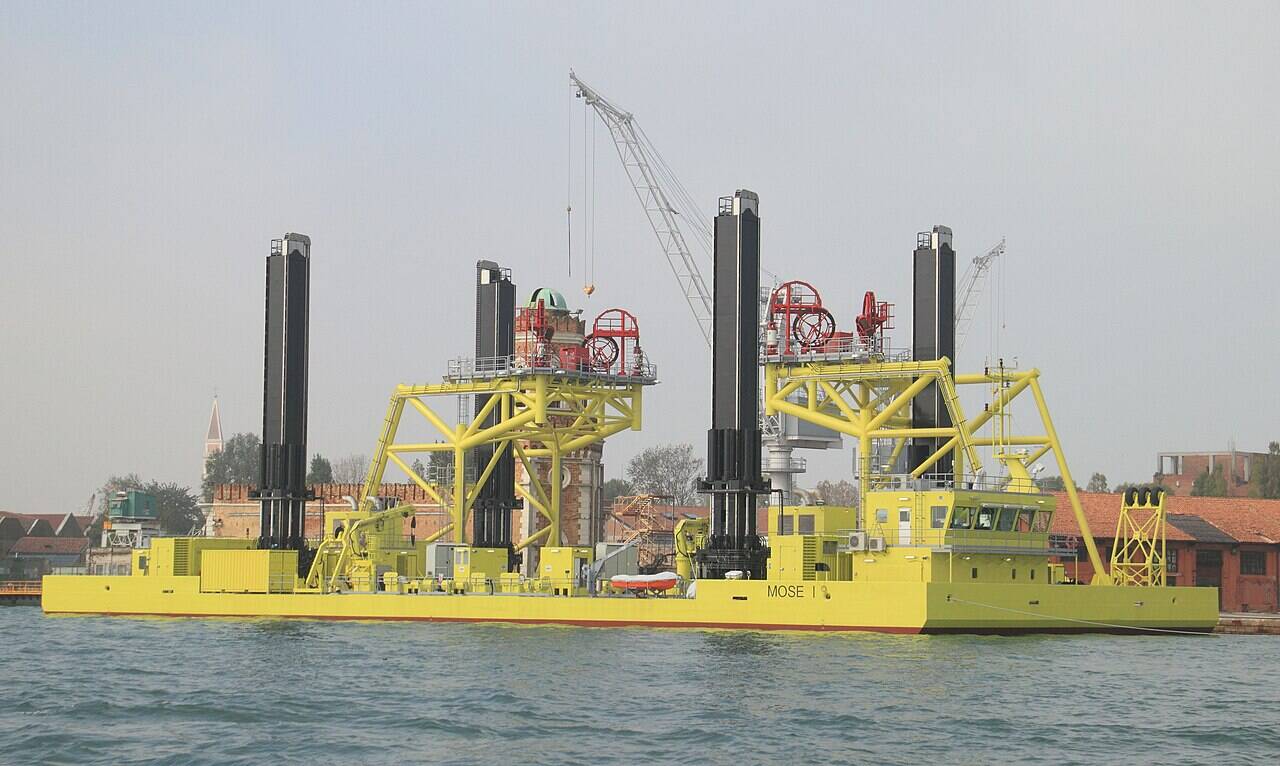
According to the research, the MOSE system was designed to reduce this risk without permanently cutting Venice off from the sea. Engineers installed 78 steel gates inside concrete structures on the seabed at the lagoon's three inlets.
Under ordinary conditions, the gates remain water-filled and rest on the seabed. As the water is pumped out, the gates become buoyant and rotate upward to form temporary barriers across the lagoon entrances. Once water levels return to normal, the air is released, seawater flows back into the gates, and they settle onto the seabed again.
The design allows tidal exchange during normal conditions while providing temporary protection during exceptionally high water. Construction required specialised marine engineering, extensive underwater work and years of testing before the full system became operational.
Like many major infrastructure projects, the barrier system took longer to complete than originally expected. The research notes that the scale of the engineering work, together with technical, financial and management challenges, contributed to the lengthy construction period.
The system's first major test
The barrier system drew attention after severe flooding hit Venice in November 2019. According to the study, the event reinforced the need for effective flood protection, as exceptionally high water caused widespread flooding across the city.
According to the study, the MOSE barriers were raised during a major high-tide event in October 2020. The study states that the system prevented the exceptionally high tide from entering the lagoon at levels that would otherwise have caused much wider flooding across Venice. It was the system's first major operational use during an exceptionally high-tide event.
The research also says the barriers were not designed to prevent all types of flooding. Instead, they are intended to reduce the impact of exceptionally high tides while allowing normal tidal movement for most of the year. Because the gates remain on the seabed when they are not needed, shipping and the natural exchange of seawater can continue under normal conditions.
The paper further explains that operating the system involves more than raising the gates. Reliable weather and tide forecasting, regular maintenance, mechanical inspections and long-term management are all necessary to ensure the barriers function when required. These operational requirements are considered just as important as the engineering itself.
The research also examines whether similar movable barriers could work in other coastal regions facing flood risks. Rather than suggesting that the MOSE design should be copied directly, the study emphasises that local geography, environmental conditions, navigation requirements and long-term maintenance must all be evaluated before adopting comparable systems elsewhere. Although they are rarely visible, the gates are a key part of Venice's flood protection strategy.