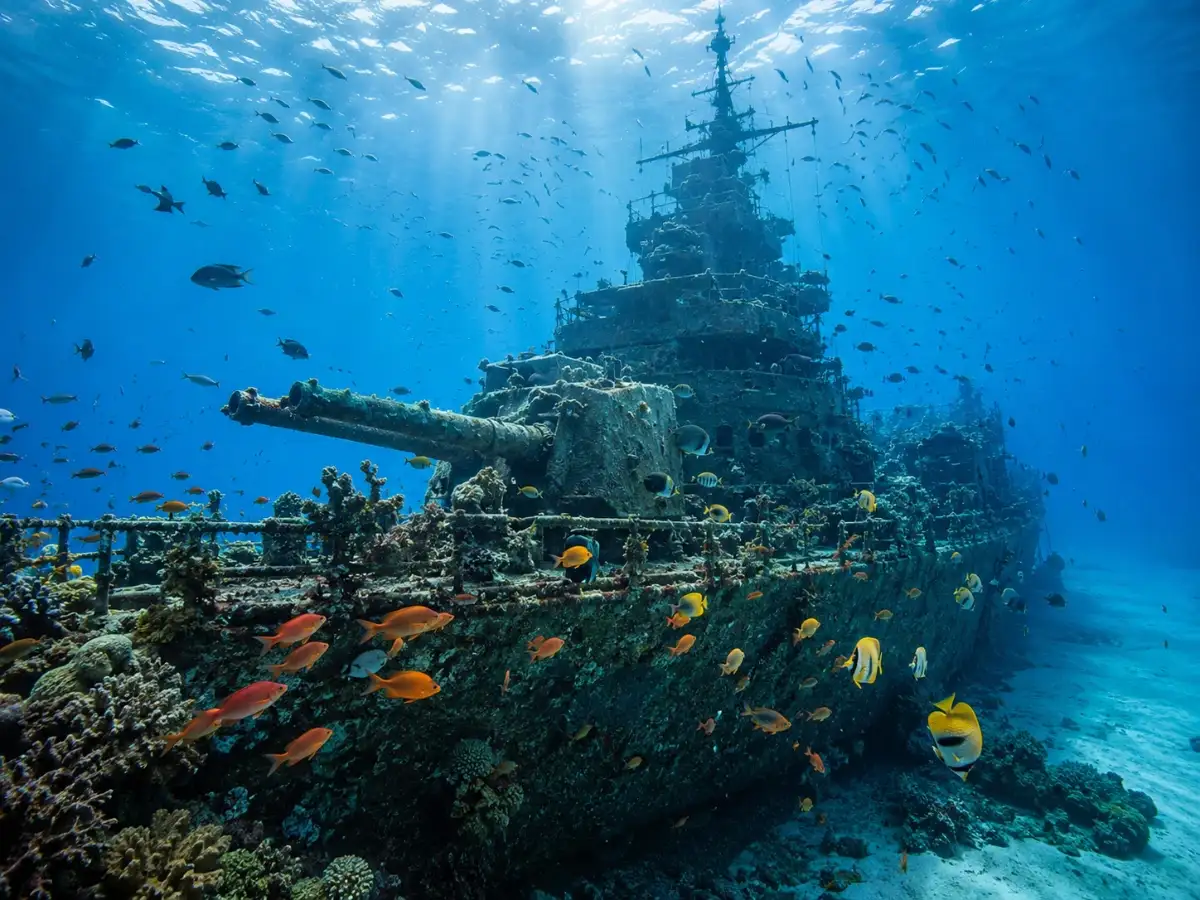
Imagine a 134-metre navy destroyer sliding into the ocean in less time than it would take you to make a cup of coffee. That is roughly what happened off South Australia's Fleurieu Peninsula in 2002. The hull of the decommissioned HMAS Hobart was packed with explosives, and the ship sank in 2 minutes and 17 seconds, according to the Naval Historical Society of Australia. By 2020, eighteen years later, a marine survey found that the vessel housed more than 50 different types of fish. The study, 'Convergence of fish community structure between a newly deployed and an established artificial reef along a five-month trajectory,' featured in Ecological Engineering, helps explain why sunken ships quickly turn into such busy underwater neighborhoods, even though its own observation window was far shorter than Hobart's 18-year record.
A warship built for combat gets a second life

HMAS Hobart was not built to sit still. Built by the Defoe Shipbuilding Company in Michigan, the destroyer was commissioned into the Royal Australian Navy on December 18, 1965, according to naval historical records. It went on to serve three tours during the Vietnam War, in 1967, 1968, and 1970. The navy decommissioned Hobart in 2000, after 35 years of service. According to South Australia's Department for Environment and Water, the Australian Government's Department of Defence formally gifted the vessel to South Australia in June 2000. The plan was to sink it on purpose and let the ocean potentially become a home for marine life.
Three minutes that changed everything
Hobart was towed from Port Adelaide to Yankalilla Bay by tugboats on November 3, 2002. Its hull had been loaded with explosives to provide controlled points of flooding. Two days after that, on November 5, the explosives were detonated. The water flooded the ship quickly, and Hobart sank upright in just over two minutes. The vessel came to rest at a depth of about 30 meters, shallow enough for experienced divers but deep enough to require proper training and gear. The wreck now lies within the Rapid Head Sanctuary Zone, part of Encounter Marine Park, a zone where South Australia's Department for Environment and Water prohibits all fishing to protect the site.