Get all your news in one place.
100's of premium titles.
One app.
Start reading
The Economic Times
The Economic Times
Trending Desk

In 1998, South Korea urged people to save the country from bankruptcy. Millions lined up with gold wedding rings and baby bracelets, raising $2.1 billion in just four months

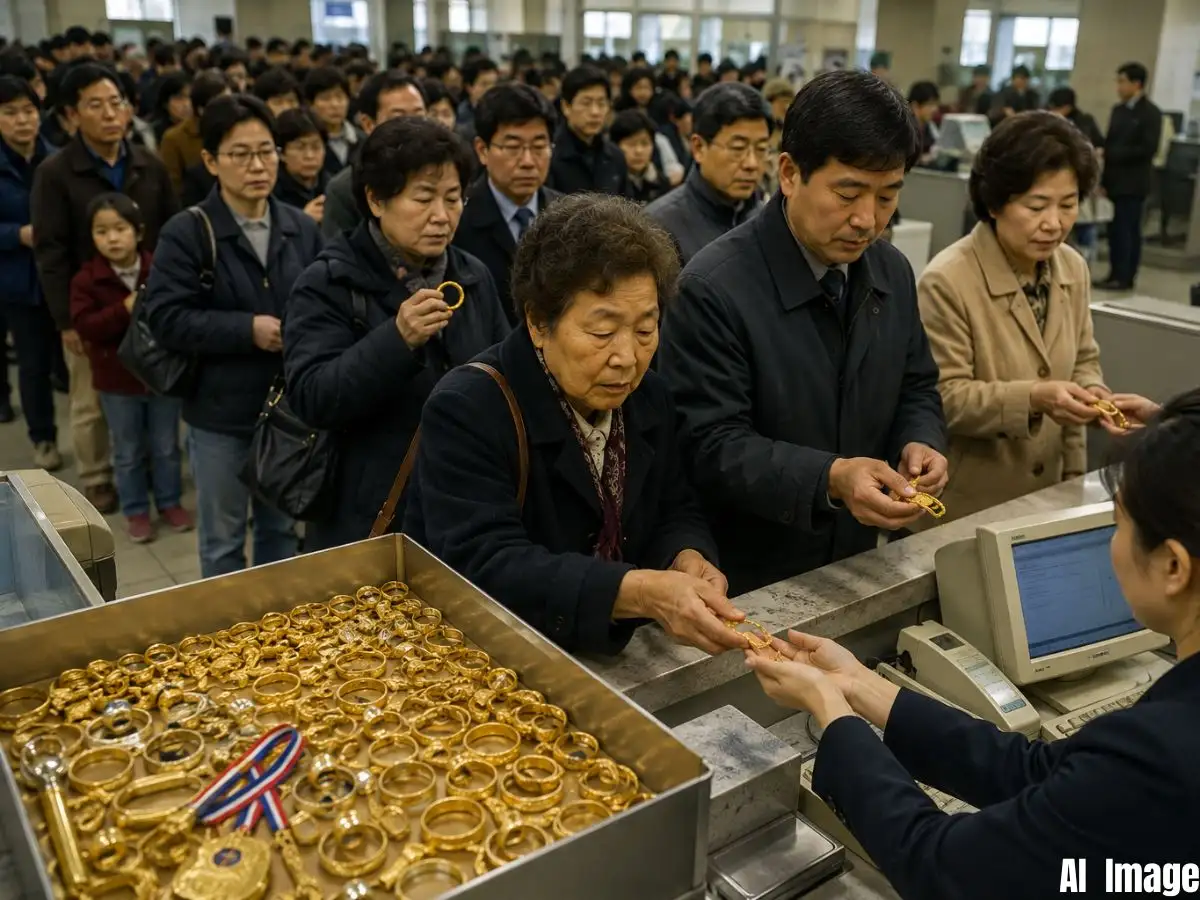
Do you love watching K-Drama? In a real-life story in 1998, banks in South Korea saw something that no international lender had ever recorded before: millions of ordinary citizens walking in, one by one, to hand over their wedding rings, baby bracelets and Olympic medals, not for a loan, not for a scheme, but to help their country repay a debt they had never personally taken.

On the very first day of a public gold-donation drive launched by South Korean broadcaster KBS, banks logged close to 44,748 separate gold deposits, adding up to roughly 3,314 kilograms of gold. Within two weeks, single-day participation touched about 88,500 people. By the time the campaign wound down at the end of April, after being extended into a second phase, nearly 3.51 million South Koreans, about 23 percent of all households in the country, had taken part, contributing an estimated 227 metric tonnes of gold worth close to $2.13 billion at the time.
Also Read: Scientists create artificial life from chemicals, and it eats, grows, and divides like the real thing

The Backstory South Korean Story Nobody Planned For

The gold rush at the banks did not start out of nowhere. Weeks before South Korea formally signed its bailout agreement with the International Monetary Fund, a women's civic group called the Saemaeul Women's Association Central Council had already begun a smaller version of the idea on 20 November 1997, calling it the "Patriotic Ring Collection Campaign." KBS later picked up the concept and scaled it into a nationwide movement.

Both campaigns leaned on a piece of history that every Korean schoolchild grows up knowing. In 1907, when the Korean Empire owed Japan a debt roughly equal to an entire year's national budget, citizens across the country tried to raise the money themselves, w omen sold jewellery, men gave up tobacco and alcohol , children handed over pocket money, to stop Japan from using the debt as an excuse to tighten its grip on Korea. That effort failed, and Japan annexed Korea in 1910 anyway. But the memory of it stayed alive for 91 years, ready to be picked back up the moment the country faced a similar humiliation.

What Actually Went Into the Collection Bins

The gold that arrived at bank counters in early 1998 was not spare jewellery lying around in drawers. It was, by most accounts of the period, gold with a story attached to it. Newlyweds gave up their wedding rings. Parents gave away dol-banji, the 24-karat gold rings traditionally gifted to Korean babies on their first birthday for luck and security. War veterans donated their military insignia. Olympic gold medallists gave their medals. Elderly citizens parted with gold gifted to them by their own children over the years.

One of the more striking donations came from Cardinal Stephen Kim Sou-hwan, Korea's first-ever Catholic cardinal and among the most respected public figures in the country at the time. He handed over the gold pectoral cross he had received when he was made cardinal back in 1969, and, like many others, declined to accept payment for it.

Technically, this wasn't charity in the purest sense. Banks bought the gold at fixed rates, close to market price or slightly under, and paid donors in Korean won. On paper, it was a sale. In practice, most people took a lower price than they could have got elsewhere, and a good number, including the Cardinal, took nothing at all.

The Money Math Didn't Quite Add Up, And That Wasn't the Point

Here's the part that tends to surprise people: the gold campaign, for all its scale, barely moved the needle on Korea's actual debt. The $2.13 billion raised worked out to roughly 3.7 percent of the country's $58 billion IMF bailout package. The gold was melted down into ingots, sold overseas for dollars, and used to chip away at Korea's foreign debt. The real economic turnaround came later, through the IMF's tough conditions, labour reforms, restructuring of the big conglomerates known as chaebols, government spending cuts, and opening the door wider to foreign investment. Those changes brought their own pain: job losses, company shutdowns, and a permanent shift in how Koreans thought about work and job security, debates that continue in Korean politics to this day.

But the campaign's real impact was never really about the money. It was about what the world saw.

A Line the IMF Had Never Seen Before

An IMF official later told KBS in an interview that he had never observed comparable citizen mobilisation in any of the other countries the IMF had bailed out across its 50-year institutional history.

That observation captured something bigger than the balance sheet. South Korea went on to repay its entire $58 billion IMF loan by August 2001, a full three years ahead of schedule. The two decades that followed saw Samsung Electronics climb to the top of the global memory-chip market, BTS make its debut in 2013 and go on to add an estimated $50 billion to Korea's economy over the following ten years, and the broader wave of Korean film, music and television, known globally as Hallyu, turn into one of the country's biggest cultural exports. Korea's per-capita income has since climbed to rank among the highest in East Asia.

Strip away the numbers, and what's left is a simple image: millions of people lining up outside Housing Bank and Nonghyup branches on cold January mornings in 1998, holding out wedding rings and their children's first-birthday gold, expecting nothing back except a smaller sum than the gold was worth. Most of them weren't bankers or economists. They just understood that their country was in trouble, and that this was something they could actually do about it.

More than two decades on, that image still shows up in Korean textbooks, documentaries and news retrospectives, not as a footnote to the 1997 crisis, but as one of the moments that shaped how modern South Korea sees itself.

Sign up to read this article
Read news from 100's of titles, curated specifically for you.
Already a member? Sign in here
Related Stories
Top stories on inkl right now
One subscription that gives you access to news from hundreds of sites
Already a member? Sign in here
Our Picks
Fourteen days free
Download the app
One app. One membership.
100+ trusted global sources.