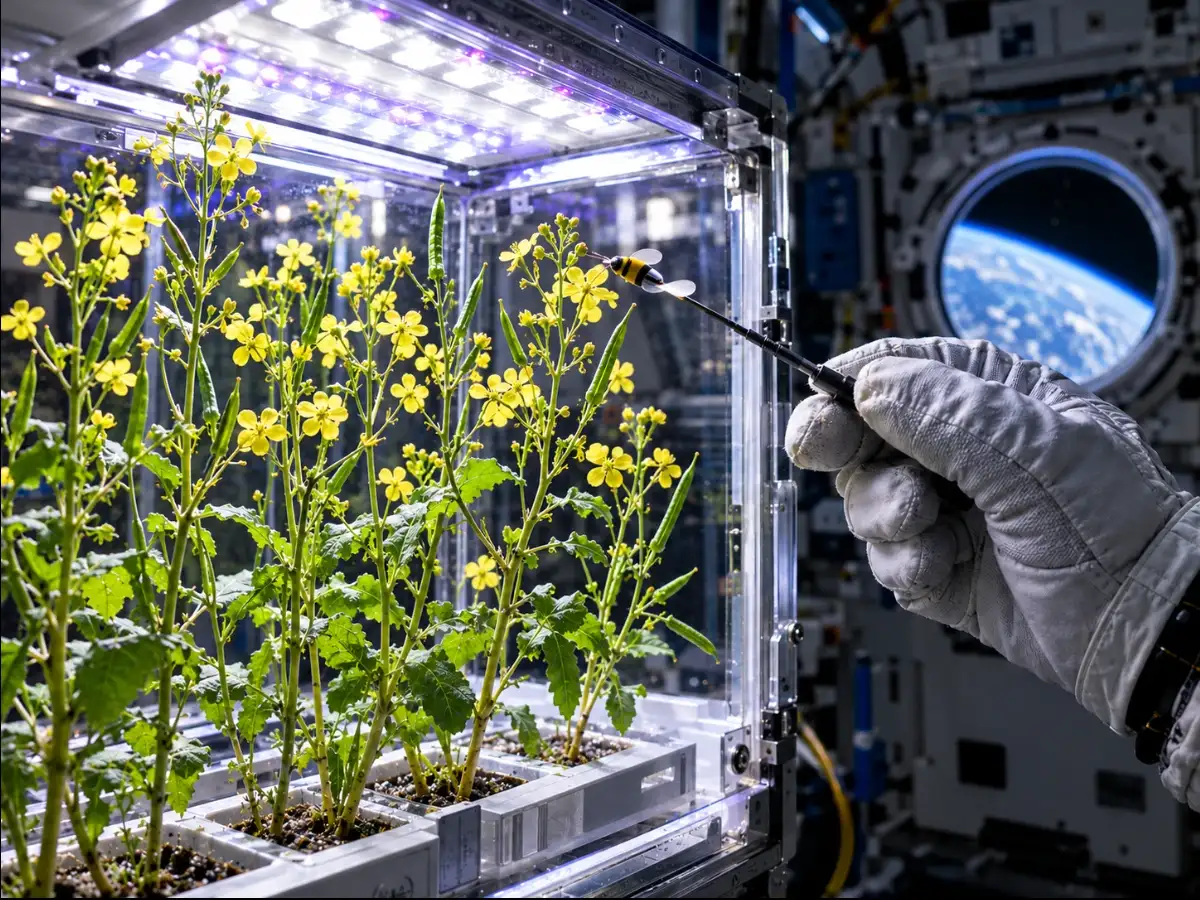
For decades, growing a plant from seed all the way back to seed in space seemed almost impossible. Plants either died before flowering or flowered without producing seed. Finally, the puzzle was solved, according to the study, ‘Gravity independence of seed-to-seed cycling in Brassica rapa,’ published in the journal Planta by a NASA-supported researcher, Mary E. Musgrave, and her team. In 1997, they spent 122 days aboard the Russian space station Mir growing Brassica rapa, a fast-growing relative of Arabidopsis from the mustard family, through two full generations. Plants bloomed and set seed. But the seeds grown in space were smaller and took longer to grow than seeds grown on the ground.
Why scientists wanted a fast-growing plant
Plants are not simply decorations on a spacecraft. They take in carbon dioxide and emit oxygen, expel water vapor that can be trapped and re-used, and can even be eaten. For astronauts on long voyages away from Earth, a crop that could continue to produce itself, generation after generation, would be a great advantage. The Musgrave team had previously conducted shorter tests on the space shuttle using Arabidopsis thaliana, a small plant in the same mustard family. Those initial flights produced something unexpected. The flowers inside the sealed growth chambers were dying, not because of the weightlessness itself, but because of the lack of airflow to bring fresh carbon dioxide to the plants. When the engineers fixed the ventilation problem and restored carbon dioxide flow, the shuttle-grown flowers were as healthy as their ground-based counterparts and produced normal seed. This finding comes from Musgrave, Kuang, and Matthews's 1997 study in Planta, 'Plant reproduction during spaceflight: importance of the gaseous environment,' which documented that later, better-ventilated flights showed normal reproductive development and seed production matching ground controls. That success gave the team confidence to try a much longer experiment aboard Mir.