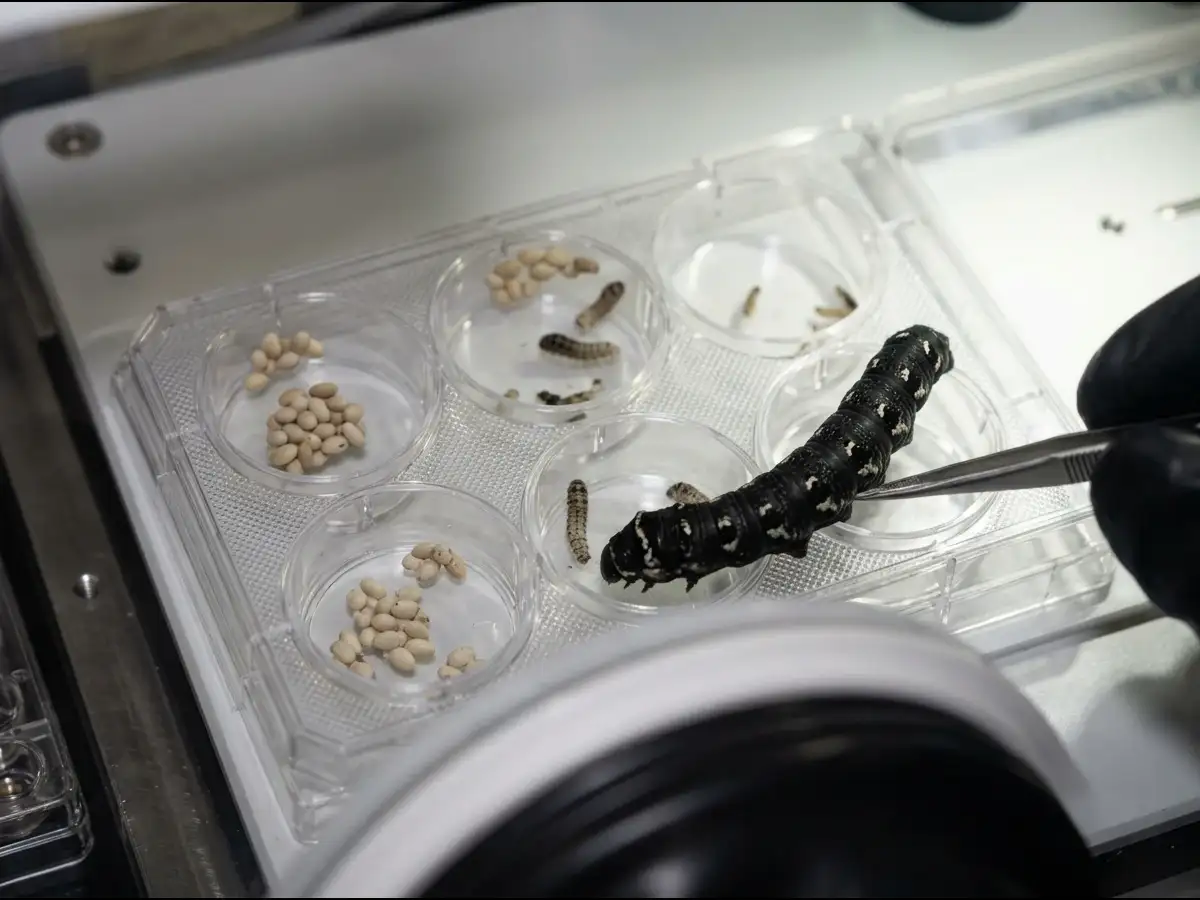
Radiation and microgravity present challenges to life forms in subtle ways that may only become evident through carefully planned experimentation. In May 1997, silkworm eggs were flown on the Shuttle Atlantis during STS-84, a nine-day mission. The study involved investigating how the space environment influences embryonic development. It is documented by JAXA that the results revealed abnormalities in the development of the flight samples, such as mottling and restricted body segmentation, occurring at higher frequencies than those in the control ground eggs. A published study by Toshiharu Furusawa and colleagues, titled “Effects of space flight on the development of silkworm eggs,” also reported a roughly twofold higher frequency of incomplete embryonic reversal in one group of flight eggs, along with increased frequencies of abnormalities such as segment fusion and abnormal crescent markings.
The 1997 experiment was an early step in a longer line of research rather than the beginning of the later ISS experiment itself. More than a decade later, JAXA's separate Rad Silk investigation placed silkworm eggs aboard the International Space Station's Kibo laboratory in 2009 to examine the biological effects of longer-term cosmic radiation exposure. The ISS experiment built on findings from the earlier shuttle work and from ground-based radiation studies.

Before Rad Silk was conducted on the ISS, researchers had repeatedly exposed silkworm eggs to simulated space radiation in laboratory experiments. These trials suggested that radiation exposure during the second and third days of embryonic development was associated with a higher mutation rate than exposure at later stages. Researchers also found that mutations in a black-skinned strain could appear as white spots on the larvae, providing a visible biological measure of radiation effects.
Why silkworm eggs fit into the idea of being small radiation detectors
According to JAXA's description of the research project, silkworms have a long history in Japan and are even mentioned in The Kojiki, the oldest Japanese text. Their long history in silk production has also made them familiar laboratory organisms for studying mutations.
Silkworms let researchers study a complete, living organism, following it from egg to larva to moth and watching how radiation exposure at different life stages changed the outcome, rather than looking at isolated cells alone. Their eggs are also incredibly small, measuring less than a millimeter across, so thousands can be packed into a compact container and sent to space at once. This scale gives scientists a large sample size for reliable data and lets them study radiation effects from the cellular level to the whole organism by tracking how the eggs develop after hatching.
For part of this work, researchers used a black-skinned strain of silkworm because mutations could show up clearly against the dark body color. Caterpillars exposed to radiation developed visible white spots on their skin during the fifth instar stage. The number of spots varied with radiation exposure, with higher radiation levels and higher-energy radiation producing more pronounced spotting. This suggested that silkworms could serve as a simple biological indicator of radiation exposure, offering a visible measure of its effects without complicated laboratory equipment. Alongside physical radiation measurements, the visible effects on a living creature show how radiation can affect development, rather than simply indicating its presence in the environment.