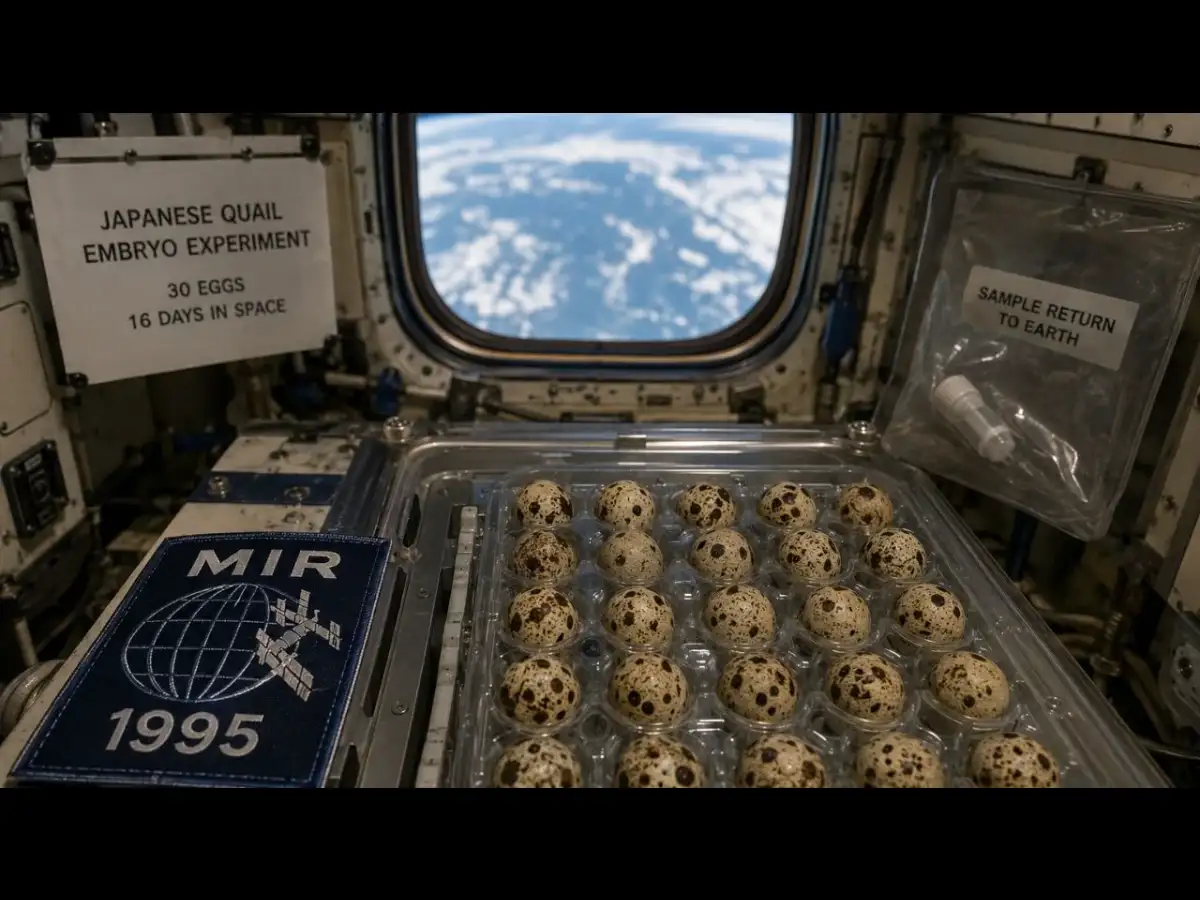
In 1995, NASA sent a batch of fertilised Japanese quail eggs from Earth to the Mir space station as part of an experiment built around a deceptively simple question: can embryos develop normally without the pull of gravity?
The eggs spent 16 days inside an incubator aboard Mir before their developing embryos were preserved and brought back to Earth for examination.
At first glance, it may have seemed like a small biological experiment. But researchers were investigating whether the earliest stages of life could unfold normally in an environment where one of the most familiar forces on Earth was almost completely absent. And when scientists examined what had happened to the embryos, the results were not quite what they expected.
Why did NASA send fertilised quail eggs into space?
The experiment was part of NASA’s broader effort to understand how living organisms respond to microgravity.
As astronauts began spending longer periods in orbit, researchers needed to investigate more than the effects of spaceflight on adults. They also wanted to understand what happened to biological processes that normally developed under Earth’s gravity.
Bird embryos provided a useful way to study the question. The fertilised Japanese quail eggs travelled to Mir aboard the same Space Shuttle mission that carried NASA astronaut Shannon Lucid to the space station. Once there, they were placed inside an onboard incubator.
For the next 16 days, the developing embryos grew in an environment dramatically different from the one they would have experienced on Earth.