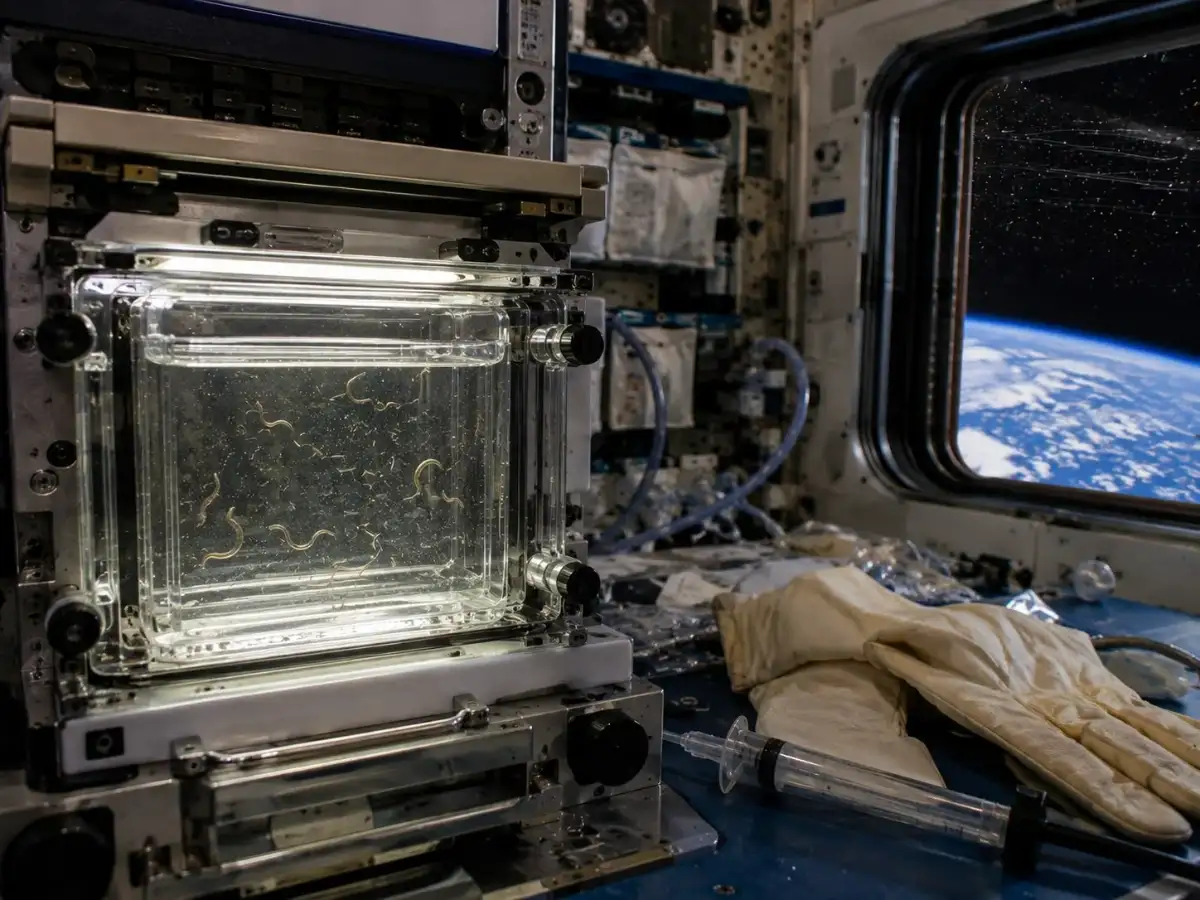
In January of 1992, the space shuttle Discovery made an unprecedented trip through space with the delivery of about seven million micro worms for a NASA experiment that sought to solve a question with a critical effect on future space travel. Would the radiation from outer space, not filtered through Earth's atmosphere, have the capacity to mutate DNA sufficiently to endanger astronauts on a long-duration mission? Indeed, according to NASA’s 1994 paper titled “Radiation effects in nematodes: Results from IML-1 experiments,” published in Advances in Space Research, it would.
The worms, a species scientifically called Caenorhabditis elegans , returned from the International Microgravity Laboratory-1 (IML-1) mission with a roughly eight-fold greater mutation rate than ground-based control groups, a figure describing the overall frequency of mutation events relative to background rates. Among the specific mutations recovered were 13 mutations in unc-22, a gene responsible for muscle function, and 53 additional lethal mutations scattered across the genome. It offered some of the first direct evidence. Space radiation not only passes through the living body; it mutates it. Over three decades since then, as NASA prepares for prolonged space travel to the Moon under the Artemis program and to Mars, this discovery does not appear to have been consigned to history.